Identifying the Ideal Locations for Your Electrical Business
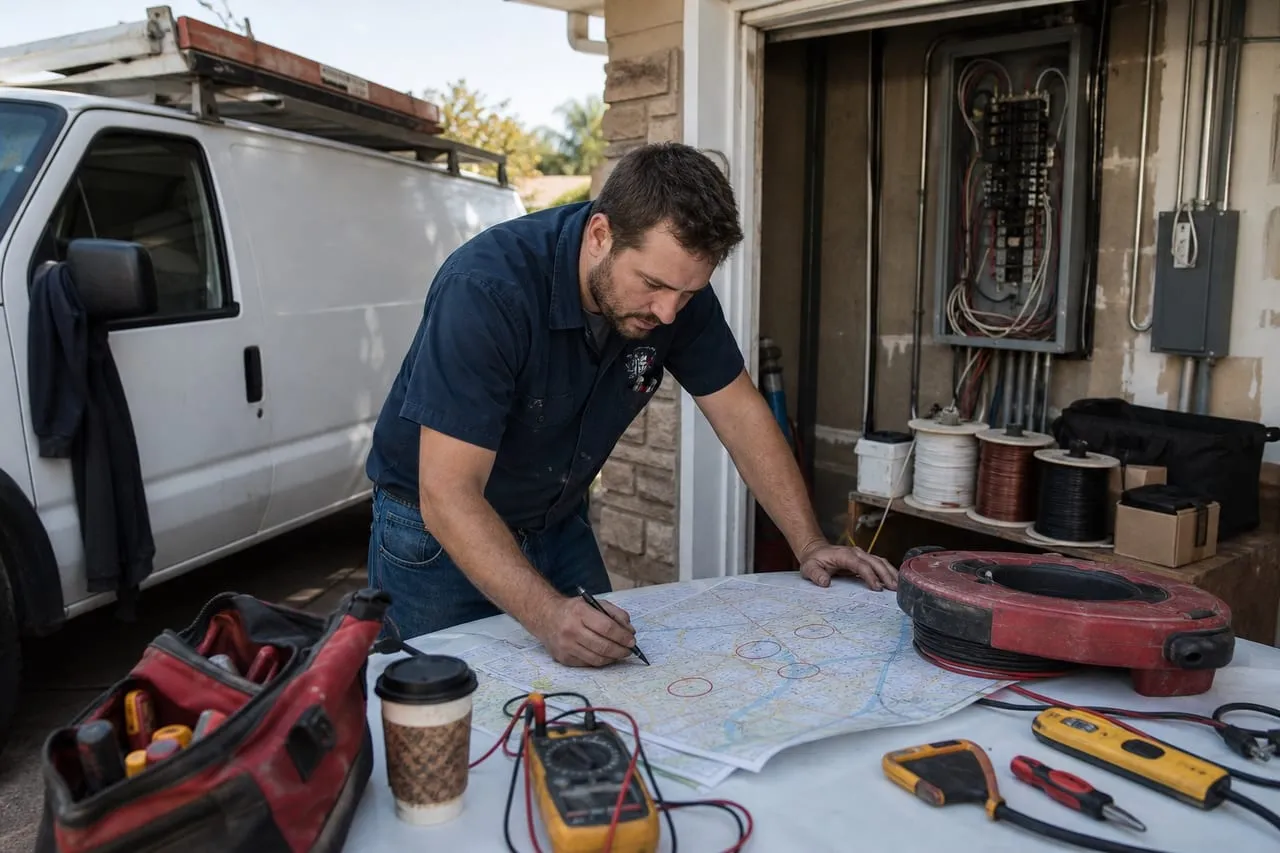
For an electrical contractor, “location” does not mean where your office is. It means the service area you actually drive to and bill in. Your office can be your garage. The real strategic question is which 15 to 30 zip codes you target, what the housing and commercial mix looks like there, and whether you can be onsite within 45 minutes. Get the service-area definition wrong and you will eat your margin in windshield time.
What Service Area Actually Means
Service area is a circle (or weird blob) on a map that you commit to in your Google Business Profile, your website, and your dispatch radius. Set it too wide and you spend half the day driving. Set it too narrow and you starve for leads in slow weeks. The sweet spot for a solo electrician in a metro area is a 25 to 40 minute drive radius from where you live.
| Setup | Radius | Zip codes | What sets the limit |
|---|---|---|---|
| Solo, dense urban or close suburb | 10 to 20 miles | 8 to 15 | Traffic, not distance |
| Solo, exurban or rural | 25 to 45 miles | 15 to 30 | Longer drives, less competition |
| Two-truck metro shop | 25 to 35 miles | 20 to 35 | Split into two dispatch zones |
| Established multi-truck | 50+ miles | Zone-based | Each truck owns a zone |
Drive the radius once in your work van during morning rush hour and again at 5pm. If you cannot consistently make a service call in 45 minutes door-to-door, the radius is too wide.
One mechanic of the system that surprises new contractors: the service area you declare in your Google Business Profile is a label, not a ranking lever. Google ranks you mostly on proximity to your real location plus your review count, so declaring 50 towns does not make you show up in 50 towns. Practically, you rank hard within a few miles of home and fade from the map pack beyond that. The fix for the outer ring is not a bigger declared area, it is town-by-town pages on your website that give Google something to rank where your profile cannot reach.
The Windshield-Time Math
Windshield time is the silent margin killer because it never shows up on an invoice. Most contractors feel “busy all day” and never run the number on what the drive actually costs.
The control number is the one in the takeaways box: billable hours divided by total worked hours including drive time, kept above 55 percent. When it slips, trimming the outer ring feels like throwing away leads, but an outer-ring service call at 50 minutes each way is often net-negative once fuel and the forgone closer job are counted. The smarter move than a hard cutoff is a minimum-ticket rule: the outer ring stays in the service area for panel upgrades, generator installs, and rewires, and quietly drops off it for $150 troubleshooting calls. High-ticket work absorbs windshield time; small tickets cannot.
Picking Zip Codes by Housing Stock and Income
Not every zip in your radius is worth equal effort. Three data points to weigh:
- Housing age. Homes built before 1980 have old panels (Federal Pacific, Zinsco, Pushmatic), aluminum wiring, knob-and-tube, ungrounded outlets. They are panel-upgrade and rewire goldmines.
- Household income. Median household income above $80k correlates with paid-as-quoted service work, EV chargers, generator installs, and lighting remodels. Below $50k correlates with price-shopped repair work and tighter margins.
- Housing-permit activity. New-construction-heavy zips mean builder relationships and rough-in work. Static or declining housing-permit zips mean service and remodel.
You can get all three from city open-data portals, the U.S. Census American Community Survey, and your county building department. An afternoon of research narrows your “best 8 zips” list to actionable.
The housing-age signal is stronger than it looks, and insurance is the reason. Carriers increasingly refuse to write or renew policies on homes with Federal Pacific or Zinsco panels, so homeowners in those zips get a letter with a deadline instead of a vague worry. A customer forced by an insurer is the best customer in the trade: motivated, time-boxed, and not price-shopping a $2,400 panel swap down to $1,800. The two data points multiply, too. Old housing plus high income is the remodel-and-upgrade goldmine; old housing plus low income skews toward minimum repairs to pass inspection.
Residential vs Commercial Mix
Your service area also has a residential-to-commercial ratio. Most one-truck contractors start 100 percent residential because the jobs are smaller, the cycle is faster, and the cash flow is better. Commercial work pays per job but on 60 to 90 day net terms that strangle a startup’s cash.
The sane mix progression:
- Year one: 90 to 100 percent residential service and small remodel
- Year two: add small commercial (a few restaurant repairs, an office build-out)
- Year three: 70 percent residential, 30 percent commercial-and-new-construction
- Year five+: niche into one or two specialties (EV chargers, generator installs, panel upgrades, multifamily, light commercial)
The niche is where margins stabilize and a competitive moat builds. See how to grow an electrical business for that progression.
Where the Builders Are
Even residential-focused contractors get 30 to 60 percent of revenue from a few builder or general-contractor relationships in year two. Mapping those relationships geographically is part of location strategy.
- Visit the county building permit office (or its online portal) and pull the last 12 months of new-construction permits
- Sort by builder, find the top 10 active builders in your radius
- Note which zip codes they build in (some only do one or two)
- Walk into their office with a business card and a price sheet
A single tract-home builder doing six homes a year in one zip can be $80k to $150k in rough-in and trim work for you. That is a one-day-a-week relationship.
Builder work: pros
- Predictable volume: one builder can fill a day a week all year
- Zero marketing cost per job once the relationship exists
- Rough-in crews are the ideal training ground for a first apprentice
Builder work: cons
- Margins run 10 to 20 points below residential service pricing
- Pay follows construction draws, not your invoice date
- Two builders can quietly become 60 percent of revenue, and losing one is a layoff
The decision rule that keeps builder work healthy: cap it near 30 to 40 percent of revenue, which is exactly where the year-three mix above lands. Treat builder volume as base load that keeps the calendar and a future apprentice busy, while residential service carries the margin. Shops that let one builder grow past half their revenue stop being contractors and become unprotected subcontractors with one customer.
For prospecting that into actual work see how to advertise to your local market and the client acquisition guide.
Frequently asked questions
Do I need a physical shop or office?
Not in year one or two. You run from the van and a home office. A shop only makes sense once you have two trucks and need a parts staging area.
Can I service two metro areas?
Yes, but you will need two service-area pages on your website, separate GBP listings only if you have a separate physical address there (not recommended for new contractors), and two sets of builder relationships.
Should I cover wealthy neighborhoods only?
You can, but you will compete with established contractors for a smaller pool of jobs. A mixed strategy of two wealthy zips plus four middle-income zips usually fills the calendar faster.
How do I know if I am driving too far?
If your billable-hours rate (hours billed divided by hours worked including drive time) is under 55 percent, you are driving too much. Trim the outer ring of your service area.
Your move
Reading this does not book a job.
The owners who pull ahead are the ones who change one thing this week. If you want that one thing to be a website that sells and ads that put it in front of the right people, we build and run both for you.
Straight answer on whether we can help, usually the same day.