How to Get Clients and Customers for an Electrical Business
Most electrical contractors do not have a marketing problem. They have a channel-mix problem. They throw $1,800 at Facebook ads, get five tire-kicker leads, and conclude that “advertising doesn’t work.” Meanwhile the contractor across town is running a verified GBP, 240 Google reviews, two builder relationships, and a $400-a-month Local Service Ads budget, and his calendar is booked four weeks out. This guide is the seven-channel playbook that actually works.
The Seven Channels at a Glance
Before the channel-by-channel detail, here is the whole playbook on one screen:
| # | Channel | Cash cost | Cost per booked job | Time to first job | Role |
|---|---|---|---|---|---|
| 1 | GBP + reviews | Free | Near $0 | 2–6 weeks | Foundation and conversion layer |
| 2 | Google LSAs | $800–3,000/mo | $50–180 | 2–4 weeks approval, then days | Core demand capture |
| 3 | Builder/GC referrals | Rate sheets + time | Near $0 cash | 1–3 months | Baseload project revenue |
| 4 | Yard signs + door hangers | $300 to start | $5–30 | 30–60 days | Neighborhood multiplier |
| 5 | Truck wrap | $1,500–4,000 once | Recall, not response | Months | Brand memory |
| 6 | Directories (Angi, Yelp) | $20–90 per lead | $80–250 | 1–2 weeks | Volume filler |
| 7 | Nextdoor | Free to low | Low | 1–3 months | Trust amplifier |
Channel 1: Google Business Profile and Reviews
Your GBP is the foundation. Without it, paid ads underperform and word-of-mouth has nowhere to land. The work:
- Verify the GBP (postcard or video verification from Google)
- Upload 20+ photos of completed jobs (panel work, EV chargers, finished walls)
- Add at least 5 short videos
- List every service category accurately
- Get to 30 reviews in 90 days, then 2 to 5 a week ongoing
- Reply to every review, especially the bad ones
A complete GBP with 80+ recent reviews appears in the Map Pack for “electrician + city” without paid spend. That is free calls.
The discipline that gets you to 80 reviews is boring and absolute: the review-request text goes out the same day as the invoice, every job, no exceptions, automated if possible. Treat it as part of getting paid, not as marketing. At a 20 to 35 percent response rate, a contractor doing 15 jobs a week compounds to a fortress profile inside a year, and that fortress lowers the real cost of every other channel on this page.
Channels 2 and 3: Google LSA and Builder Referrals
These two together produce 60 to 80 percent of revenue for most residential contractors.
- Google Local Service Ads. Pay-per-lead, $15 to $80 per lead, $800 to $3,000 a month budget. The detailed setup lives in how to run Google Ads.
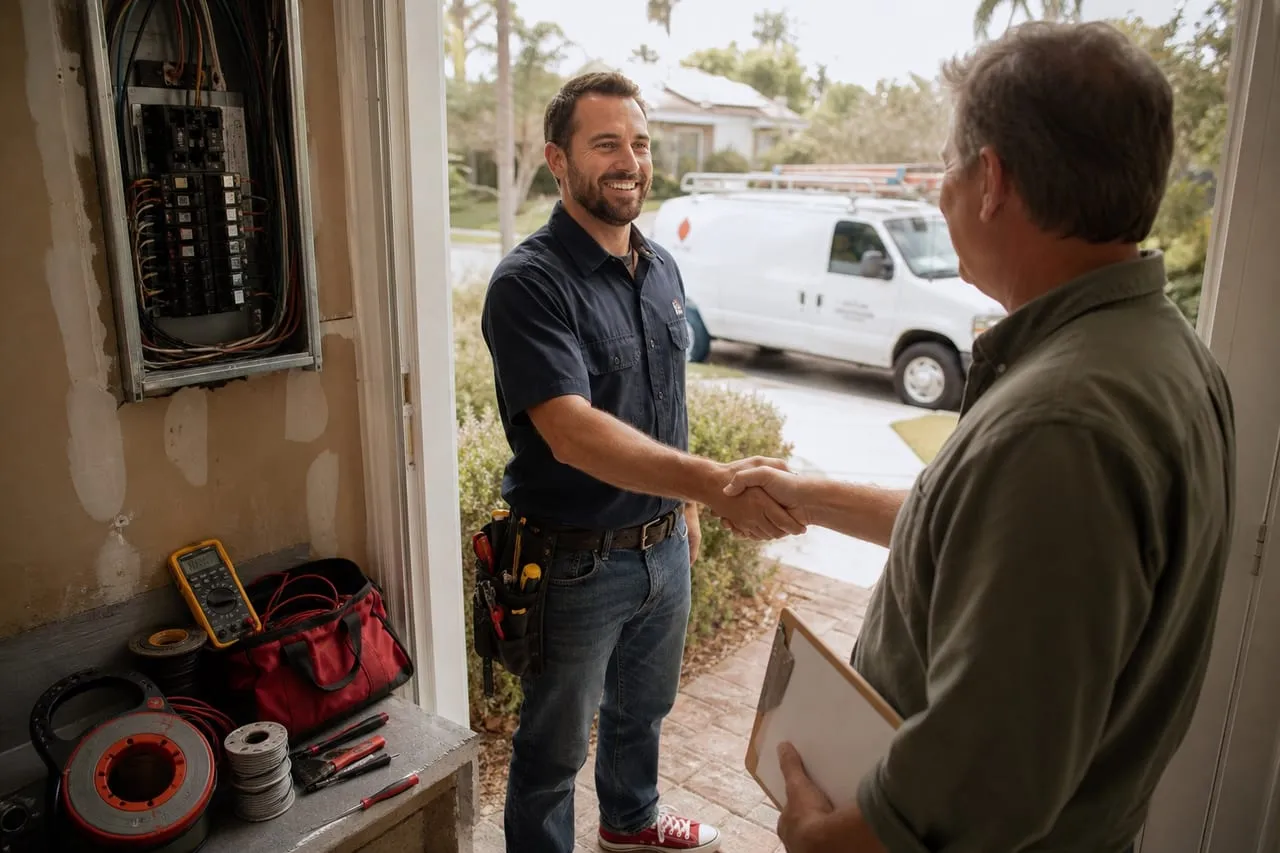
- Builder and GC relationships. Walk a service-rate sheet into 10 general contractors, 3 HVAC shops, 2 plumbing shops, 2 real estate agencies. Aim for 2 to 4 ongoing relationships.
The builder side is unglamorous and slow. You drop cards, you take coffee, you respond to the first quote within an hour, you finish on time on the first job. A single builder doing six homes a year is $50k to $150k of annual rough-in work.
Should You Lean Into Builder Work?
Builder revenue looks like the obvious prize, and for many shops it is. But it is structurally different money than ad-generated service calls, and the difference deserves a clear-eyed decision rather than a drift.
Builder work: pros
- Predictable baseload that smooths slow service months
- Zero marginal marketing cost once the relationship lands
- One relationship compounds into a multi-year pipeline
- Bigger tickets per job than most service calls
Builder work: cons
- Bid margins run thinner than flat-rate service pricing
- Net-30 to net-45 payment while you float materials
- Concentration risk when one builder dominates the calendar
- Scope creep eats the margin without firm change-order terms
The working rule: take builder work, but cap any single builder near 40 percent of revenue, and never quote it without written change-order terms. A builder who slows down, switches electricians, or starts paying in 60 days can take half your year with him. Service work funds the float that builder work creates, which is why the healthy shop runs both and lets neither win completely.
Channels 4 and 5: Neighborhood and Yard Signs
Once you have a steady stream of jobs, the job site itself becomes a marketing channel.
- Yard signs on every job site with permission. $4 per sign, $200 for 50. A panel-upgrade job in a subdivision generates 1 to 3 unsolicited calls from neighbors over 30 days.
- Door hangers in the 10 to 20 nearest neighbors at end of day. $0.20 each, 500 for $100. Conversion is 0.5 to 2 percent into a call within 60 days.
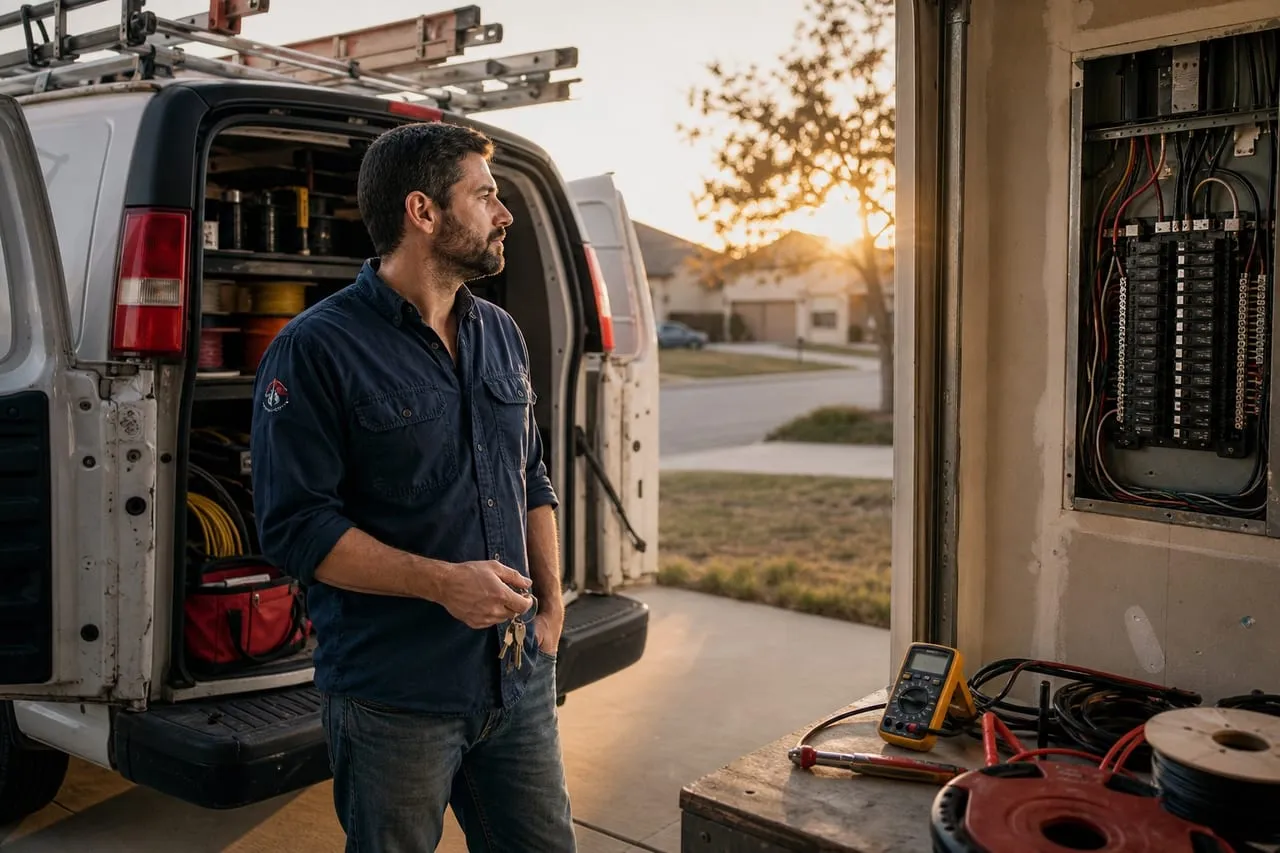
- Truck wrap or magnetic doors. The van parked at a job site for 6 hours is a billboard seen by 200 to 800 passing cars.
Yard signs and door hangers feel old-school. They work because customers trust “the electrician who did our neighbor’s panel” 10 times more than a Facebook ad.
Channels 6 and 7: Online Directories and Nextdoor
Three online directories actually produce calls. The rest are a waste.
- Angi (formerly Angie’s List). Paid lead model. Cost per lead $20 to $90. Quality variable. Worth testing.
- Yelp. Free listing plus paid ads. Skews to younger residential buyers. Modest call volume but low cost.
- Nextdoor. Neighborhood-based. Sponsor local posts and request the “Faves” badge from satisfied customers. Slow burn, high conversion.
HomeAdvisor used to be on this list. It is now part of Angi. Treat it as one channel.
Bing Places and Apple Maps are free. Claim them. They produce 5 to 15 percent of GBP-equivalent volume.
Know what you are buying on the paid directories: a shared lead. Angi typically sells the same homeowner to three or four contractors at once, which turns the channel into a footrace. The contractor who calls within five minutes books a disproportionate share; the one who calls back after dinner pays full price for a customer who already hired someone. If you cannot answer or return directory leads nearly instantly during work hours, skip the channel entirely rather than fund your competitors’ benchmark. And read the contract terms before entering a card number: lead platforms are known for auto-renewing commitments and charging for junk leads unless you dispute them inside a short window.
What Does Not Work
Three channels that contractors burn money on with poor return:
- Paid LinkedIn ads (low residential intent)
- Newspaper print ads in metro markets (too broad, expensive)
- “Marketing in a box” $500-a-month subscriptions from random agencies
The common thread is mismatch. LinkedIn has professionals but no homeowner-with-a-dead-panel moment. Metro newspapers reach a hundred zip codes when you serve eight. And the agency subscriptions fail for a subtler reason: they spread $500 across six channels at $80 each, which is below the working minimum of every single one. You end up owning seven half-built assets and zero working ones. Concentrate the same money into the numbered channels above, in order, and revisit the losers only after channels 1 to 3 are saturated.
For where each channel fits in the operating year, see how to grow an electrical business and how to promote locally. The budget view of the same mix lives in how to advertise an electrical business.
Should you handle winning customers yourself, or hand it off?
The channels that produce most of your revenue, the Business Profile, the review flywheel, and the builder relationships, are free or nearly so and reward the owner who works them personally. It is the paid layer, LSAs and search on top, where a small shop has to decide whether the management is worth buying rather than learning on live budget. We wrote an honest breakdown of when that spend actually pays back for a small business: is a marketing agency worth it for a small business?. Work the free flywheel yourself; buy the paid execution when the math favors it. When you want it handled, request a free proposal.
Frequently asked questions
What is the fastest channel to get my first paying customer?
Google LSAs once approved (2 to 4 weeks to live) plus your existing personal network. Your first 5 to 10 jobs come from friends, family, and the GC you used to work for.
How long until referrals are filling the calendar?
For a residential contractor with consistent quality work, 60 to 70 percent of jobs are referrals or repeat by month 18. Year one is paid acquisition heavy.
Is door-to-door cold-knocking worth it?
In a few zip codes with the right neighborhood feel, yes. A coordinated half-day knocking after a successful panel install can land 1 to 3 jobs from immediate neighbors.
Should I pay for fake reviews?
No, and the answer to the unasked follow-up is also no. Google catches fake review patterns and suspends listings. A suspended GBP destroys the business.