Buying Equipment and Supplies for Electrical Business
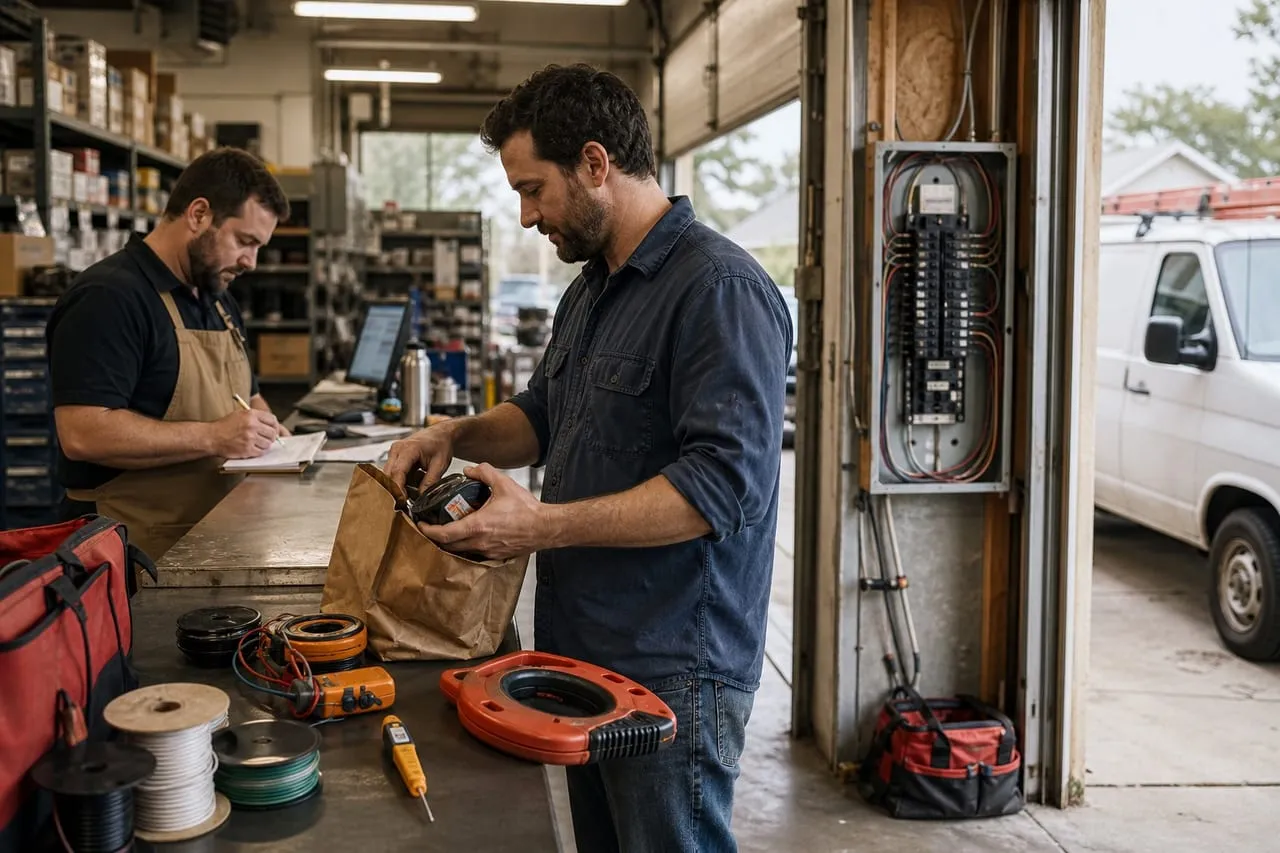
The temptation when you open an electrical contracting business is to walk into Home Depot with a credit card and walk out $14,000 lighter on tools you may or may not need. Resist it. Your goal in the first 90 days is to be able to take any reasonable residential service call, troubleshoot, repair, and bill. You do not need every tool in the Klein catalog. You need a working kit that fits in one van.
The Van and Storage Setup
Your van is your office, your warehouse, and your billboard. Buy used, gas-powered, under 150,000 miles, and shelved out. Ford Transit, Ram ProMaster, and Mercedes Sprinter (used) are the three common picks. Budget $12k to $22k for a usable used cargo van and another $1,500 to $4,000 for shelving from Adrian Steel or Ranger Design.
- Used cargo van with service records: $12k to $22k
- Steel or composite shelving system: $1,500 to $4,000
- Roof ladder rack rated for fiberglass extension ladder: $300 to $700
- Vehicle wrap or vinyl decals with phone number: $400 to $2,500
- Backup camera and dash cam: $200 to $500
If the budget will not stretch to $12k, a $5k to $8k high-mileage runner with clean service records does the same job. The van earns you nothing extra for being newer; it just has to start every morning and hold the shelving. What you should not skip is the shelving itself, because a contractor digging through loose buckets for ten minutes per call gives away a billable hour every day, and that habit is invisible until you put a number on it.
Letter the van the week you buy it. Vinyl decals with the company name, license number, and a big phone number run $400 to $800 and turn every parked job into a billboard. The full wrap is a different decision: wraps build recall over years, not weeks, so it can wait until cash flow is real. If the choice is between a wrap and two more months of operating reserve, take the reserve.
Hand Tools That Earn Their Keep
You can pay double for Klein and Knipex and still come out ahead because they last 10 years instead of 18 months. The full hand-tool kit for a working electrician runs $1,500 to $2,500 if you buy quality. Skip the bargain bin combo packs.
- Insulated screwdrivers (Phillips, flat, square) $200
- Linesman pliers, needle-nose, side cutters $250
- Wire strippers (Klein Katapult) $80
- Tape measure, torpedo level, chalk line $80
- Knipex Cobra pliers, channel locks $150
- Fish tape, fish sticks, wire pulling lube $200
- Conduit benders (1/2” and 3/4” EMT) $180
- Hole saws, step bits, spade bits $250
- Heat shrink kit, electrical tape stock, wire nuts assortment $200
The new-or-used question is really three separate questions, one per category, and most first-time buyers answer all three the same way and get one of them wrong.
Buying used: pros
- Hand tools and ladders lose half their price and none of their function
- Retiring electricians and estate sales sell complete, quality kits in one transaction
- The cash you free up goes to inventory and reserves, which earn faster than shiny tools
Buying used: cons
- Test gear calibration cannot be trusted secondhand, and a lying meter is a safety problem
- Used batteries hide their cycle count, so you inherit a dying pack at full-looking price
- Assembling a used kit takes weekends of hunting instead of one supply-house order
The clean split: used for anything mechanical (hand tools, ladders, benders, the van itself), new for anything that measures or stores energy (meters, testers, batteries) and anything that protects your body. That single rule captures most of the savings and none of the risk.
Power Tools and Test Gear
Standardize on one battery platform (Milwaukee M18 or DeWalt 20V are the two safe picks) so every tool shares charged batteries. The bare-tool prices below assume you already own the battery starter kit.
- Drill driver and impact driver combo $400
- 1/2” hammer drill for masonry $200
- Reciprocating saw and oscillating multi-tool $350
- 6-1/2” circular saw for plywood and panel work $150
- Battery and charger starter kit $300
- Work light (rechargeable) $80
Test gear is where you spend real money because cheap test gear lies to you. A Fluke multimeter is the industry standard for a reason. Plan on $1,500 to $2,200 for a proper diagnostic kit: Fluke 87V multimeter ($500), Fluke 1587 insulation tester or megger ($700), Fluke 902 clamp meter ($400), non-contact voltage tester ($40), thermal camera for $300 if you can swing it.
The reason the test-gear line is non-negotiable goes beyond accuracy. Your diagnostic fee is the most profitable line on your invoice, and it is only defensible if your readings are. A megger that passes a marginal circuit costs you a callback at best; a meter that shows dead on a live circuit costs far more than $700. This is also the gear that makes panel inspections, troubleshooting calls, and EV charger load calculations billable as expertise instead of guesswork.
PPE, Stock, and the First Job Float
Safety gear is not optional. OSHA-compliant arc-rated FR clothing, hard hat, safety glasses, leather gloves, voltage-rated rubber gloves with leather protectors, and rated dielectric boots. Budget $500 to $900 for a proper PPE kit. Plus a Class A fire extinguisher for the van.
Opening parts stock keeps you from running to the supply house mid-job. Stock receptacles (15A, 20A, GFCI, USB), switches, wire nuts in every size, common breakers for the local panel brands you see (Square D QO and Homeline, Eaton CH, Siemens), 12-gauge and 14-gauge Romex by the box, conduit fittings, junction boxes. Plan on $1,200 to $2,000 in opening inventory and replenish from supply houses like Rexel, CED, or your local independent.
Inventory is the fastest-payback line in the whole budget. A $40 breaker on the truck turns a diagnostic visit into a same-day repair invoice instead of a return trip the customer has a day to cancel. Stock to the panels in your zip codes, not to a generic list: an afternoon of looking at what is actually in the houses you will serve tells you whether you need QO or Homeline by the case.
The supply-house accounts matter as much as the stock. After 90 days of paying on time, most counters extend net-30 terms, which means the supply house quietly finances the gap between buying materials and getting paid by the customer. That float is worth more to a new contractor than any tool discount.
What the Whole Kit Costs
Here is the whole list compressed, in two honest versions of the same business.
| Category | Used-smart | All-new |
|---|---|---|
| Cargo van | $5,000 to 8,000 runner with records | $12,000 to 22,000 |
| Shelving + ladder rack | $1,000 to 2,000 secondhand | $1,800 to 4,700 |
| Hand tools | $800 to 1,500 | $1,500 to 2,500 |
| Power tools + batteries | $700 to 1,200 used platform, new batteries | $1,400 to 1,800 |
| Test gear | $1,500 to 2,200 (buy new) | $1,500 to 2,200 |
| PPE | $500 to 900 (always new) | $500 to 900 |
| Opening parts stock | $1,200 to 2,000 | $1,200 to 2,000 |
| Decals or wrap | $400 to 800 decals | $1,000 to 2,500 partial wrap |
| Total | $11,100 to 18,600 | $20,900 to 38,600 |
Notice that test gear, PPE, and stock are identical in both columns. That is the point: the safety-and-billing core of the kit does not have a cheap version. All the savings in the used-smart column come from the van, the shelving, and the mechanical tools, which is exactly where used buying is safe.
For the full startup-cost picture, see how much you need to start an electrical business and the step-by-step launch checklist.
Frequently asked questions
Can I buy used tools to save money?
Hand tools yes (Facebook Marketplace, retired electricians, estate sales). Test gear no, because you cannot trust the calibration. Power tools depend on the seller, but check the battery age.
What does a complete first-van kit really cost?
Realistically $18k to $30k including the van itself. Tools, test gear, PPE, and opening stock alone are $5k to $8k if you buy the mechanical tools used, $6k to $9k all-new.
Do I need a thermal camera right away?
No, but you will want one within the first year. A FLIR One Pro or Seek Thermal Compact phone attachment runs $300 to $500 and pays for itself on panel inspections and finding hot connections.
Where do I buy bulk parts?
Open accounts at two electrical supply houses (Rexel, CED, Graybar, or a local independent). Net 30 terms appear after a few months of paying on time. The big box stores work in a pinch but markups are 20 to 40 percent.
Your move
Reading this does not book a job.
The owners who pull ahead are the ones who change one thing this week. If you want that one thing to be a website that sells and ads that put it in front of the right people, we build and run both for you.
Straight answer on whether we can help, usually the same day.