How to Advertise Your Electrical Business on Facebook
Facebook ads for an electrical business are a brand and retargeting channel, not a direct-call channel. If you go in expecting Facebook to deliver “emergency electrician at 9pm” calls the way Google does, you will burn $1,500 and quit. Done right, Facebook keeps your name in front of the right households so that when they need an electrician next month, they remember your van wrap and your friend’s review.
Why Facebook Is Different From Google
Google searches happen when intent already exists. Facebook scrolling does not. Your job on Facebook is not to capture demand, it is to plant a name so demand finds you later.
- Best for: brand awareness, retargeting GBP visitors, recruiting apprentices, promoting service-plan offers
- Decent for: lead-gen on home improvement themes (lighting remodels, EV chargers, generators)
- Poor for: emergency service calls (those happen on Google)
- Useless for: commercial accounts (LinkedIn or direct outreach is better)
Budget expectation: Facebook produces lower-quality direct leads than Google. The leads it does produce close at a lower rate. The trade-off is reach and brand recall, which compound over months.
The one place Facebook can beat Google on its own terms is work nobody searches for until you suggest it. A homeowner with a 30-year-old panel is not Googling “Federal Pacific replacement” because they do not know the brand name in their garage is a fire risk. A Tesla owner charging off a 110V outlet has not priced a wall connector circuit. Facebook lets you put that idea in front of exactly those households and harvest the project weeks later. That is demand creation, it runs at project-work margins, and it is the honest business case for the channel, not cheap emergency calls. If your Google engine is not built yet, start there: how to run Google Ads.
Targeting That Actually Works
Facebook’s targeting got worse for service businesses after the 2021 iOS privacy changes. The targets that still work for an electrical contractor:
- Location radius of 10 to 25 miles around your service area
- Homeowners (Facebook has a homeowner interest layer that still functions)
- Age 35 to 65 (the household decision-makers)
- Recent home buyers (interest layer) for rewire and panel upgrade
- Interest layers: home improvement, DIY, EV ownership, solar, Tesla
- Retargeting: anyone who visited your website in 30 days
Skip: detailed-demographics targeting on income (gone), behavioral targeting on “in market for electrician” (Facebook does not have this layer reliably).
The counterintuitive lesson since the iOS changes: stacking five interest layers usually performs worse than radius plus age plus homeowner with strong creative. The algorithm now finds buyers mostly by watching who engages with your ad, which means the ad itself does the targeting. A before/after panel photo self-selects people with old panels. An EV-charger reel self-selects EV owners. Narrow audiences just raise your cost per thousand impressions while starving the algorithm of the data it learns from.
Creative That Books Calls
Photos and short videos beat polished graphics every time. The content that performs:
- Before/after panel upgrades: dirty old Federal Pacific replaced with a clean Square D QO
- Time-lapse of a rewire or panel install (15 to 30 seconds)
- A 30-second educational video: “is your panel a fire hazard? here are the 3 brands to replace”
- Customer testimonials shot on a phone (not scripted)
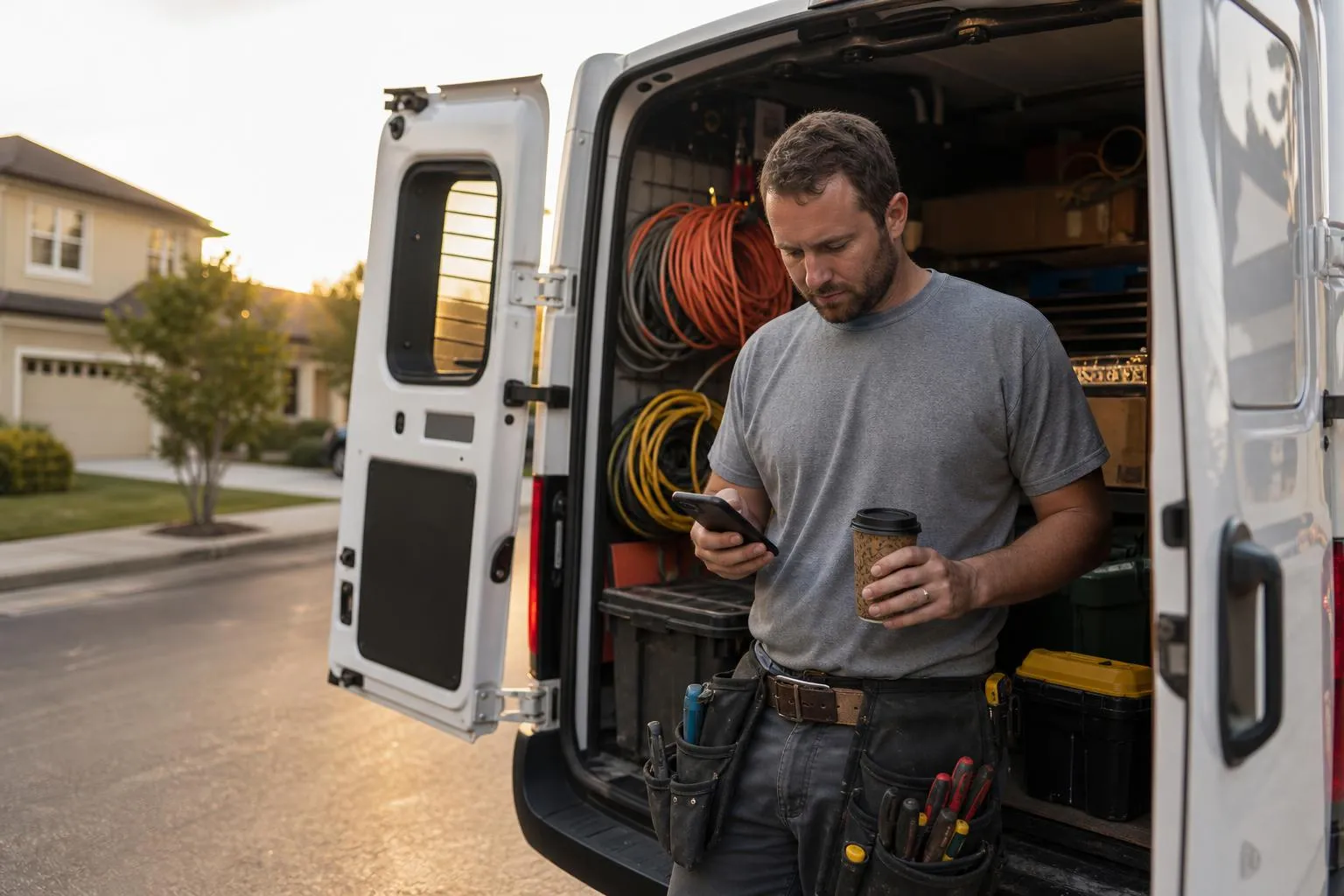
- Behind-the-truck “day in the life” videos
- An EV-charger install reel for the Tesla and EV owner targeting
Caption tone: human, direct, short. Drop a phone number, a service area mention, and a soft offer. Avoid emoji spam and “limited time offer” hype. Customers buying electrical work want competence signals, not pressure.
Ad Formats and Budgets
Three Facebook ad formats are worth running. Skip the rest.
- Lead-gen ads with the in-app form. Catches contact info in 10 seconds. $25 to $80 per lead in most metros.
- Click-to-Messenger ads. Customer messages your page, you (or a chat tool) reply. Higher engagement, fewer calls.
- Click-to-call ads on mobile. Underrated. Targets mobile users with a tap-to-call.
The real format decision is where the lead lands: Facebook’s in-app instant form, or your own landing page. It is a genuine trade-off, not a best practice with one right answer.
In-app lead forms: pros
- 10-second completion, no website needed
- Cheapest cost per raw lead, mobile-native
- Algorithm optimizes fast on form completions
In-app lead forms: cons
- Auto-filled forms mean low commitment; many submitters forget they applied
- 30 to 50 percent unqualified or unreachable
- Leads cool within hours and demand an immediate callback
Whichever destination you pick, speed-to-lead decides the outcome. A Facebook lead called inside 5 minutes books at several times the rate of one called the next morning, because the person was idly scrolling when they submitted and your call is what converts curiosity into an appointment. If you cannot call back fast during work hours, use an auto-text that fires on submission (“Got your request, this is Mike the electrician, I’ll call at 4:30”) and watch the no-answer rate drop.
| Phase | Monthly spend | Setup | What to expect |
|---|---|---|---|
| Test | $300 to 500 | One campaign, one ad set, two creative variants | Data, not profit; first leads at $25 to 80 |
| Working | $500 to 1,200 | Brand awareness plus lead-gen campaigns | 8 to 20 leads a month, roughly half qualified |
| Scaling | $1,200 to 2,500 | Adds retargeting and a service-plan offer | Cost per booked job settling toward $80 to 200 |
Common Facebook Mistakes
Three patterns that burn money:
- Using the “Boost Post” button instead of Ads Manager. Boost is overpriced and undertargeted.
- Sending traffic to the home page instead of a landing page. The home page converts at 1 to 3 percent. A dedicated landing page hits 6 to 12 percent.
- No retargeting pixel. Without the pixel, you lose the ability to retarget GBP and website visitors, which is the highest-ROI Facebook play.
The pixel mistake deserves the emphasis. Retargeting people who already visited your website is the cheapest, highest-converting audience Facebook will ever give you, because the intent came from Google and Facebook just keeps you in the room while the homeowner gets two more quotes. Install the pixel the week the website goes live, months before you plan to spend a dollar, so the audience is already built when you start.
For the full Facebook setup with Business Manager, see how to run Facebook for an electrical business. For where Facebook fits in the overall mix, see how to advertise an electrical business.
Should you run Facebook and Instagram ads yourself, or hand them off?
With a few hours of tutorials and the pixel installed, a contractor can genuinely run this channel in-house, and below $2,500 a month you probably should. The point where it flips is when creative fatigue, retargeting, and the weekly optimization start competing with the actual panel work. We wrote an honest breakdown of when to keep it and when to hand it off: 6 signs it’s time to hand off your Facebook and Instagram ads. Keep shooting the job-site creative either way. When you want the campaigns run for you, request a free proposal.
Frequently asked questions
How much does Facebook advertising cost for an electrician?
Realistic minimum is $400 a month to gather any meaningful data. Working budgets are $800 to $2,000. Below $400 the algorithm cannot optimize.
Can I run Facebook ads myself or do I need an agency?
You can run them yourself with 4 to 8 hours of YouTube tutorials. An agency makes sense above $2,500 a month in spend, when the management fee is justified by the optimization.
What is a good cost per lead from Facebook?
For an electrical contractor: $25 to $80 per raw lead, but expect 30 to 50 percent of those to be unqualified or non-responsive. Real cost per booked job often lands $80 to $200.
Should I run Facebook ads if I am brand new?
Not in month one. Get the GBP, reviews, and Google ads working first. Facebook is the third or fourth channel to layer on, not the first.
Your move
Reading this does not book a job.
The owners who pull ahead are the ones who change one thing this week. If you want that one thing to be a website that sells and ads that put it in front of the right people, we build and run both for you.
Straight answer on whether we can help, usually the same day.