How to start a pool cleaning business
Pool cleaning is one of the few service trades where the customer pays you the same amount every single month, in good weather and bad, whether the pool is filthy or spotless. That recurring check is the whole business. A solo route of 50 to 60 weekly accounts at $120 to $200 a month each clears six figures in revenue on a truck, a pole, and a test kit. The work is not glamorous, but the math is, and the barrier to entry is a few thousand dollars and a willingness to learn water chemistry properly.
What pool service actually is, and what you charge for it
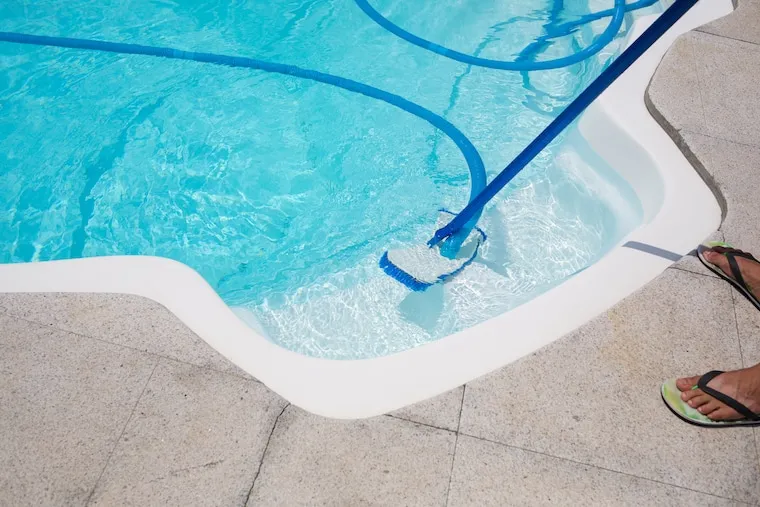
Strip away the brochure language and weekly pool service is four repeated tasks: skim the surface, brush the walls and steps, empty the baskets, and balance the water. Most visits take 15 to 30 minutes once you are quick. The skill that separates a pro from a teenager with a net is chemistry. You are managing free chlorine (target 1 to 3 ppm), pH (7.4 to 7.6), total alkalinity (80 to 120 ppm), calcium hardness, and cyanuric acid (the stabilizer that keeps sun from burning off your chlorine). Get that wrong and you turn pools green, etch plaster, or corrode equipment, and you lose the account.
You charge in two streams. The first is the recurring monthly service plan, which is the foundation. The second, and where the real money hides, is repairs and equipment: replacing a failed pump motor, swapping a cartridge filter, installing a salt chlorine generator, fixing a leaking valve. Service buys you the relationship; repairs are where margin lives. Decide early whether you are service-only or service-plus-repair, because the second path needs more skill, more parts inventory, and in many states a separate contractor’s license.
Pricing fundamentals are simple to state and easy to get wrong. Price each service line separately rather than burying everything in one number: a base weekly chemical-and-clean plan, then chemicals at cost-plus when usage spikes (a hot July pool drinks chlorine), then filter cleans (typically $75 to $150) and repairs as line items. Offer a small discount for prepaid or annual recurring plans, because locking in the account is worth more than the few dollars you give up. For the full pricing breakdown by service type, see cleaning business how much to charge.
What it costs to start, line by line
You do not need much to start a residential route. You need a vehicle that will not strand you, a tight set of tools, and chemicals. Here is a realistic solo startup, framed as typical ranges, not a precise quote.
| Item | Typical cost | Notes |
|---|---|---|
| Used truck or van (or use what you own) | $0 to $6,000 | Your single biggest line; a reliable bed is non-negotiable |
| Telescopic pole, nets, brushes, vac head and hose | $200 to $500 | The daily kit; buy commercial-grade, not big-box |
| Professional test kit (Taylor K-2006 type) | $60 to $120 | Drop test, not strips, for accuracy you can defend |
| Chemical starting stock (chlorine, acid, etc.) | $300 to $800 | Restocks monthly from a pool supply distributor |
| LLC registration and business license | $50 to $500 | Varies by state and city |
| General liability insurance | $400 to $1,200/yr | Often payable in monthly installments |
| CPO certification course | $300 to $400 | One to two days; renews every 5 years |
| Website and basic booking setup | varies | The lead engine, covered below |
That puts a bootstrapped solo start around $3,000 to $5,000 if you already own a truck, and $8,000 to $12,000 if you have to buy one. You are not buying a franchise; you are buying a pole and a chemistry kit. For the deeper equipment list and where to source it, see buying equipment and supplies.
Route density is the entire game
A pool tech is not paid for cleaning pools; he is paid for the 15 minutes at the pool. Every minute between pools is unpaid driving. This is why route density (how many pools you can service per mile) decides whether you make money or just stay busy. Ten pools clustered in two subdivisions is a great day. Ten pools scattered across 40 miles is a money-loser no matter what you charge.
So when you are starting, do not chase every lead across the metro. Concentrate. Pick two or three neighborhoods with the right pools (suburban single-family homes, HOA communities, mid-to-upper income) and build density there before you expand. Turn down the one-off account 25 miles out, however tempting, because it will cost you an hour each way and break the rhythm of a good day. For choosing where to build, see ideal locations for a cleaning business.
Service-only vs service-plus-repair
- Service-only: start earning in days, no contractor’s license needed in most states, near-zero parts inventory.
- Repairs add $1,000 to $5,000/month per tech once you can do pump and filter swaps.
- A green-to-clean recovery (neglected pool) bills $250 to $600 as a one-time job on top of signing the account.
Service-only vs service-plus-repair
- Service-only caps your revenue per stop at the monthly plan, with no upside on big-ticket failures.
- Repair work often requires a separate license, bond, and more insurance, which takes weeks to obtain.
- Carrying parts (motors, cartridges, valves) ties up $2,000 to $5,000 in inventory and a stocked truck.
The decision rule is service-first, repair-second, not both-at-once: launch service-only to get cash flowing, then add repairs once you have 30-plus accounts and have earned the CPO and any contractor’s license your state requires.
Hiring, and when to stop being a one-person show
You can run a full route solo, but the ceiling is real: one tech caps out around 60 to 70 accounts. To grow past that you hire, and the first hire is usually a route tech you train on chemistry and your standards, not someone you expect to arrive expert. Pay is commonly $16 to $24/hour or a per-pool rate, and the make-or-break is whether they balance water correctly without supervision, because a sloppy tech turns pools green and you lose accounts faster than you win them. Build a simple checklist for every stop and spot-check water yourself for the first month. For the full hiring and training playbook, see hire and train staff.
If you would rather grow without building a route from scratch, weigh the trade-offs in own cleaning business or go with a franchise, and if you are still choosing a niche, start a pressure washing business is a common companion service that fills the slow season.
Getting customers, and where it gets high-stakes
Here is the honest part. Everything above (chemistry, gear, routing, hiring) you can learn and execute yourself. Customer acquisition is where most pool businesses quietly stall, because the channels that actually fill a route are expensive and unforgiving to get wrong.
Start with the genuinely free moves, because they work and cost nothing but time. Claim and fully complete your Google Business Profile, because “pool service near me” is exactly how homeowners search, and the map pack drives real calls at zero ongoing cost. Then relentlessly ask happy customers for reviews, since a recurring-service business lives and dies on local reputation. Put a yard sign at every pool you service. Those three cost nothing and should be done this week.
Beyond the free basics, your website and paid acquisition get high-stakes fast, and doing them badly costs more than not doing them at all. Good is specific: a site that loads in under three seconds, is tap-to-call in the thumb zone on mobile, ranks for your towns, leads with the exact service searched, and turns visitors into booked accounts instead of just looking tidy. That conversion gap is the whole game, because most pool service sites are pretty brochures that quietly leak every visitor. Closing that gap takes architecture, speed, copy, and conversion design, which is why we do it for you. If you want a site engineered to book recurring accounts, see get a cleaning website. Get a free video walkthrough.
The same logic applies to paid acquisition. Google Ads, local service ads, and paid social can fill a route fast or quietly burn $1,500 a month on clicks that never call, depending entirely on how campaigns, targeting, and landing pages are built. If you want lead generation handled by people who do it every day, that is what our services are for. And if you have an idea bigger than a single pool route, start at expntl.com.
Frequently asked questions
How much does it cost to start a pool cleaning business?
Solo, expect $3,000 to $12,000, and the spread is almost entirely whether you already own a usable truck. The pole, nets, vac, and a professional test kit run a few hundred dollars; chemicals, licensing, insurance, and a CPO course make up most of the rest. You can start lean and reinvest repair revenue into a stocked truck later.
Do I need a license or certification?
You almost always need a business license and general liability insurance, and many states regulate pool servicing directly. A Certified Pool Operator credential is not always legally required but is the standard proof you understand chemistry, and it builds trust fast. The moment you do equipment repair or installation, check whether your state requires a contractor’s license and bond, because that line gets enforced.
How many pools can one person clean in a day?
Realistically 8 to 12 residential pools a day once you are efficient and the route is tight, which builds to a full-time book of 50 to 70 weekly accounts. The number is dictated less by cleaning speed than by drive time between stops, which is why route density matters more than raw hustle. A scattered route of the same size will exhaust you for less money.
Is pool cleaning seasonal, and how do I survive winter?
In warm states it is close to year-round and the recurring check keeps coming. In cold climates the season compresses, so techs pivot to closings and openings, equipment repairs, and adjacent services like pressure washing to bridge the off-months. Build for the slow season from day one rather than being surprised by it.
How do I grow past a single route?
You hire and train a route tech, systematize chemistry with checklists, and add repair revenue, which raises income per stop without adding windshield time. The constraint shifts from your hours to your ability to keep water balanced across techs you do not personally supervise. The growth playbook, including pricing and retention, is in how to grow a cleaning business.
Your move
Reading this does not book a job.
The owners who pull ahead are the ones who change one thing this week. If you want that one thing to be a website that sells and ads that put it in front of the right people, we build and run both for you.
Straight answer on whether we can help, usually the same day.