When and how to hire and train staff for cleaning business
A cleaning business lives or dies on labor. Your product is two hours of someone else’s careful work in a stranger’s home, repeated reliably for years. Hire the wrong person and you lose a client, a key deposit, and a referral chain in one bad Tuesday. Hire right and your crew becomes the one thing competitors cannot copy.
Know the exact moment to hire
Most owners hire too late, then panic-hire the first warm body. The trigger is not a feeling, it is a number: track booked hours against available hours for three weeks, and when you are consistently turning away 2 to 3 jobs a week, the next “no” costs more than a paycheck. A cleaner who bills at $40 to $60 an hour and costs you $16 to $24 fully loaded contributes $20 to $35 an hour in margin, so every week solo leaves $500 to $1,000 on the table. Hiring early costs a bounded amount; hiring late costs a churned client who tells ten people.
First confirm demand is steady, because a crew with no jobs is the fastest way to go broke. See how to find cleaning contracts and how to grow a cleaning business before committing to payroll.
W-2 employee or subcontractor: pick correctly
This is the decision that gets cleaning owners audited. The test is control: if you set the schedule, dictate the method, supply the products, and require your shirt, the person is an employee. “1099 cleaner” is not a magic phrase that makes payroll taxes disappear.
W-2 employee vs subcontractor
- You control quality: your checklist, your products, your route, which is the whole game in cleaning.
- Lower per-job liability when workers are covered under your comp and general liability.
- Clients trust a uniformed, background-checked employee far more than a stranger in their home.
W-2 employee vs subcontractor
- Payroll burden adds 10 to 15% on top of wages (FICA, unemployment, workers’ comp).
- You eat the cost of downtime, training, and PTO whether the schedule is full or not.
- More admin: payroll filings, I-9s, and state new-hire reporting.
The decision rule is W-2, not 1099: if you control how and when the work gets done, classify them as an employee and price the burden into your rates, because the penalties for getting it wrong (back taxes, fines, back wages) dwarf the payroll tax you tried to dodge. If you truly want a subcontract model, that usually means a franchise, weighed in own cleaning business or go with a franchise.
Find people who will actually show up
The hard part of cleaning is not skill, it is reliability. Anyone can learn to clean a bathroom in a day, but almost nobody you interview will show up at 8am, three towns over, for two years. Recruit for attendance and trustworthiness first, technique second. Where good candidates come from, in rough order of yield:
- Referrals from current cleaners. They will not refer a flake who makes them look bad. Pay a $100 to $300 bonus after the referral survives 60 to 90 days.
- Local Facebook groups and community boards. Free, hyper-local, and candidates already live near your routes.
- Indeed and similar boards. High volume, low signal: expect 15 to 30 applicants per good hire, so write a filtering post stating the pay, the hours, and the background check.
- Local ESL and job-training programs. Reliable, motivated people that bigger competitors overlook.
Two screening steps separate the keepers. A background check ($20 to $50 per candidate) is non-negotiable when you hand people keys and alarm codes, and when you call references, ask the one question that cuts through: “Would you hire this person again?”
Train with a checklist, not a vibe
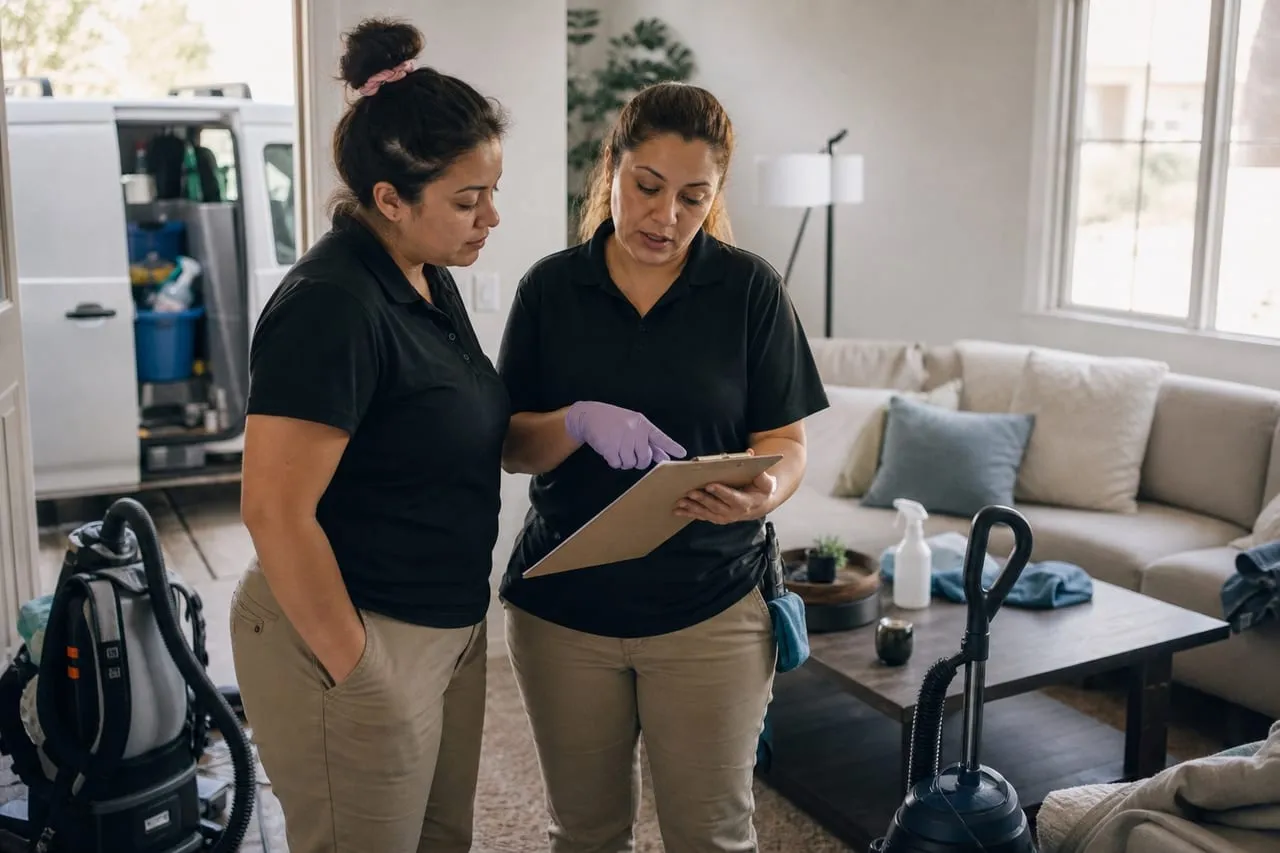
Most cleaning companies are inconsistent because the owner “trains” by saying “just clean it like I do,” then is shocked when the new hire’s idea of clean differs. Training has to be a written, repeatable system, because consistency is the product and a house cleaned to a different standard each visit cancels. Build a room-by-room checklist with the exact tasks, the order, and the product for each surface, put it in an app on their phone, then run new hires through a paid ramp:
| Stage | What happens | Duration | Cost to you |
|---|---|---|---|
| Orientation | Paperwork, safety, chemical handling, checklist | Half a day | 4 hrs wages |
| Shadow shifts | New hire watches and assists a senior cleaner | 2 to 3 shifts | $250 to $400 |
| Reverse shadow | New hire leads, senior cleaner inspects | 1 to 2 shifts | $130 to $260 |
| Solo with QC | First solo jobs get a follow-up photo audit | First 2 weeks | Inspection time |
Two parts do the heavy lifting. Chemical safety is not optional: mixing bleach and ammonia makes toxic gas, and OSHA hazard-communication rules require workers to know what is in the bottles they spray, so cover dilution and ventilation on day one. A photo quality check, where the cleaner texts you the finished kitchen and bathroom, catches drift in week one before a client notices. The gear behind that checklist is its own topic, in buying equipment and supplies for a cleaning business.
Where staffing meets your marketing
Here is the trap nobody warns you about: the moment your crew is reliable and your quality consistent, your binding constraint flips from operations to demand, and a trained crew sitting idle two afternoons a week is pure loss.
That is a different discipline from hiring, and it is high-stakes to get wrong. Good lead generation means a website that turns visitors into booked quotes, not just a brochure, a claimed and reviewed Google Business Profile, and paid channels that bring jobs in at a cost per lead you can afford. The free moves you can make today are to claim your Google Business Profile and ask every happy client for a review. The rest is where most owners quietly lose thousands. If your website does not turn lookers into bookings, get a free video walkthrough. For ads, SEO, or paid social that must return more than they cost, start with our services. And if you have an idea for a new service line and need a plan to test it, that is what expntl.com is for.
Frequently asked questions
When should I hire my first cleaner?
When you are consistently turning away 2 to 3 jobs a week, or working past 90% of your capacity, for three weeks straight. Hiring early costs a bounded amount of payroll; hiring late costs churned clients and lost referrals.
Should I pay cleaners hourly or per job?
Hourly as a W-2 is the safer default and keeps you clear of worker-classification trouble, since you control the schedule and method. Per-job piece-rate invites rushed cleans, and either way you must price a 10 to 15% payroll burden into your rates.
How long should training take before someone cleans solo?
Budget 2 to 5 paid shifts: orientation and safety, 2 to 3 shadow shifts, then 1 to 2 reverse-shadow shifts where they lead and a senior cleaner inspects. Skipping the ramp to save a few hundred dollars is how you lose a client worth thousands.
Do I really need background checks and insurance for cleaners?
Yes. A $20 to $50 background check is the cheapest risk reduction you can buy when you hand people keys and alarm codes, and most states require workers’ comp once you have a single employee. Carry both before the first shift.
How do I stop my cleaners from quitting so often?
Pay at or slightly above local market, keep routes tight, and keep schedules predictable. Turnover runs 50 to 75% a year, so build a checklist-and-QC system that lets you train a replacement to client-ready in about a week.