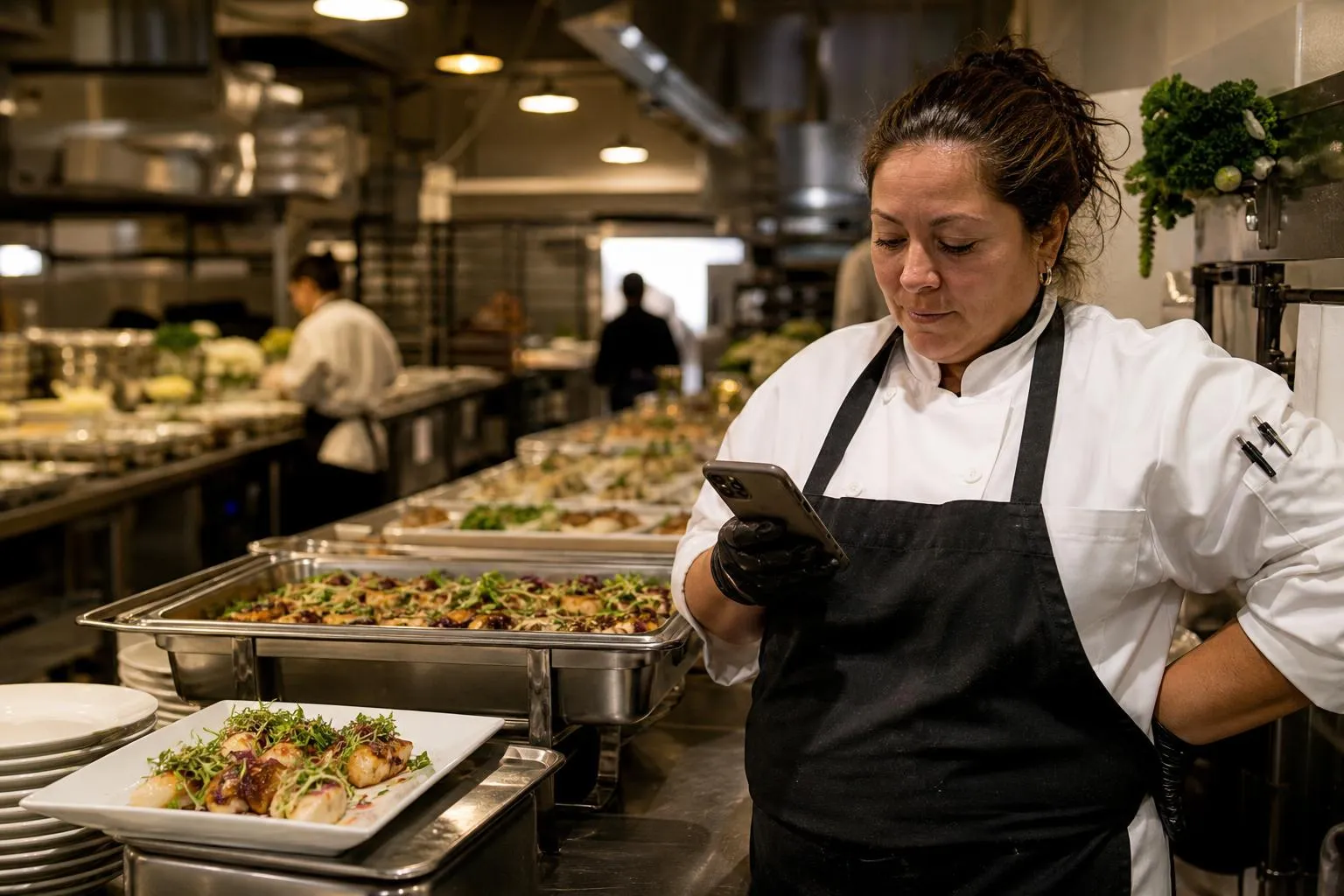
When and How to Hire and Train Staff for a Catering Business

The mistake new caterers make with staffing is thinking about it like a restaurant: hire a crew, put them on payroll, keep them busy. Catering labor doesn’t work that way, because your demand is spiky. You need twelve people this Saturday and nobody on Tuesday. So you don’t hire a staff; you build a bench of on-call event workers you can call up per event, and you only convert anyone to full-time when the calendar is so consistently full that you’re turning work away. Get this order wrong and you either can’t staff your events or you’re paying wages for empty days. Here is how to build the crew and keep it showing up.
Build a bench before you build a payroll
Your first “hires” are not employees in the salaried sense; they are a roster of on-call event staff (servers, prep cooks, dishwashers, bartenders) you call in per event. The reason is structural: a single Saturday might need fourteen people and the following Tuesday might need zero, so a fixed payroll would bankrupt you on the quiet days. Build a roster two to three times larger than any single event needs, so that when four people are unavailable for a given date, you still fill the shift.
Recruit this bench from the places event workers already are: culinary schools, hospitality job boards, staffing agencies that supply event servers, and, best of all, referrals from your existing good staff. The people who cater well tend to know others who do. This on-call model is also what lets you scale up for a big month without committing to year-round wages, which ties into the broader growth path in how to grow a catering business.
| Role | Typical pay (hourly) | Ratio / need | When you add them |
|---|---|---|---|
| Event server | $18-$28 | 1 per 20-25 plated, 1 per 30-40 buffet | From your first event |
| Captain / lead | $25-$40 | 1 per event to run the floor | Once events exceed ~50 guests |
| Bartender | $20-$35 | 1 per 50-75 guests | Any event serving alcohol |
| Prep cook | $18-$26 | As menu complexity demands | When kitchen prep outgrows you |
| Full-time coordinator/chef | $45k-$70k salary | 1 | Only when the calendar is consistently full |
Know exactly when the full-time hire is justified
The most expensive staffing mistake is hiring a full-time person too early. A W-2 salary is a fixed cost you pay in slow months as well as busy ones, so the trigger is not “we had a great month.” The trigger is a calendar that is consistently full enough that you are turning away bookings or burning out, month after month, because your on-call model can’t keep up with steady demand.
Until then, on-call and part-time staff flex with your actual volume. When you cross the line, the first full-time role is usually a coordinator or sous chef who takes the operational load off you so you can sell and run more events, not another pair of hands for a single event. The revenue math that tells you whether you can afford that salary is the same per-event margin discipline covered in how much profit a catering business can make.
Interview for the event, not the resume
Catering staff are hired for temperament under pressure more than for a polished resume, because the work is fast, physical, and public. Screen for reliability and composure with scenario questions, not credentials: “A guest complains their meal is cold in the middle of service, what do you do?” or “The line is backing up and you’re out of clean forks, walk me through your next two minutes.” How someone answers those tells you more than years listed on paper.
The practical filters matter too: weekend and evening availability (that is when events happen), reliable transportation to venues, and a food-handler card or willingness to get one. A brilliant server who can’t work Saturdays is useless to a caterer. For a smooth pipeline, post to hospitality boards and your social channels, and lean on staff referrals, which the marketing side of that is covered in how to advertise a catering business on Facebook.
Train a standard so any crew runs the same event
Because your crew rotates, you cannot rely on everyone “just knowing” how you run an event. You need a repeatable standard so a captain and four servers who haven’t worked together still deliver the same experience. Build a short training that covers the non-negotiables: food-safety and temperature basics (a ServSafe or food-handler card should be a condition of working), your plating and presentation standards, service flow, and how you want guests spoken to. Pair a written or short-video standard with on-the-job shadowing, where a new server works a real event alongside your best one.
The captain is the multiplier here. Investing in one or two reliable leads who can run the floor, brief the servers, and handle a problem without calling you means you can be in the kitchen or selling the next event instead of babysitting service. This is the piece that lets the whole model scale, and it connects to running the business as a system, covered in how to successfully run a catering business.
On-call event crew vs. full-time staff
- You only pay for labor on days with paid events, so quiet weeks cost you nothing.
- You can scale up to a 14-person Saturday and down to zero without carrying fixed wages.
- A large bench absorbs no-shows and lets you take on more events at once.
On-call event crew vs. full-time staff
- Less consistency; a rotating crew needs a repeatable training standard to stay uniform.
- No-shows and last-minute availability gaps are a constant scheduling load.
- You reinvest in training people who may work for other caterers too, so retention takes real effort.
Getting found is the part that decides everything
A great crew is wasted if the calendar is empty, and staffing and bookings feed each other: you can only justify a deeper bench when the events are coming in. Two free moves this week: post behind-the-scenes photos of your team plating and setting up (it doubles as recruiting and as marketing that clients love), and ask every happy client for a review, because a full review page is what lets you book the volume that justifies more staff. The local playbook is in how to promote a catering business locally.
The lever that keeps the calendar full enough to staff is your website. A catering site that ranks, loads fast, shows your team and food, and turns a searcher into an inquiry is what generates the booking volume your crew depends on. The gap between a site converting at 6% and one at 2% is two-thirds of your leads, invisible until you compare the numbers. That is the work we do. To have the site built to convert, get a free video walkthrough. For Google Ads and SEO that fill the calendar, see our services. If you have the concept but not the plan, start at expntl.com.
Frequently asked questions
When should I hire full-time staff for my catering business?
Only when your calendar is consistently full enough that you’re turning away bookings or burning out month after month, not after a single busy stretch. A W-2 salary is a fixed cost you pay in slow months too, so until demand is steady, carry an on-call event crew that flexes with your volume. The first full-time hire is usually a coordinator or sous chef who frees you to sell more, not another pair of event hands.
Can I pay my catering servers as 1099 contractors?
Usually not. If you set their schedule, dictate their uniform, and direct how they work the event, the IRS and your state treat them as W-2 employees regardless of what you call them. Misclassifying to avoid payroll tax and workers’ comp can trigger thousands per worker in back taxes and penalties if audited. Run event staff you direct as W-2, and reserve 1099 for genuinely independent vendors.
How many staff do I need for a catering event?
Plan one server per 20-25 guests for plated dinners, one per 30-40 for buffets, one bartender per 50-75 guests if you serve alcohol, and always a captain to run the floor once events exceed about 50 guests. Understaffing is the most visible way to fail an event, because guests see slow lines and empty glasses even when the food is excellent, and that is what lands in reviews.
How do I stop catering staff from no-showing?
Recruit a bench two to three times your typical need, confirm every shift 48 hours out with a one-page sheet listing address, call time, uniform, and the captain’s number, and enforce a no-show policy that drops unreliable workers down the call list. Much of what looks like flaking is really confusion about where and when to be, so clear confirmation plus a standby list turns a potential disaster into a minor fill-in.
What should catering staff training cover?
Cover the non-negotiables that make any rotating crew deliver the same event: food-safety and temperature basics (make a ServSafe or food-handler card a condition of working), your plating and presentation standards, service flow, and guest interaction. Pair a short written or video standard with on-the-job shadowing alongside your best server, and invest especially in one or two captains who can run the floor without you.
Your move
Reading this does not book a job.
The owners who pull ahead are the ones who change one thing this week. If you want that one thing to be a website that sells and ads that put it in front of the right people, we build and run both for you.
Straight answer on whether we can help, usually the same day.