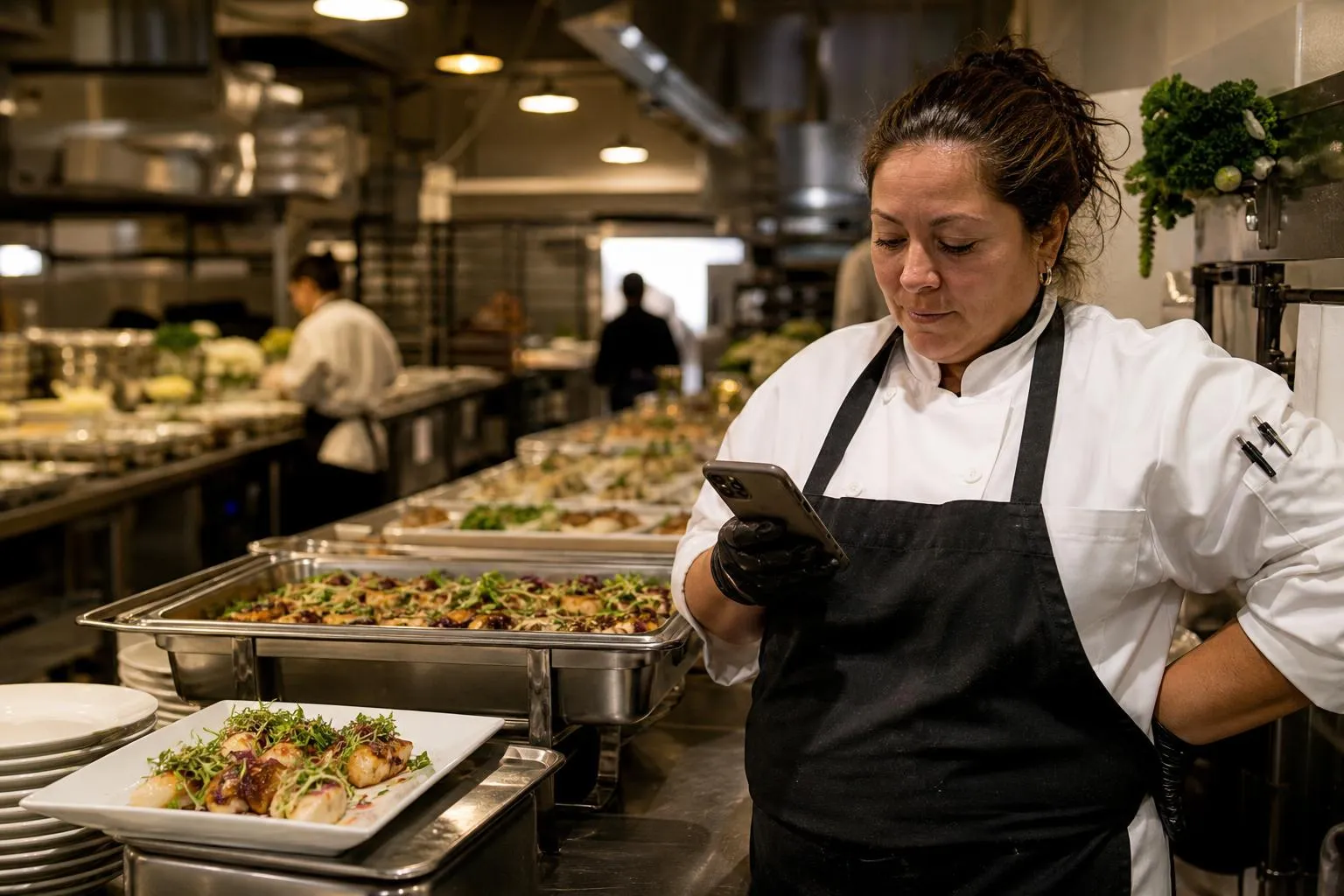
How to grow a catering business

Most caterers try to grow by booking more events, hit a wall of exhaustion around the fortieth wedding, and conclude the business does not scale. The ones who actually grow do something different: they make each event worth more and add revenue that repeats, so the calendar works harder without the owner working more hours. Growing a catering business is a revenue-per-event and systems problem long before it is a more-leads problem.
Grow the check before you grow the calendar
The fastest growth lever is already sitting in your booked events. Every wedding and party you have signed can be worth more with add-ons the client genuinely wants: a staffed bar, a passed-appetizer hour, a carving or raw-bar station, late-night snacks, upgraded rentals, and more service staff for a smoother event. These raise the per-head number and carry high margin because your fixed costs (travel, setup, kitchen) are already covered by the base booking.
Build a menu with clear good-better-best tiers and let clients climb. A caterer who lifts the average wedding from $4,000 to $5,500 through upsells grows revenue 38% without booking a single extra event or spending a dollar on marketing. The pricing structure behind this is covered in setting best prices and billing for your catering business.
Add the revenue that repeats
One-off events are a treadmill: every booking must be replaced next month. Recurring revenue changes the shape of the business. Corporate lunch accounts, weekly office deliveries, meal-prep subscriptions, and standing monthly client events fill your dead weekday hours and stack predictable income under the volatile event calendar.
Chase the office manager, not just the bride. A single company ordering lunch for 40 people twice a month is about $24,000 a year that you win once and keep, versus re-selling a wedding every time. List on ezCater, build a corporate landing page, and target “corporate lunch catering” so the recurring buyer can find you. Identifying where those accounts cluster is the work in identifying the ideal locations for your catering business.
Build the systems that let you leave the kitchen
The owner-operator who preps, cooks, plates, and serves every event is the ceiling on their own business, usually somewhere around $250k to $400k in revenue before the calendar physically cannot hold more. Growing past that means the business runs without your hands on every dish: standardized recipes with exact yields, prep sheets and packing lists per event, a trained lead who can run a floor without you, and clear service standards a new hire can follow.
Document the event, do not carry it in your head. When the process lives on paper, you can hire and train instead of clone yourself, which is the whole subject of when and how to hire and train staff for your catering business. The kitchen and rental capacity to support it is in buying equipment and supplies for your catering business.
Hire a crew or subcontract each event
At some point one owner cannot staff the events on the books, and the growth decision is whether to build a payrolled crew or subcontract event staff per job. Both scale you past your own two hands; they trade off differently on cost and control.
Payroll crew vs per-event staffing
- A trained core crew delivers consistent quality that protects your reviews and referrals.
- You control standards, timing, and upsells, so the client experience is repeatable.
- A reliable lead can run events without you, which is what lets you actually step back.
Payroll crew vs per-event staffing
- You pay wages, payroll tax, and workers comp whether the weekend is booked or empty.
- Catering demand is lumpy and seasonal, so a fixed crew can sit idle in slow months.
- A bad hire on a wedding floor can cost a referral source and a five-figure future client.
The practical path: keep a small trained core (a lead and a key cook) on payroll for consistency, and flex up with vetted per-event staff for the busy season, converting to more permanent roles only when the calendar is reliably full.
Getting found is the part that decides everything
Two growth moves are free and belong on this week’s list. Add good-better-best tiers to your proposals so existing clients can upgrade themselves, and email your recent clients to convert at least one into a recurring account. Those two actions grow revenue without a single new lead. The acquisition side that feeds continued growth is in how to get clients for a catering business, and the day-to-day discipline of running it well is how to successfully run a catering business.
Then the part that decides whether growth compounds or leaks: the website carrying your bigger, better-priced offer. As you move upmarket, a slow or cheap-looking site actively undercuts the premium you are trying to charge, and the corporate buyer comparing caterers judges you on it in seconds. It needs to load in under three seconds on a phone, show real event photos and your tiered per-head pricing, and make both an inquiry and a corporate quote easy to request. To have it built to match where you are taking the business, get a free video walkthrough. For the ads and SEO that scale the pipeline, see our services, and if you are formalizing the growth plan and numbers, start at expntl.com.
Frequently asked questions
What is the fastest way to grow a catering business?
Raise the value of events you are already booking before chasing more of them. Add tiered upsells (bar service, extra stations, more staff, upgraded rentals) so the average check climbs with no new marketing spend. Lifting an average wedding from $4,000 to $5,500 grows revenue nearly 40% off the same number of bookings, and the add-ons carry high margin because your fixed event costs are already covered.
How do I scale a catering business past just me?
Put the business on paper so it can run without your hands on every dish: standardized recipes with exact yields, prep and packing sheets per event, and a trained lead who can run a floor. A solo owner-operator caps out around $250k to $400k in revenue; documented systems and a small core crew are what let you book more events without personally cooking them.
Should I focus on weddings or corporate catering to grow?
Weddings pay a big one-time check; corporate pays a smaller check that repeats. For durable growth you want both, but the corporate account is the underrated flywheel: one office ordering lunch twice a month is around $24,000 a year won once and kept, and it fills the weekday hours your kitchen is already paying rent on.
How do I keep margins healthy while growing?
Cost every event before you book it and hold food to 28% to 35% of the event price and labor to 20% to 30%. Volume multiplies whatever margin you have, good or bad, so re-price the instant a supplier increase or overtime pushes you past those bands. Growing revenue while margins slip just means working harder for less cash at year end.
When should I hire staff instead of subcontracting?
Keep a small trained core (a lead and a key cook) on payroll for consistency, and flex up with vetted per-event staff during the busy season. Convert those flex roles to permanent only when the calendar is reliably full year-round, because catering demand is lumpy and a fixed crew you cannot keep booked becomes a fixed cost that eats the margin you grew.
Your move
Reading this does not book a job.
The owners who pull ahead are the ones who change one thing this week. If you want that one thing to be a website that sells and ads that put it in front of the right people, we build and run both for you.
Straight answer on whether we can help, usually the same day.