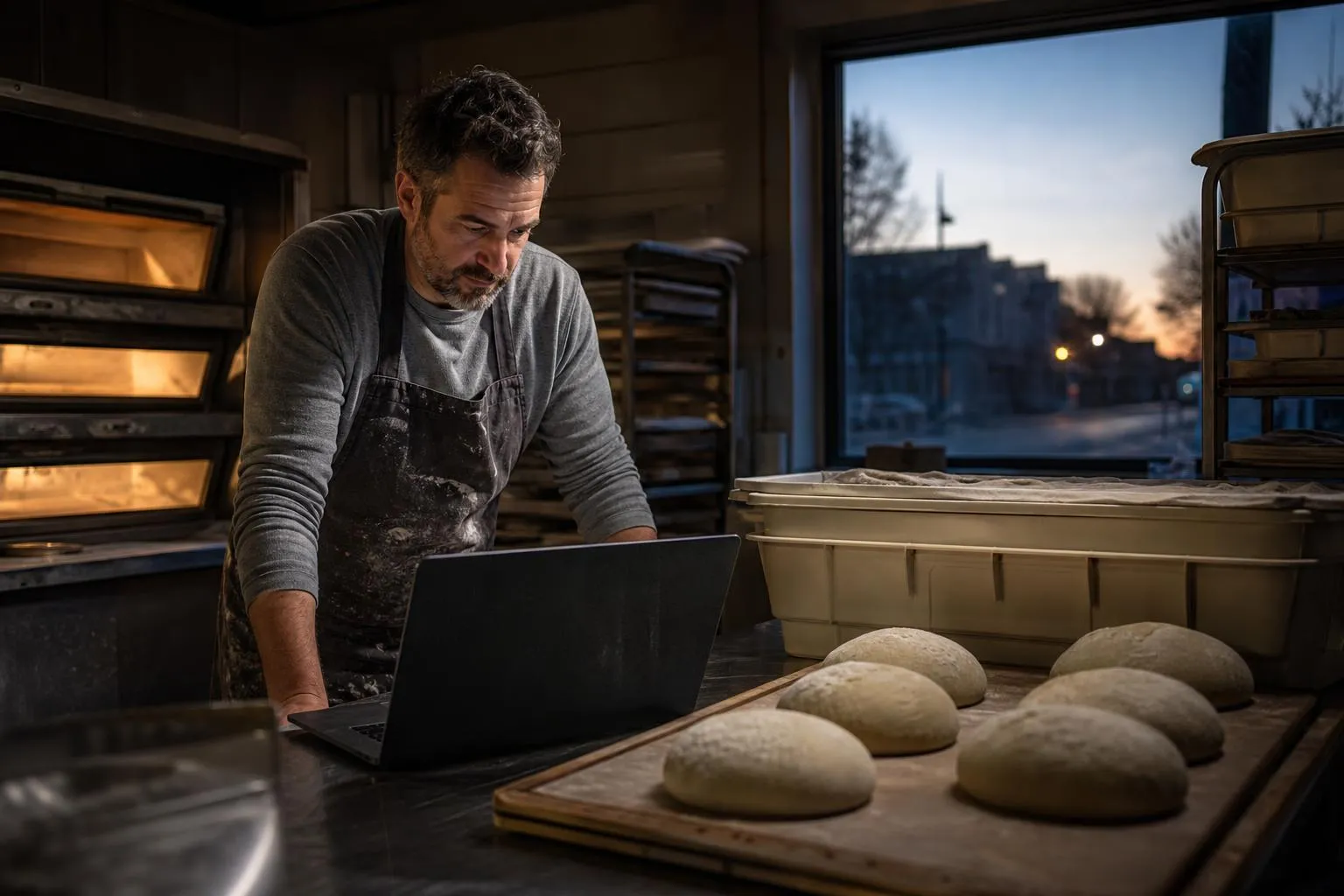
Best way to start and get into baking business

The best way to get into baking is not to sign a lease and buy a deck oven. It is to start in the kitchen you already own, under the cottage food law your state almost certainly has, and sell your first thousand dollars of cookies before you spend a dollar on rent. Overhead is what kills new bakeries, and the smartest launch removes it entirely until demand proves itself. Here is how to start lean, legal, and profitable from your own oven.
Start under cottage food law, not a lease
Cottage food laws let you legally sell “non-hazardous” baked goods, breads, cookies, cakes without perishable frosting, made in your home kitchen. This is the single biggest advantage baking has over almost any other food business: you can be selling this month with the equipment already in your house. The rules vary by state, but the pattern is consistent.
| State | Annual sales cap | Where you can sell | Notes |
|---|---|---|---|
| California | $75k (Class A) / higher (Class B) | Direct + some wholesale | Class A is a self-cert; Class B needs a county inspection |
| Texas | Unlimited | Direct to consumer | No state inspection; must complete a food handler course |
| Florida | $250k | Direct + online with in-state shipping | No permit required under the cap |
| Ohio | Unlimited | Direct to consumer | ”Cottage Food” label rules apply |
| New York | No hard cap | Home Processor exemption | Requires a state application |
The two things nearly every state requires: a specific ingredient label (net weight, ingredients by weight, allergens, and a “made in a home kitchen” disclosure) and, in many states, a cheap food handler’s card ($10 to $25 online). What cottage food usually does not let you do is sell cheesecake, custard pies, or anything needing refrigeration, and it usually blocks true wholesale into grocery stores. That is your ceiling, and hitting it is a good problem.
Prove demand before you spend
Your goal in the first 90 days is not revenue, it is a signal: do strangers, not your friends, pay full price and come back. The cheapest place to get that signal is a farmers market. A booth runs $25 to $60 a Saturday, you meet fifty potential customers in a morning, and you learn which products sell and which you love making but nobody buys. Pair it with a free Instagram account posting your actual bakes, and you have a marketing engine that costs your time and nothing else.
Do not overbuild the menu. Three things you make excellently beat twenty things you make adequately. Pick a signature, a sourdough, a laminated croissant, a specific cake, and become the person known for that one thing locally.
Know when home stops working
Home-based is the right start, not the right forever. You outgrow cottage food when one of three things happens: you want to sell refrigerated or filled products the law prohibits, you want wholesale accounts in cafes and grocery stores, or your home oven physically cannot keep up with orders. The bridge is almost never a full storefront. It is a shared commercial kitchen, also called a commissary.
Commissary kitchens rent certified commercial space by the hour, $15 to $35 typically, with the deck ovens, sheeters, and walk-in coolers already installed. You get the legal status to do wholesale and perishables without a six-figure buildout. Only after you are consistently maxing out commissary hours does a dedicated space make financial sense.
Home kitchen to start
- Overhead is effectively zero: no rent, no separate utilities, no commercial insurance minimum.
- You can be selling legally within weeks using the oven you already own.
- Near-total flexibility to test products, prices, and menus with no sunk cost.
Home kitchen to start
- The cottage food product list blocks refrigerated, filled, and most wholesale items.
- Physical output is capped by one residential oven and your own two hands.
- Some HOAs and leases restrict home businesses, and a few states require a kitchen inspection anyway.
The rule is simple: stay home until the orders you are turning away are worth more than the cost of the next step up. For most bakers that is a commissary, not a lease, and often not for a year or more.
Getting found is the part that decides everything
You can bake the best croissant in your zip code and still fail if nobody local knows you exist. A couple of pieces are free and worth doing this week; the rest is where doing it badly costs more than not doing it at all.
The free pieces, now: create a Google Business Profile even as a home baker (you can hide your address and show a service area), and post to Instagram three times a week with real photos and your city in the caption. Text a photo and a reorder link to every customer who buys. Those first reviews and follows pull more first-time buyers than any ad. More tactics are in how to promote your baking business locally and how to get clients and customers for a baking business.
Now the high-stakes part. A bakery website is not a menu PDF. Good means it loads in under three seconds on a phone, shows your best product photos and an order button above the fold, ranks for “custom cakes near me,” and turns a hungry searcher into a paid order. The gap between a site that converts and a pretty one that does nothing is invisible until you compare the numbers: a bakery converting 2% of visitors instead of 6% loses two thirds of its orders. Paid ads are the same, where a badly built campaign teaches the platform to send you worse traffic. This is the work we do. To have the site handled instead of guessed at, get a free video walkthrough. For ads and SEO, see our services. If you have the bakery idea but not the plan yet, start at expntl.com.
Frequently asked questions
Do I need a commercial kitchen to start a baking business?
Almost never at the start. Every state but a couple has a cottage food law that lets you legally sell many baked goods from your home kitchen. You move to a shared commercial kitchen (a commissary, $15 to $35 an hour) only when you want refrigerated products, wholesale accounts, or more output than a home oven allows.
What can I actually sell under cottage food law?
Shelf-stable baked goods: breads, cookies, most cakes, muffins, brownies, and pastries without perishable fillings. What is usually prohibited: cheesecake, custard and cream pies, anything needing refrigeration, and true wholesale into grocery stores. Check your state’s exact product list, because it is the line you cannot cross without leveling up.
How much money do I need to start from home?
Often just a few hundred dollars if you already own a decent oven and mixer, since your real costs are ingredients (25% to 35% of each sale), labels, and packaging. The full breakdown is in how much you need to start a baking business.
Where should I sell first?
Farmers markets are the best proof of demand: a booth costs $25 to $60 a Saturday and puts you in front of fifty real customers in a morning. Pair it with a free Instagram and a Google Business Profile, and you have a marketing engine before you have a storefront.
When should I open an actual storefront?
Not until a commissary kitchen is fully maxed out and you are consistently turning away wholesale and event work. A storefront adds $500 to $5,000 a month in rent plus utilities and staff, so it should be the answer to “I have too much demand,” never “I hope demand shows up.”
Your move
Reading this does not book a job.
The owners who pull ahead are the ones who change one thing this week. If you want that one thing to be a website that sells and ads that put it in front of the right people, we build and run both for you.
Straight answer on whether we can help, usually the same day.