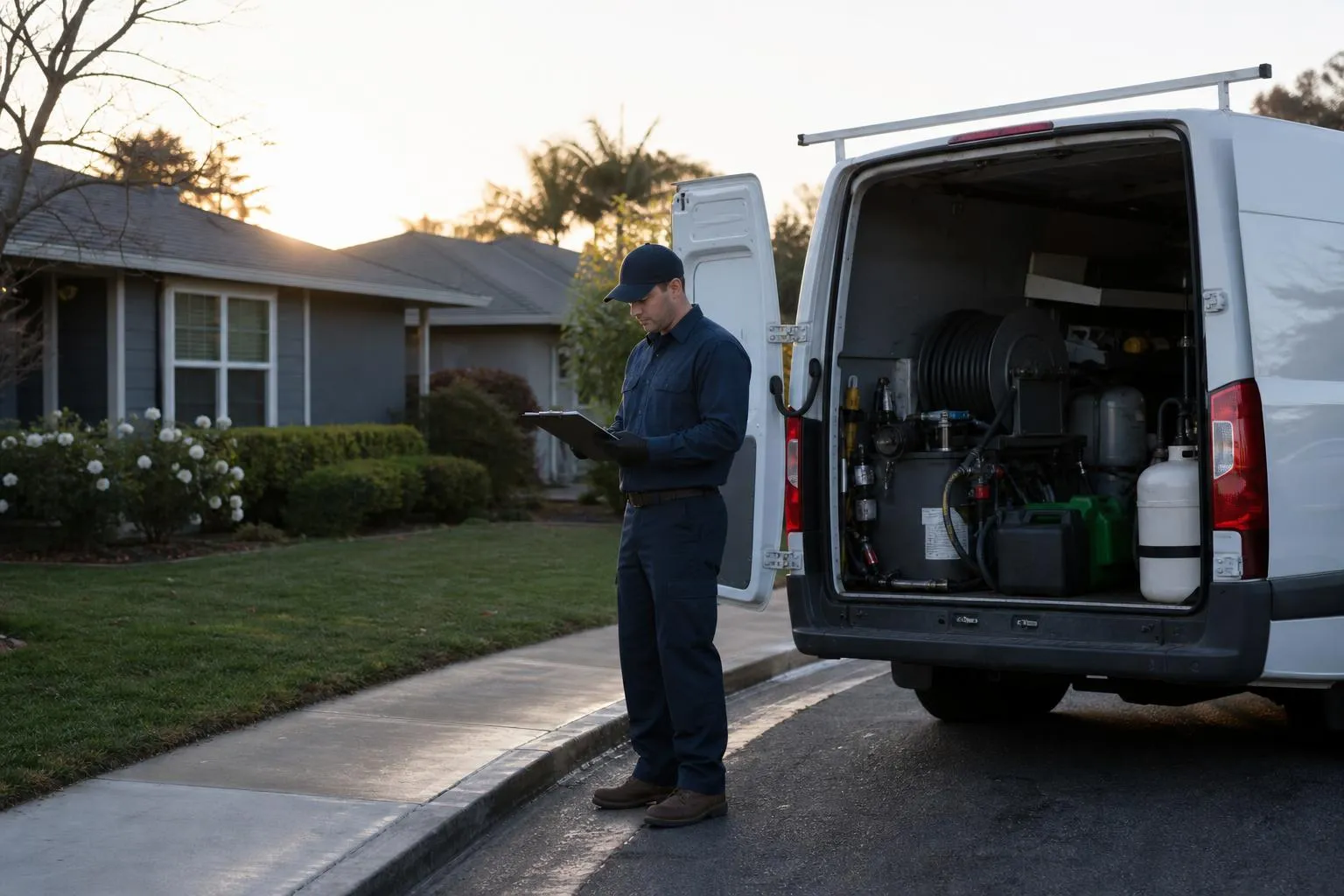
How to grow a pest control business

Growing a pest control company is not about doing more jobs, it is about owning a bigger annuity. The owner-operator who chases one-time sprays hits a hard ceiling the day his own truck is full, because he has bought a job, not a business. The one who grows past it is building a book of recurring accounts that renew whether or not the phone rings that week, then densifying routes and adding crews so the annuity compounds. The lever is not effort, it is recurring revenue and retention. Here is how the jump actually works.
Grow the recurring book, not the job count
The number that measures a pest control company’s growth is not jobs completed this month, it is monthly recurring revenue. A book of 300 quarterly accounts at $130 a visit is roughly $156,000 a year that arrives on a schedule, before you advertise or answer a single new call. That predictability is the whole asset, and it is what a one-time-spray operator will never have no matter how hard he works.
So every growth decision runs through one question: does this add recurring revenue or just a one-off? A one-time bed-bug job is welcome cash, but a quarterly plan is an annuity that renews for years, which is why your marketing, your pricing, and your upsells should all push customers onto plans. If your pricing is not built around recurring revenue yet, that is the first fix, and it is laid out in setting your prices and billing. The wider question of how profitable the book can get is in how much profit a pest control can make.
Plug the leaky bucket before you pour in more leads
Most owners try to grow by pouring in more leads while the bucket leaks out the bottom, and that is the expensive way. If you lose 15% of your recurring customers a quarter, you have to replace 60% of your book a year just to stand still, and every replacement costs a $25 to $40 lead you already paid for once. Cutting that churn is pure profit, and it usually costs less than the ad spend it replaces.
Retention in pest control comes from a short, unglamorous list: show up on the scheduled day, honor the free re-service when a customer calls between visits about a resurgence, and answer the phone. The callback (a customer reporting the bugs came back) is your churn early-warning system, so treat a fast, no-charge re-treat as a retention investment, not a cost. Track it: a rising callback rate means a technique or product problem that will bleed your book if you ignore it. Keeping quality high as you scale is covered in how to successfully run a pest control.
| Growth lever | Effort | Typical payoff |
|---|---|---|
| Cut churn 15% to 8% | Low, systems only | Highest ROI, keeps the book you paid for |
| Densify existing routes | Low, scheduling | More stops per hour, higher margin per tech |
| Upsell plans to one-time customers | Low, at point of service | Converts cash jobs into annuities |
| Raise prices 5-8% annually | Low, one letter | Straight to the bottom line if churn stays flat |
| Buy paid leads | High, ongoing cost | Necessary but the most expensive lever |
Densify routes before you widen your map
The single biggest margin lever as you scale is not more customers, it is tighter customers. A technician who does 12 stops a day all inside one or two zip codes bills far more revenue per paid hour than one doing 8 stops scattered across a county, because the difference is drive time you pay for but cannot invoice. Density is the quiet reason two companies with identical account counts can have wildly different profit.
So grow deep before you grow wide. When you pick a new territory or a marketing push, aim it at the streets and zips where you already have stops, so each new account slots into an existing route instead of starting a lonely one across town. Routing software like PestPac or FieldRoutes exists precisely to optimize this, sequencing stops to cut windshield time, and it earns its subscription the moment you pass a couple hundred accounts. Choose expansion areas deliberately with identifying the ideal locations.
Make the second-truck jump at the right moment
The scariest growth step is the first hire and the second truck, because it converts you from a technician into a manager and adds a fixed cost that shows up whether the route is full or not. Done at the right time it doubles capacity; done too early it bleeds you. The trigger is simple: add the truck only when your existing route is consistently 80% full and you are turning work away or booking three weeks out.
A new tech runs $18 to $25 an hour, plus workers comp (pest control class codes typically run a few dollars per $100 of payroll), plus a wrapped truck and equipment. That is roughly $3,500 a month or more in fixed cost before the tech books a dollar, so an idle second truck is the fastest way to erase the profit your first one earns. Hire and train deliberately using when and how to hire and train staff, and outfit the new truck from buying equipment and supplies.
Decide how to add capacity: hire a W-2 tech or subcontract
When demand outgrows your truck, you face a real either/or on how to add hands. Both are legitimate, and the right call depends on how steady your overflow is.
Hire a W-2 technician
- You control quality, technique, and customer manner, which protects your reviews and retention.
- A trained tech who learns your routes cuts callbacks, and fewer callbacks is money and retained customers.
- Consistency: the same face on a route builds the trust that keeps plan customers renewing.
Hire a W-2 technician
- You pay the wage, payroll tax, and workers comp whether the route is full or empty.
- Recruiting and training a licensed applicator takes weeks and real management time.
- A bad hire you carry too long can erase a season’s profit and dent the accounts they touched.
Hire the W-2 tech once your overflow is steady and predictable, because quality control and retention are everything in a recurring-revenue business. Lean on subcontracting or overtime only while the extra demand is lumpy and seasonal, then convert to a salaried tech the month you are consistently turning work away.
Getting found is the part that decides everything
Two free growth moves compound before you spend a dollar: keep feeding your Google Business Profile fresh reviews so your map-pack ranking climbs as you scale, and audit your callback rate monthly so churn never quietly drains the book you already paid to build. Those two habits protect the annuity that growth depends on.
Here is the part that decides whether new demand converts as you scale: the machine that turns searchers into booked plan customers. A growing company generates more searches for its name and more clicks from ads, and if those land on a slow page that hides the phone number and buries your reviews, you are paying to grow and leaking the growth at the last step. The gap between a site that converts 8% of visitors and one that converts 2% is invisible until you compare booked jobs, and at scale it is the difference between a second truck that pays and one that sits. That is the work we do. To have the site built to convert instead of guessed at, get a free video walkthrough. For SEO and ads run properly as you scale, see our services. If you are planning a bigger expansion and want the numbers modeled first, start at expntl.com.
Frequently asked questions
What is the fastest way to grow a pest control business?
Grow the recurring book and protect it, rather than chasing one-time jobs. The fastest real growth comes from three cheap levers: convert one-time customers onto quarterly plans, cut churn by showing up reliably and honoring free re-services, and densify your routes so each tech does more stops per hour. Paid leads matter, but they are the most expensive lever, so pull the free ones first.
How do I keep pest control customers from canceling?
Retention runs on reliability, not gimmicks: arrive on the scheduled day, answer the phone, and treat every callback (a customer reporting bugs came back) as a fast, no-charge re-service. A rising callback rate is your early warning that a product or technique problem is about to bleed your book, so track it monthly and fix the root cause. Cutting quarterly churn from 15% to 8% often adds more profit than doubling your ad budget.
When should I hire my first technician?
Hire when your existing route is consistently about 80% full and you are booking two to three weeks out or turning work away, not before. A new tech and truck is roughly $3,500-plus a month in fixed cost the day it launches, so adding capacity on optimism about future demand can wipe out a quarter of profit while the route sits half empty. Wait for the full-route signal, then move quickly.
Do I need routing software to grow?
Once you pass a couple hundred accounts, yes. Tools like PestPac or FieldRoutes sequence stops to cut drive time, which is the single biggest hidden cost as you scale, and they handle scheduling, billing, and the recurring plan renewals that manual systems drop. Below a hundred accounts you can get by on a spreadsheet, but the software pays for itself the moment density and route optimization start moving your margin.
How much is a pest control business worth when I sell it?
Established companies typically sell for a multiple of recurring revenue, often somewhere around 1.5 to 3 times annual recurring revenue, with the multiple driven by low churn, route density, and clean books. That is why building recurring plan customers is worth far more than chasing one-time jobs: every retained account adds enterprise value on top of the cash it brings in, so the way you grow directly sets what you can eventually sell for.
Your move
Reading this does not book a job.
The owners who pull ahead are the ones who change one thing this week. If you want that one thing to be a website that sells and ads that put it in front of the right people, we build and run both for you.
Straight answer on whether we can help, usually the same day.