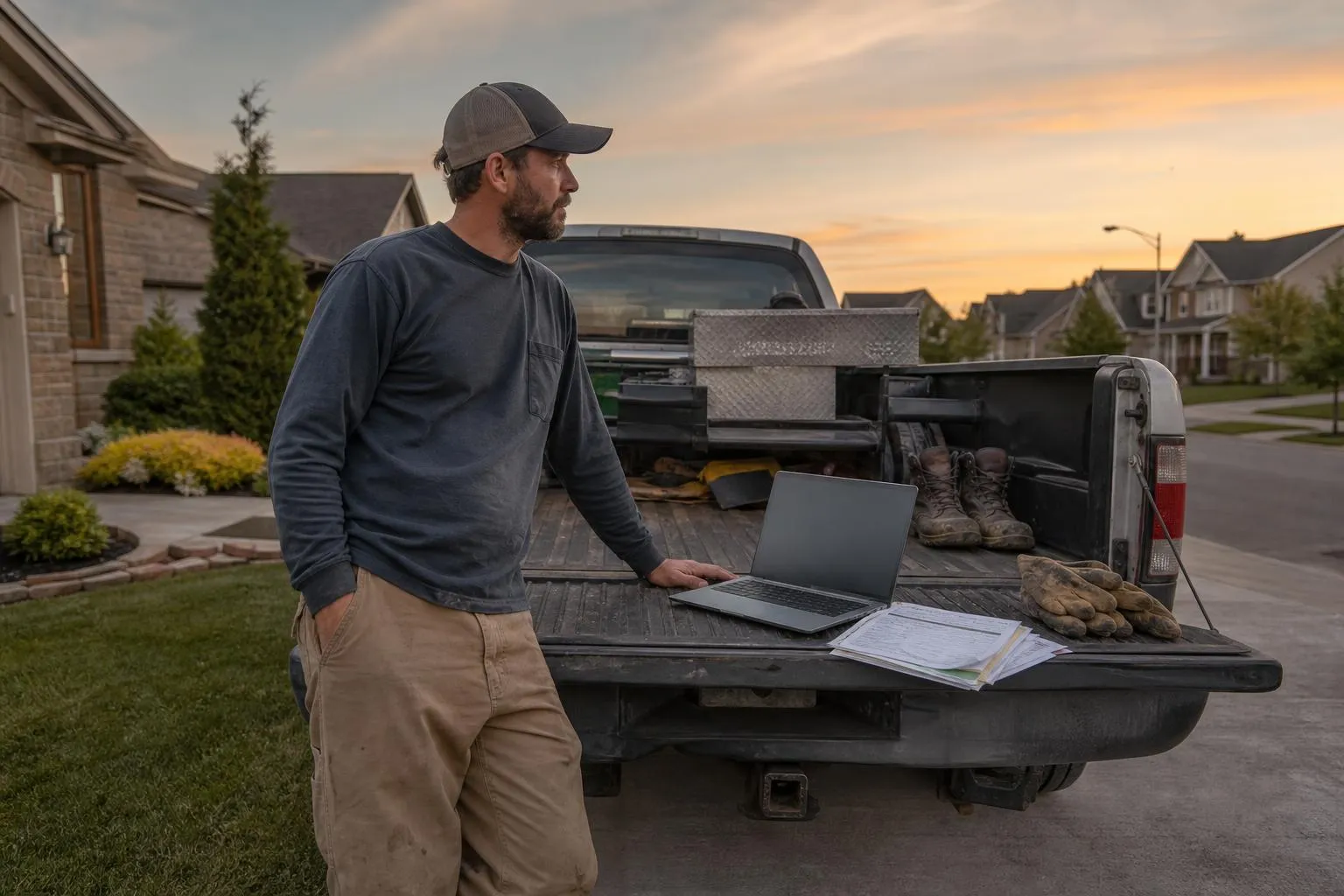
How to successfully run a landscaping business

The landscaper who wins is rarely the one with the most leads. It is the one whose crew is actually cutting grass instead of sitting in traffic between jobs on opposite sides of town. Once you are open and booked, the business stops being about the wrench and starts being about the schedule: how tight your route runs, how much of your revenue recurs every month without a new sale, and what percentage of every paid hour is billable. Nail those three and a modest client list out-earns a competitor with twice the trucks and half the discipline. This is the operations game, and it is where the real money is made or quietly lost.
Run the route by geography, not by request
The most expensive line item in landscaping is not equipment or fuel; it is windshield time, and it does not show up on any invoice. A crew paid $22 an hour that spends 90 minutes a day driving between scattered jobs costs you $33£26 a day in pure drive time, and worse, those are minutes that could have been three more billable lawns. The fix is to cluster clients by neighborhood and cut them on the same day, so the truck unloads once and works a street before moving on. Say no to the great customer 25 minutes past your farthest stop unless they anchor a whole new cluster, because a lone outlier lawn quietly loses money no matter what you charge.
Route software makes this manageable past a dozen clients. Jobber and LMN both optimize the day’s stops, hold client history, and cut the scheduling chaos that eats an owner’s evenings. The point is not the app; it is that you plan tomorrow’s day by the map, not by who called last.
Sell the contract, not the cut
A one-off mow is a transaction; a signed season-long maintenance agreement is a business. Recurring contracts turn your revenue from a nervous week-to-week guess into a predictable monthly number, which is the difference between a job you own and a job that owns you. Price maintenance as a flat monthly or seasonal fee covering a set scope (weekly mow, edge, blow, plus a spring and fall cleanup), bill it on autopay, and your income stops swinging with the weather and the phone.
That predictable base, the closest thing landscaping has to recurring revenue, is what lets you hire, invest, and take a week off without the business stalling. It also raises the value of every client: a homeowner on a $220-a-month agreement is worth far more over a season than the same yard cut ad hoc, and they stop price-shopping you every visit. The pricing structure for these agreements is in setting the best prices and billing, and the path to more of them is in how to grow a landscaping business.
Watch the number that decides your year: billable hours
You pay a crew for every hour they are clocked in, but you only get paid for the hours they are on-site producing. The gap, spent driving, reloading, fueling, and standing around, is pure loss, and most owners never measure it. Billable-hour percentage (on-site productive hours divided by total paid hours) is the single number that separates a landscaping business that clears real profit from one that stays busy and broke.
| Billable-hour rate | What it means | Typical cause |
|---|---|---|
| Below 50% | Bleeding money | Scattered route, long drives, disorganized loading |
| 55% to 60% | Surviving | Some clustering, avoidable downtime remains |
| 60% to 70% | Healthy | Tight routes, staged trailer, crews that move |
| Above 70% | Excellent | Dense neighborhoods, disciplined dispatch |
Push toward the bottom two rows and profit appears without a single new client. Stage the trailer so tools come off in the order used, top off fuel the night before, and dispatch by geography. Every point you move up is margin you already had and were leaving on the road.
Keep the clients you have before chasing new ones
Winning a new maintenance client costs you a door hanger campaign, an ad click, or a referral you cannot control; keeping one costs a same-day callback and a crew that shows up when it said it would. The math is lopsided, and it is why retention, not lead-gen, is where a running business protects its margin. A client on a season-long agreement who trusts you is worth several one-off strangers, and the two things that lose them are missed visits and slow communication, both fixable for free.
Own the crew (W-2) vs subcontract crews
- A trained W-2 crew that learns your routes and standards cuts callbacks and protects your reviews.
- You control schedule, quality, and the upsell conversation on every property.
- Steady work retains the good operator who stays for years instead of the one who leaves mid-season.
Own the crew (W-2) vs subcontract crews
- You carry the wage, payroll tax, and workers comp whether the schedule is full or a rainout kills the day.
- Landscaping workers comp runs roughly $5 to $9 per $100 of payroll, a real four-figure line as you grow.
- A bad hire you carry two months can erase a season’s profit before you replace them.
The rule most operators land on: run W-2 crews for the recurring maintenance route where quality and retention pay off, and subcontract the occasional big install that would otherwise sit your people idle waiting on it. The hiring and training method is in when and how to hire and train staff, and the profit math behind these calls is in how much profit a landscaping business can make.
Getting found is the part that decides everything
A well-run route still needs a steady trickle of new clients to replace natural churn, and the free pieces are worth keeping sharp. Keep your Google Business Profile complete and current, ask every satisfied maintenance client for a review and a referral, and stay consistent so your reputation compounds. The local engine that keeps the pipeline full is in how to promote your landscaping business locally.
The piece that ties operations to growth is a website that turns a searching homeowner into a booked estimate and reflects the professional operation you have built. A slow or thin site sends the referrals you earned to the competitor who ranks above you. Building that site is the work we do; to have it handled instead of guessed at, get a free video walkthrough of your website. For the Google and Facebook ad management that fills the route as you scale, see our services. And if you are ready to plan the next stage of the business, start at expntl.com.
Frequently asked questions
What is the single biggest factor in running a profitable landscaping business?
Route density. The most expensive and most invisible cost in landscaping is drive time between jobs, which you pay for in wages but never bill to a customer. Clustering clients by neighborhood so a crew works a street before moving on can add several billable lawns a day on the same labor bill. Fix the map before you chase more leads.
How do I make my landscaping income more predictable?
Convert one-off cuts into recurring maintenance agreements billed monthly on autopay. A route of season-long contracts gives you a base revenue number you can count on, which covers fixed costs through slow weeks and lets you hire and invest without panic. High-ticket installs then become upside sold to clients you already serve, rather than the feast-or-famine you live on when you chase only big jobs.
How many lawns can one crew realistically handle?
It depends far more on route density than on the crew’s speed. A two-person crew on a tight, clustered route can complete 25 to 35 residential lawns a day; the same crew on a scattered route might manage 15 to 20 because half the day is spent driving and reloading. That is why measuring billable-hour percentage matters more than pushing the crew to move faster on each property.
When should I hire my first employee, and W-2 or subcontractor?
Hire when you are consistently turning work away, not before, because a wage you pay on a rained-out day comes straight out of profit. For the recurring maintenance route, a trained W-2 crew that learns your standards protects quality and retention; for the occasional large install, subcontracting keeps your own people from sitting idle. The full timing and training method is in when and how to hire and train staff.
Is it cheaper to keep a client or win a new one?
Far cheaper to keep one. Winning a new maintenance client costs marketing spend, an ad click, or a referral you cannot manufacture on demand; keeping one costs a same-day callback and showing up when you said you would. A client on a season-long agreement who trusts you is worth several one-off strangers, so protecting retention with reliable service guards your margin better than any increase in ad budget.
Your move
Reading this does not book a job.
The owners who pull ahead are the ones who change one thing this week. If you want that one thing to be a website that sells and ads that put it in front of the right people, we build and run both for you.
Straight answer on whether we can help, usually the same day.