How to Advertise a Landscaping Business on Facebook

Facebook is not where homeowners search for a landscaper. It is where they get reminded they need one. That difference should reshape every dollar you spend. Nobody types “who mows lawns near me” into Facebook, but plenty of people scroll past a jaw-dropping before-and-after of a weed-choked yard turned into a striped emerald carpet and think “mine looks like the before.” Your job on Facebook is to show the transformation to the right 10-mile radius, capture the lead before they scroll on, and follow the 90% who hesitate. Here is how to do it without lighting money on fire.
Set up the page and pixel before you boost anything
The single worst move on Facebook is hitting “Boost Post” on your phone. It hands your budget to Meta with no targeting, no form, and no tracking. Instead, build the plumbing first. Create a proper Facebook business Page (Local Business category), fill in service area, hours, and a call button, and pin one killer before-and-after to the top.
Then set up two free things inside Meta Business Suite: a Meta Pixel on your website (so Facebook can track who visited and retarget them later) and Facebook Lead Ads (so people can submit their info without leaving the app). Both are free to install and are the difference between a campaign you can measure and one you are guessing at. For the day-to-day page management that sits alongside your ads, see how to run Facebook for a landscaping business.
Target the radius you can actually service
Facebook’s real superpower for a landscaper is not interests, it is the map. Set a location radius of 5 to 10 miles around your existing route or your densest neighborhoods. This does two things: it keeps you from paying to reach someone 40 minutes away you would lose money servicing, and it tightens your route density. Then layer homeowners (Facebook lets you target “likely to move” and homeownership), age 30 to 65+, and a modest interest layer like “home improvement” or “gardening” only if your audience is still too broad.
Do not over-stack interests. On a local budget, a tight geo-radius plus homeownership is usually enough, and every extra filter shrinks your audience until Facebook can’t spend efficiently. The goal is a few thousand of the right households, not a laser on 200 people.
Make before-and-after the whole creative
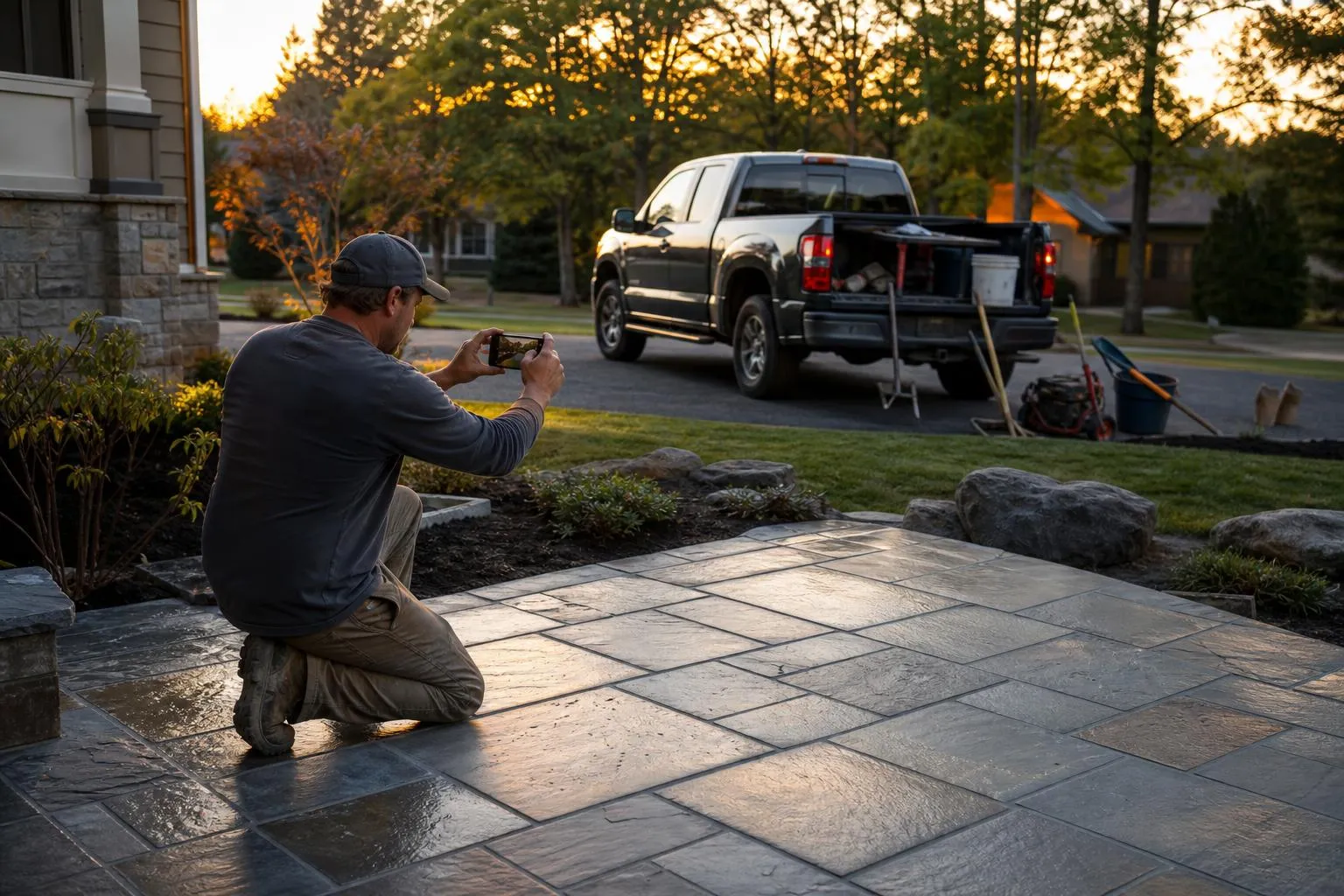
Landscaping is a visual trade, so your ad should be almost entirely image. The highest-converting format is a clean before-and-after: the neglected yard on the left, the finished, striped, edged result on the right. It sells the outcome instantly and needs almost no copy. Video walk-throughs of a finished property, shot vertically on a phone, are a close second and cheap to make.
Keep the copy short and local: “Tired of looking at your lawn? We maintain yards in [Town] starting at $45 a visit. Tap for a free quote.” A specific price and a specific town beat vague “quality service” language every time. Run three or four versions and let Meta find the winner.
Use Lead Ads to capture the click before it scrolls away
Send your ad to a Facebook Lead Ad form, not to your homepage. The instant form pre-fills the user’s name, email, and phone from their Facebook profile, so booking a quote takes two taps without leaving the app. That low friction is why Lead Ads book estimates at $8 to $25 per lead in most suburban markets, often cheaper than a single Google Ads click.
Ask for only what you need: name, phone, address, and one dropdown (“What do you need? Mowing / Cleanup / Design / Other”). Every extra field cuts your completion rate. Then the discipline that decides whether it works: call every lead within an hour. A form lead that sits until tomorrow is usually already talking to a competitor.
Facebook Lead Ads vs sending to your website
- The form pre-fills from Facebook, so completion rates run far higher than a cold website form.
- Leads flow straight to your phone or email in real time, and you can call while they are still on their couch.
- Setup is free and lives entirely inside Meta, with no landing page to build or host.
Facebook Lead Ads vs sending to your website
- Pre-filled forms make it too easy, so you get more casual “just curious” leads to sift through.
- You lose the chance to show off a full portfolio, reviews, and pricing that a real landing page can.
- Leads don’t sync to your CRM automatically without a tool like Zapier or a Jobber integration wired up.
For most new landscapers, Lead Ads win for cold traffic because speed and volume matter early; graduate to a real landing page once you want to pre-sell and filter harder.
Retarget the 90% who didn’t convert the first time
Here is where the Pixel pays off. Roughly nine out of ten people who click your ad or visit your site will not book on the first touch. Retargeting shows a follow-up ad only to those warm people: past website visitors, video viewers who watched more than half, and anyone who opened your Lead Ad form but didn’t submit. These audiences convert far cheaper than cold traffic because they already know you.
Build a Custom Audience of your site visitors (from the Pixel) and your video viewers, then run a simple “Still thinking about your lawn? Here’s what we did for a neighbor on [Street]” ad to them. A tiny retargeting budget, $5 to $10 a day, often produces your cheapest leads of the whole campaign.
Getting found is the part that decides everything
Facebook fills the top of your funnel, but two free habits decide whether it converts. First, post a real before-and-after to your Page every week so cold visitors who check you out see recent, real work. Second, reply to every comment and message within the hour, because response speed is the whole game on social.
The paid side is where doing it badly costs the most. A Facebook campaign is only as good as where it sends people and how fast you follow up. If your ad sends a homeowner to a slow, ugly website, or a Lead Ad piles up unanswered, you paid Meta to lose the customer. A page that loads fast on a phone, shows your reviews and real photos, and books estimates is what turns Facebook spend into contracts. That is the work we do. To have the site and funnel built to convert, get a free video walkthrough. For managed Facebook and Google campaigns, see our Facebook and Instagram ads service. If you have the business but not the plan yet, start at expntl.com.
Should you run Facebook and Instagram ads yourself, or hand it off?
If you have the discipline to install the Pixel, keep the radius tight, and call every lead within the hour, a landscaper can run a profitable Facebook campaign without help. Where it slips is the ongoing work: fresh before-and-after creative, retargeting audiences, and reading cost per booked estimate instead of cost per lead. We put together an honest read on when in-house still works and when it is time to hand the paid side over: signs your business should hand off its Meta ads. When you want it run right from the first dollar, request a free proposal.
Frequently asked questions
How much does it cost to advertise a landscaping business on Facebook?
Most suburban landscapers can run an effective campaign on $10 to $20 a day, and Lead Ads produce leads at $8 to $25 each in that range. You do not need a big budget; you need tight geo-targeting, a strong before-and-after creative, and a fast callback. Start at $12 a day, measure your cost per booked estimate, and scale only what is profitable.
What kind of Facebook ad works best for landscaping?
Before-and-after photo ads, hands down, followed by short vertical video walk-throughs of finished properties. They sell the transformation instantly, which is what homeowners actually respond to. Pair the image with a specific offer and your town name, send it to a Lead Ad form, and you have the highest-converting setup for the trade.
Should I boost posts or use Ads Manager?
Use Ads Manager, never the Boost button. Boosting hands Meta your money with no real targeting, no Lead Ad form, and no Pixel tracking, so you can’t tell what worked. Ads Manager lets you set your radius, run a proper form, and retarget, which is the entire reason Facebook works for a landscaper. The setup takes 20 extra minutes and pays for itself immediately.
How do I target only local homeowners on Facebook?
Set a location radius of 5 to 10 miles around your route, then add the homeownership and “likely to move” targeting Facebook offers, plus age 30-65+. Keep interest layers minimal so your audience stays large enough to run efficiently. The tight radius is what keeps you from paying to reach people you can’t profitably service and packs new leads near your existing stops.
Is Facebook or Google better for a landscaping business?
They do different jobs, so most growing operators eventually run both. Google captures people actively searching “landscaper near me” today; Facebook reminds scrollers their yard needs work and captures them cheaply with visuals. If you are choosing one to start, Google tends to bring higher-intent leads, while Facebook wins on cost-per-lead and retargeting, covered here and in the broader advertising strategy guide.
Your move
Reading this does not book a job.
The owners who pull ahead are the ones who change one thing this week. If you want that one thing to be a website that sells and ads that put it in front of the right people, we build and run both for you.
Straight answer on whether we can help, usually the same day.