How to Make a Logo for a Junk Removal Business
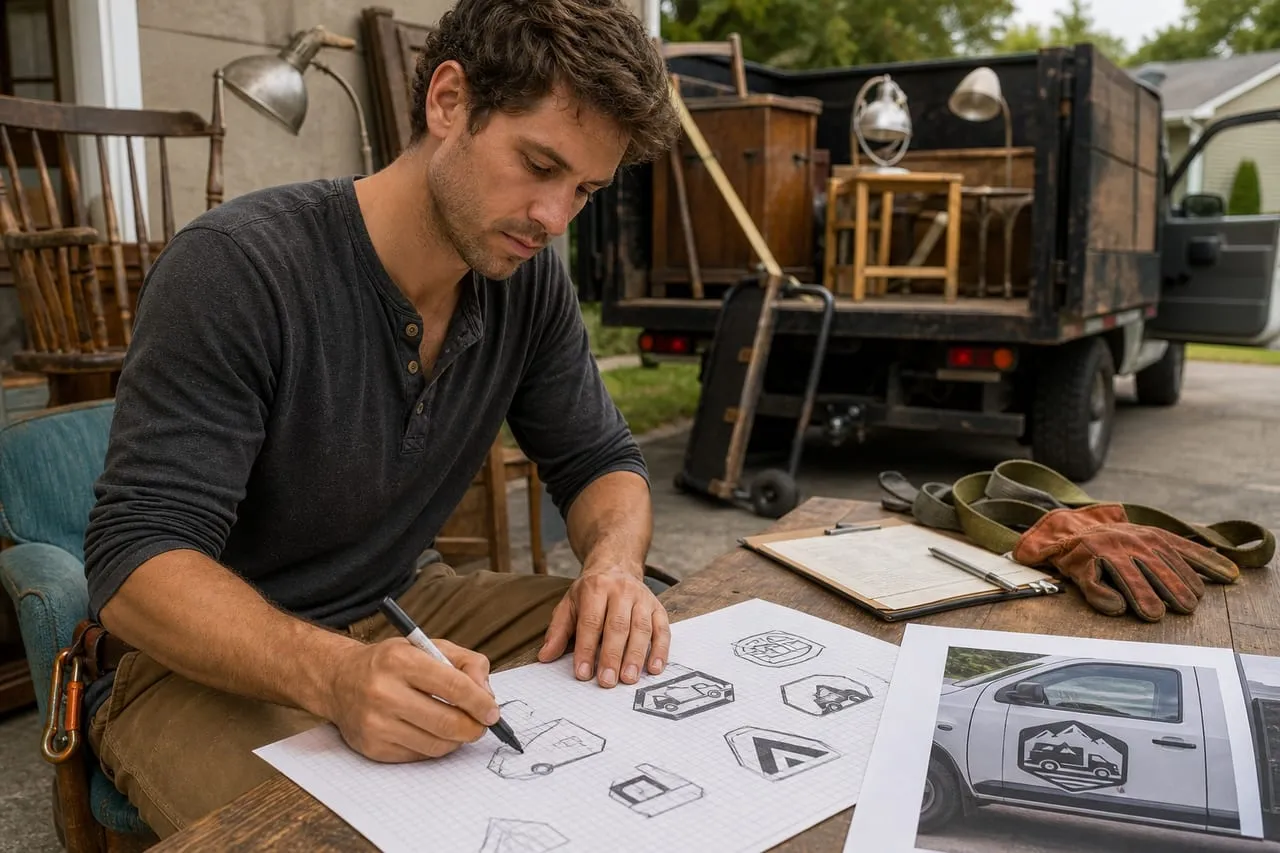
Your junk removal logo lives on the side of a truck doing 45 mph through a residential neighborhood. That’s the design brief. If a homeowner can read your phone number from the next lane and remember your name three blocks later, the logo works. Everything else is decoration.
Design for the Truck First, Everything Else Second
The biggest mistake new haulers make is designing a logo for an Instagram avatar instead of a moving billboard. Truck wrap is where your brand earns money.
- Wordmark over icon-only: someone calling you needs to remember the name, not a clever symbol. “Apex Junk Removal” wraps clearer than a stylized truck icon.
- Two colors max for the primary mark: bright colors photograph well, hold up on faded vinyl, and stay legible in low light. 1-800-GOT-JUNK uses blue and white. College Hunks uses orange and green. JDog uses red, white, and blue.
- Minimum stroke width of 1/8 inch at billboard scale: thin script logos disappear at 50 feet. Bold sans-serif is your friend.
- Phone number bigger than the logo on the truck: this is heresy to designers and the right call for haulers. The logo brands. The phone number books.
- High contrast: dark logo on light truck or light logo on dark truck. Never two mid-tones together.
If you have a 14-foot dump body and you’re not comfortable reading your wordmark from 100 feet, the logo isn’t done. Print a sample, tape it to the truck, walk away, and look back.
The reason to obsess over legibility and nothing else is where junk removal leads actually come from. A signed truck parked in a driveway for 90 minutes is seen by every neighbor, dog-walker, and passing car on the street, and in dense neighborhoods that single parked-truck impression produces 1 to 3 callbacks per job. The logo is not a piece of art, it is the conversion layer on free advertising you are already paying for with your time. A beautiful mark nobody can read from across the street earns exactly nothing.
Pick Friendly, Memorable Colors
Junk removal is a “we’ll handle the mess” service. The brand should feel friendly, not industrial. Color carries 60% of that work.
- Bright blues (Royal, Cobalt): trustworthy, clean, the 1-800-GOT-JUNK family
- Bright greens (Kelly, Lime): eco, donation, recycling-forward
- Orange and yellow accents: high visibility on the road, energetic
- Avoid dark gray, muddy brown, deep navy without an accent: reads industrial, hides on truck wraps at distance
The strongest combinations are a saturated primary (royal blue, kelly green, or fire-engine red) with a clean white truck base. This is why almost every national brand looks similar. The math works.
Treat that convergence as evidence, not as a lack of imagination to fix. The national brands have collectively spent decades and millions of impressions testing what reads at distance, and they all landed on the same answer: one saturated color on white. Trying to stand out with an unusual palette means betting your truck against their test data. Differentiate where it is cheap and effective instead: the name, the phone answer, the reviews. Nobody hires the hauler with the most original color scheme; they hire the one whose number they could read.
If you’re naming the business with your last name (Smith Junk Removal, JDog), lean American and patriotic-friendly. If you’re naming for the work (Trash Titans, Haul Pro, Junk-It), lean fun and approachable.
Build It in 90 Minutes with Free Tools
You do not need to hire a designer for your first logo. You need a clean wordmark you can replace in 18 months if revenue justifies it. Three real options.
- Canva Pro ($15/month, free trial): the fastest path. Use the logo templates as a starting point, swap fonts to Montserrat Bold or Bebas Neue, two-color it, export as PNG and SVG. Total time: 60 to 90 minutes.
- Looka or Hatchful by Shopify (free to $20): AI-driven logo generators that produce 30+ variations from your name and keywords. Good enough for truck wrap.
- 99designs or Fiverr Pro ($150 to $400): designer marketplace if you want a custom mark. Brief the designer with the rules above, share 2 to 3 competitor wraps you like, ask for vector files (AI and SVG).
DIY logo now: pros
- Done this week for $0 to 20, no briefing rounds
- Easy to tweak yourself when the wrap shop asks for changes
- The $350+ saved funds a month of local ads or 2 years of domain and hosting
DIY logo now: cons
- Template look; a competitor may use the same starting point
- Easy to break the legibility rules without noticing
- You’ll likely redo it at rebrand time anyway
The decision rule that resolves this: DIY now, designer later, and let revenue pick the date. In month one a logo has exactly one job (be readable on a truck) and templates do that fine. By month 18, if the trucks are busy, a $400 designer pass is a rounding error and you will brief it far better after a year of watching which jobs your brand attracts. The only genuinely bad option is the middle one: burning week one and $2,000 on custom design before the phone has ever rung.
Whatever tool you use, leave with the right files. This is the checklist wrap shops and printers will run you through:
| Format | Where it’s used | Who will ask for it |
|---|---|---|
| SVG or AI (vector) | Truck wrap, magnetics, any large print | The wrap shop, every time |
| PNG, transparent background | Website, GBP listing, invoices | You, weekly |
| One-color knockout (white) | Shirts, hats, dark backgrounds | The shirt printer |
| Square crop | GBP avatar, Facebook, Instagram | Every platform you sign up for |
Vector files matter because vinyl is cut at sizes a phone-screen logo never sees. A PNG scaled to 12 feet turns to fuzz, so the shop redraws your mark by hand, bills you for it, and occasionally redraws it slightly wrong, which is how you end up with three versions of your own logo in the wild.
Export the final logo in all four formats the day you finish it. For the next step, your website also needs the logo at multiple sizes. See how to make a website for your junk removal business for placement.
Get Real Feedback Before Locking It In
Designers ask other designers for feedback. Don’t do that. You’re not selling to designers, you’re selling to homeowners who need a couch hauled away tomorrow.
- Show it to five non-designer friends and ask: “What does this business do?” If three or more guess wrong, redesign.
- Show it next to two direct competitors’ logos. If yours is the one their eye skips, redesign.
- Mock it up on a truck silhouette (Canva has one). If you can’t read it at the size it’ll actually appear, redesign.
- Print a sticker version (Sticker Mule $10) and put it on your truck for a week. Watch reactions from people loading groceries next to you.
When the logo works, lock the colors in a brand sheet (HEX, RGB, CMYK, Pantone). Wrap shops and shirt printers will ask for these and you don’t want to be guessing in three months. See how to advertise your junk removal business for where the logo runs once it’s done.
One warning about this whole process: logo work is the most seductive form of procrastination in a new service business. It feels like building the company while conveniently postponing the parts that are actually hard, like calling transfer stations and asking strangers for work. Cap it at one evening. An ugly-but-legible logo on a truck that worked five jobs this week beats a beautiful mark on a truck that hasn’t left the driveway, and since you kept vector files, a rebrand in year two costs one afternoon and a new set of magnetics.
Frequently asked questions
Should the logo include a truck or trash can icon?
Optional. A clean wordmark is fine. If you add an icon, keep it simple enough that it still reads at thumbnail size.
How much should I spend on a first logo?
Zero to $400. Reinvest the savings into truck wrap, Google reviews, and a second truck. Logo refreshes are easy in year two.
Can I use AI tools to design a logo?
Yes. Looka, Brandmark, and Canva’s AI tools are all fine for a starter logo. Just make sure you can download a vector (SVG) file. PNG-only won’t print large.
What about trademark protection?
Search the USPTO database (free at uspto.gov) to make sure your name isn’t taken in junk removal services. Trademark registration is $250 to $350 and worth it once you’re stable, but skip it on day one.
Do I need different logos for trucks vs business cards?
Same logo, different formats. The truck version is huge and high-contrast. Business cards and invoices use the same mark at smaller scale. Don’t redesign. Re-size.
Your move
Reading this does not book a job.
The owners who pull ahead are the ones who change one thing this week. If you want that one thing to be a website that sells and ads that put it in front of the right people, we build and run both for you.
Straight answer on whether we can help, usually the same day.