How to start a janitorial business
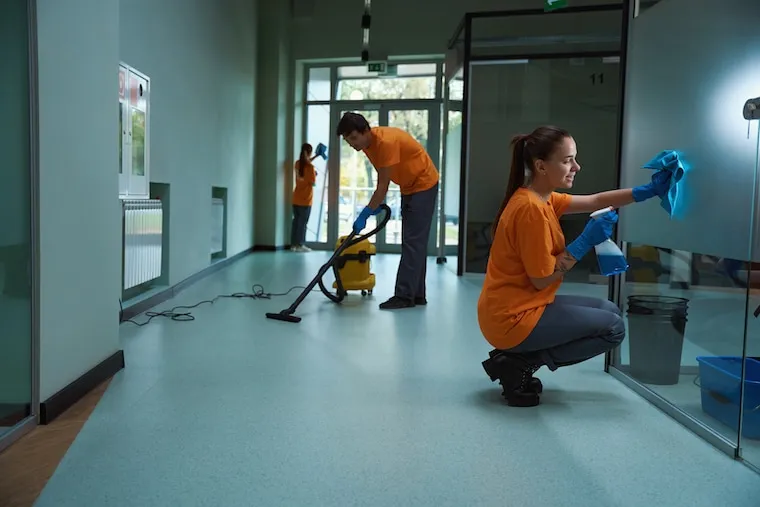
Janitorial is the quiet, recurring-revenue corner of the cleaning trade. You are not chasing one-off house cleans; you are after the office park that needs floors buffed five nights a week, the clinic that needs restrooms sanitized to a checklist, the school that signs an annual contract and pays net-30. Win three of those accounts and you have a book of business that bills whether or not your phone rang this morning. This is how to build one, what it costs, and where the money actually is.
Why janitorial is a different business from house cleaning
A house cleaner gets paid per visit. A janitorial operator signs a contract: fixed scope, fixed monthly price, set schedule, usually after-hours, for a year. You sell a facility manager on reliability, not a friendly face; you work at night, so you need keys and staff you trust; and because the revenue is contracted, the game is landing and keeping accounts, not chasing new leads. Pick a lane before you buy a mop, and keep your first three accounts in it so supplies, training, and pricing transfer: general office is the easy entry, medical pays more but demands bloodborne-pathogen handling, and schools and government mean bids and slow but rock-solid payment.
Register and insure before you touch a client’s keys
Form an LLC, not a sole proprietorship: it shields your personal assets from a slip-and-fall claim, and clients increasingly require it before signing. Expect $50 to $500 for state filing, a free EIN, and a local business license ($50 to $400 a year). Insurance is where janitorial differs hard from residential, because you work unsupervised in someone else’s building at night, and three coverages matter:
| Coverage | Typical annual cost | Why a janitorial client demands it |
|---|---|---|
| General liability ($1M) | $500 to $1,500 | Covers property damage and slip-and-fall; nearly every contract requires proof |
| Janitorial bond | $100 to $500 | Protects the client against theft by your staff inside their building |
| Workers’ comp | $1,500 to $4,000 per employee | Legally required once you hire in most states; floor work means real injury risk |
Most contracts name a minimum coverage figure and ask to be added as an “additional insured,” which is routine. The mistake is winning a contract you cannot legally service because you have not bound coverage, so get the certificate of insurance in hand first.
What to buy, and the one big-ticket decision
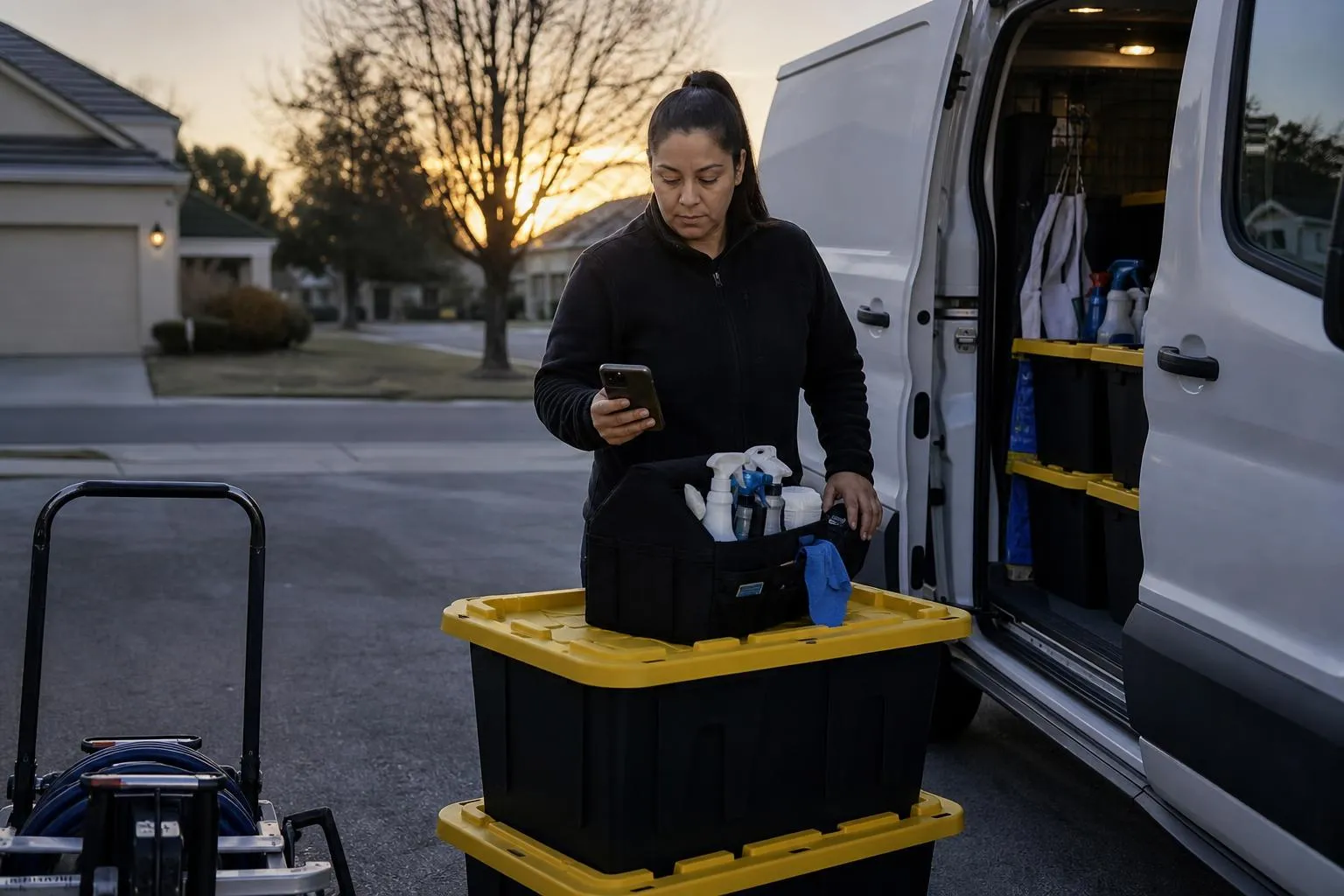
A workable starter kit runs $1,000 to $2,000 before any floor machine, cheap relative to the revenue it services:
- Commercial backpack vacuum (HEPA): $200 to $600, and it cleans an office floor roughly twice as fast as an upright.
- Color-coded microfiber system, mops and cloths and buckets: $150 to $400. Restroom cloths kept separate from desk cloths is basic infection control.
- Cart, caddies, wet-floor signs, and PPE: $150 to $300.
- Concentrated chemicals (neutral floor cleaner, disinfectant, glass, restroom acid): $100 to $300. Buy concentrate, not ready-to-use.
The big-ticket item, a floor machine, is the first real buy-versus-rent decision, and the equipment and supplies breakdown covers what is worth paying up for.
Buy the floor machine vs rent it
- A used walk-behind auto-scrubber runs $1,500 to $4,000 and pays for itself in 8 to 15 jobs versus renting at $80 to $150 a day.
- You can schedule strip-and-wax and deep scrubs on demand, often the highest-margin add-on you sell.
- The machine lives in your van, not behind a rental counter that is closed when you work nights.
Buy the floor machine vs rent it
- $1,500 to $4,000 is cash that could fund insurance and two months of supplies while you land accounts.
- A machine you use twice a month sits idle and still needs $100 to $300 in pad and squeegee upkeep a year.
- If your first contracts are carpet-only, a hard-floor scrubber earns nothing until you win a tile-heavy account.
The decision rule is rent until it is booked, not buy on faith: rent until you have a contract whose floor-care scope alone covers a monthly payment, then buy used.
Price by the square foot, then check it against your hours
Janitorial is priced by the square foot, because that is how facility managers compare bids. General office runs $0.05 to $0.20 per square foot per clean, driven by frequency, restroom count, and scope. The trap is bidding a rate without backing into cost, which is mostly labor: a trained cleaner covers 3,000 to 4,000 square feet per hour at $18 to $28 fully loaded (wage plus payroll tax, comp, supervision). Run the per-foot rate against the hours-times-cost number, and if both do not leave you 15 to 25 percent after supplies, you underbid.
Build a 3 to 5 percent annual escalator into the contract, and quote deep cleans and strip-and-wax separately, since those add-ons carry the fattest margins. Labor is also your biggest legal risk: classify night cleaners as 1099 to dodge payroll tax and, if you set their hours and supply the gear, the authorities will reclassify them as employees with brutal back taxes. Most janitorial staff are W-2; the hire and train staff guide covers onboarding and background checks.
Getting found: what good looks like, and where it gets hard
Getting found by facility managers quietly decides whether the business grows, and a good lead engine does three things: a website that earns a buyer’s trust in ten seconds, a Google Business Profile that ranks for “commercial cleaning near me,” and a steady drip of reviews. Two are free: claim your Google Business Profile, set “Commercial Cleaning Service” and “Janitorial Service” as categories, and ask every happy facility manager for a review the week after a clean walkthrough.
Where it gets hard, and high-stakes, is everything after those free pointers. A janitorial website has one job, converting a skeptical B2B buyer into a quote request, and most owner-built sites fail it: no proof of insurance, no client logos, a form nobody answers. Google Ads for “office cleaning bids” is a knife fight where wrong match types and a weak landing page burn a month’s budget for nothing, and a bad job is invisible until the phone goes silent. That is the work we do.
If your problem is the website that turns facility managers into quote requests, get a free video walkthrough. If it is the ads, search, and paid-social engine that feeds it, see our services. If you have an idea but no plan yet, start at expntl.com. For the free side of winning work, how to find cleaning contracts goes deeper.
Frequently asked questions
How much does it really cost to start a janitorial business?
Plan for $2,000 to $10,000. The low end is a solo operator with a starter kit, insurance, registration, and supplies in a vehicle you own; the high end adds a used floor machine, a payroll cleaner with comp, and a wrapped van.
Do I need a license to clean offices?
You need a general business license in almost every city, an LLC and EIN are strongly advised, and you must carry general liability plus a janitorial bond because clients require both before signing. Specialized facilities add rules, such as bloodborne-pathogen handling at medical sites and prevailing-wage clauses in some government contracts.
How do I price a janitorial contract?
Quote per square foot per clean (commonly $0.05 to $0.20 for general office), then check it against real labor: hours on site times fully loaded cost, plus supplies, plus a 15 to 25 percent margin. Quote deep cleans and floor care as separate line items, never bundled.
How many contracts do I need to make a living?
Fewer than you would think, because the revenue recurs. Three to five steady mid-size accounts can replace a full-time income at 10 to 25 percent net margins and bill every month without new sales effort. See how to grow a cleaning business for scaling past the first few.
Your move
Reading this does not book a job.
The owners who pull ahead are the ones who change one thing this week. If you want that one thing to be a website that sells and ads that put it in front of the right people, we build and run both for you.
Straight answer on whether we can help, usually the same day.