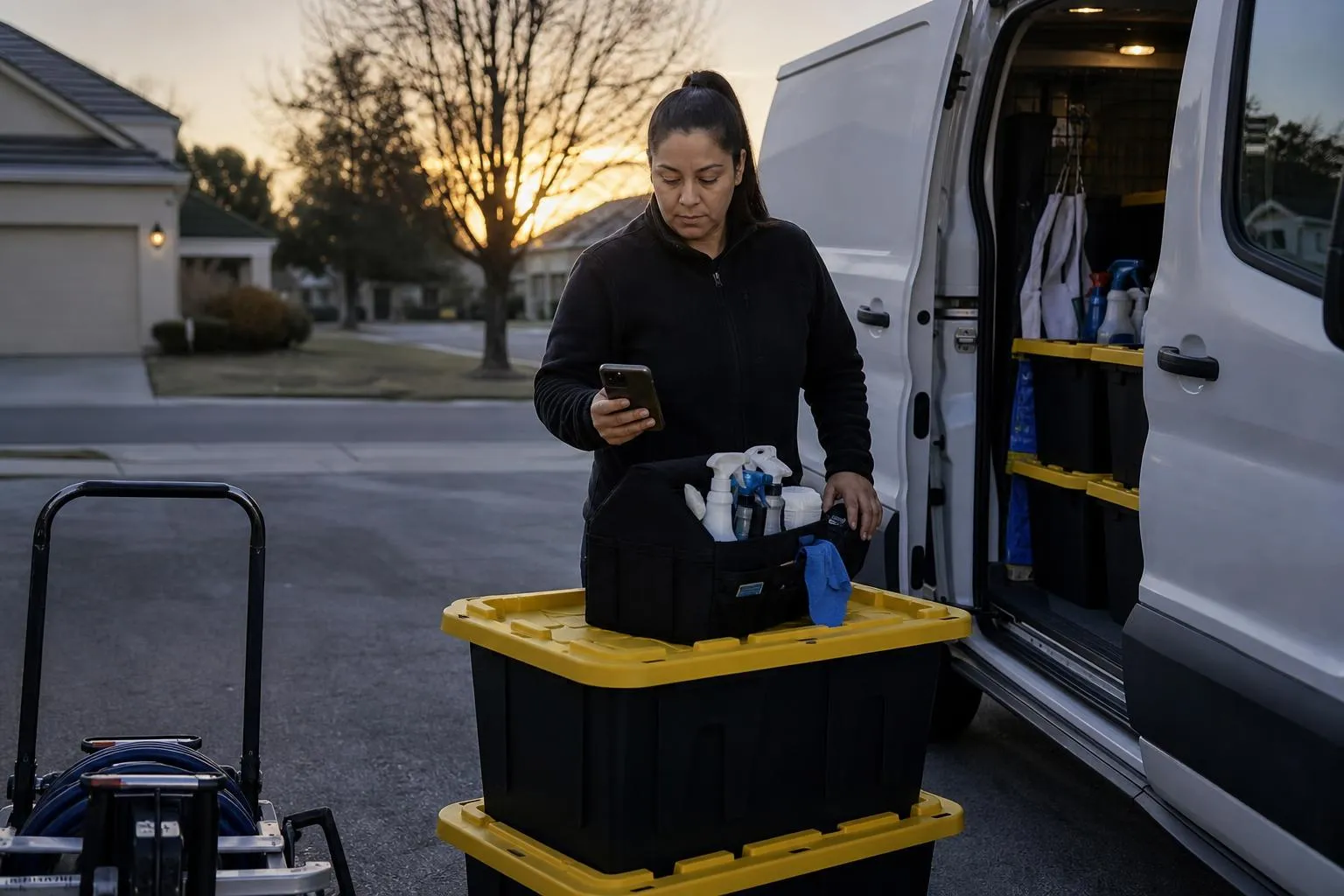
How to start an Airbnb cleaning business

Airbnb turnovers are the most predictable recurring work in cleaning. A host with one rental needs a turnover after every checkout, which can be twenty-plus cleans a month, and the booking calendar hands you the schedule. The catch is that this is hospitality, not housekeeping: a tight checkout window, a guest review riding on every clean, and a host who will drop you the first time a toilet is missed. Get the operation tight and a handful of hosts becomes a route that pays every week.
What an Airbnb turnover actually is
Short-term-rental cleaning sits between residential and commercial. The pay is per-turnover rather than hourly, and your real customer is often a property manager juggling ten to forty units, not the homeowner. That changes how you price, staff, and win the work.
A turnover is a full hotel-grade reset on a fixed deadline: strip and remake every bed with fresh linen, fully sanitize bathrooms, reset the kitchen including dishwasher and fridge, do floors and trash, restock consumables, and stage a clean finish for the listing photos. You usually have one window between an 11 a.m. checkout and a 3 p.m. check-in. A one-bed takes 1.5 to 2.5 hours; a three-bed runs 3 to 4. The skill that separates a turnover cleaner from a house cleaner is not scrubbing harder, it is finishing reliably inside that window every time. You also run a light property check on every visit, because a single hair on a pillow becomes a one-star review that costs the host bookings.
What it costs to start
This is one of the cheapest trades to enter, because the host already owns the property and usually the vacuum, mop, and on-site basics. You mostly buy linen and consumables.
| Item | Typical cost | Notes |
|---|---|---|
| Linen par stock (per bed) | $90 to $180 | 3 sets per bed: sheets, cases, towels |
| Supply caddy and chemicals | $80 to $150 | Disinfectant, glass cleaner, microfiber, gloves |
| Vacuum and mop (if not on-site) | $150 to $400 | Many hosts supply these; confirm per property |
| General liability insurance | $400 to $700 per year | Often required by property managers |
| Registration and LLC | $50 to $500 | Varies by state; sole prop is cheapest |
| Scheduling app | $0 to $50 per month | Turno, Breezeway, or a shared calendar |
All in, a solo operator launches for $500 to $2,500, and the biggest swing is linen. Hotel-style turnovers run on par stock, meaning three sets per bed: one on the bed, one clean in the closet, one in the wash. Skip par stock and a single delayed laundry load blows a checkout window, the one thing this business cannot do. For the full kit, see buying equipment and supplies for a cleaning business.
Registering, insuring, and the legal floor
You can clean your first unit as a sole proprietor, but two things push you to register fast. First, property managers, who control the bulk of multi-unit work, almost always require proof of general liability insurance and a registered business before they hand you keys. Second, liability is real: you are alone in someone’s furnished property with a guest’s belongings, and a flood or a theft accusation lands on you.
Get general liability insurance ($400 to $700 a year for a solo cleaner) and add janitorial bonding to win property-manager accounts, since bonding protects the client against theft. The moment you bring on one helper you cross into employer territory: workers’ compensation becomes legally required in most states, and misclassifying that helper as a contractor to dodge it is the most expensive mistake new owners make. The full walkthrough is in set up and register your cleaning business.
Pricing turnovers so the route pays
Turnovers price flat, not hourly. Hosts want a predictable per-clean number to fold into their nightly rate, and you want the upside of getting faster without getting paid less. Price by bedrooms and bathrooms, add for laundry volume, and build photo-staging into the base. Typical ranges run $75 to $120 for a one-bed, $120 to $180 for two to three beds, and $180 to $250-plus for larger homes, higher in premium markets.
Two rules keep the math honest. Set a minimum that covers your drive plus the clean, since a $75 turnover thirty minutes away loses money, and factor in laundering time, because linen is where turnovers quietly bleed hours. Tight same-day turns earn a premium.
The real money is route density. Eight to twelve units clustered in one neighborhood fills a solo week, while scattered units kill you on drive time, so concentrate on one area and one or two property managers rather than chasing single hosts across the city. See ideal locations for a cleaning business for picking that zone.
Staffing: do it yourself, hire, or subcontract
For the first 5 to 8 units, do the cleans yourself. You learn the checkout-window rhythm, set the quality bar, and keep all the margin. Past 8 to 10 units the calendar collisions force a decision, because checkouts cluster on the same days and you cannot be in three units between 11 and 3.
Hire W-2 cleaners
- You control quality, training, and the checklist, protecting you from the one-star review that loses an account.
- Schedules are yours, so you cover Friday-to-Sunday checkout clusters.
- Reliable employees become team leads and let you run 20-plus units.
Hire W-2 cleaners
- Payroll, workers’ comp, and taxes add 15 to 25% on wages.
- You carry the cost of slow weeks, since employees get paid whether bookings are up or down.
- Training a turnover-ready cleaner takes 2 to 4 weeks before you trust them with keys.
The decision rule is hire, not subcontract, once turnovers are recurring: subcontractors are fine for overflow and one-off deep cleans, but a host who depends on you week after week needs the control only employees give. For the onboarding system, see hire and train staff for a cleaning business.
Winning hosts and property managers
The fastest path to a full route is not single hosts, it is property managers and co-hosts who control ten to forty units each, so landing one fills half your week from a single relationship. Pitch them directly, lead with reliability and insurance rather than price, and offer a discounted or free first turnover so they can inspect your work risk-free. Single hosts are worth pitching too, through local host Facebook groups and turnover marketplaces like Turno. The full prospecting playbook is in how to find cleaning contracts.
Where most owners overreach is marketing. They teach themselves Google Ads, run their own paid social, and rebuild a website at midnight, and they lose money learning. The honest line: claim your Google Business Profile, fill it out fully, and ask every happy host for a review. That is free, it works, do it today. Beyond that, getting found is genuinely hard and high-stakes, because the gap between a tuned campaign and a leaky one is often a 2 to 3 times swing in cost per lead. If you want booked turnovers rather than a hobby, route the paid channels through our services.
Your website is the other half, and it is where most cleaning sites quietly leak. Good looks specific: a clear “request a quote” path, fast load, proof and reviews above the fold, and a form that converts a visitor into an inquiry. That last part is fiddly, technical work, which is why we build the site for you. If yours is doing anything less than turning visitors into booked jobs, get a free video walkthrough and we will show you where it leaks.
Frequently asked questions
How is Airbnb cleaning different from regular house cleaning?
It is closer to hotel housekeeping. You work to a fixed checkout-to-check-in deadline, remake every bed with fresh linen instead of tidying, restock consumables, stage the finish for photos, and inspect for damage. The host’s review score and revenue ride on every turnover.
How much can I charge per turnover?
Price flat by size, not by the hour: roughly $75 to $120 for a one-bed, $120 to $180 for two to three beds, and $180-plus for larger homes, higher in premium markets. Build in laundry and staging time, and set a minimum that covers your drive. The reliability premium is real: hosts pay more for a cleaner who never misses a checkout window.
Do I need insurance and a registered business to start?
To clean one unit for a friendly host, technically no, but register and insure before you scale. Property managers, who control most recurring work, almost always require general liability insurance and often bonding before they hand over keys. Going uninsured is the risk that ends the business in one incident.
How many properties do I need to go full-time?
Fewer than you would think. One active rental can produce 15 to 25 turnovers a month, so 8 to 12 clustered units fills a solo week. The constraint is rarely demand, it is drive time and the checkout-window crunch.
Your move
Reading this does not book a job.
The owners who pull ahead are the ones who change one thing this week. If you want that one thing to be a website that sells and ads that put it in front of the right people, we build and run both for you.
Straight answer on whether we can help, usually the same day.