How to successfully run a cleaning business

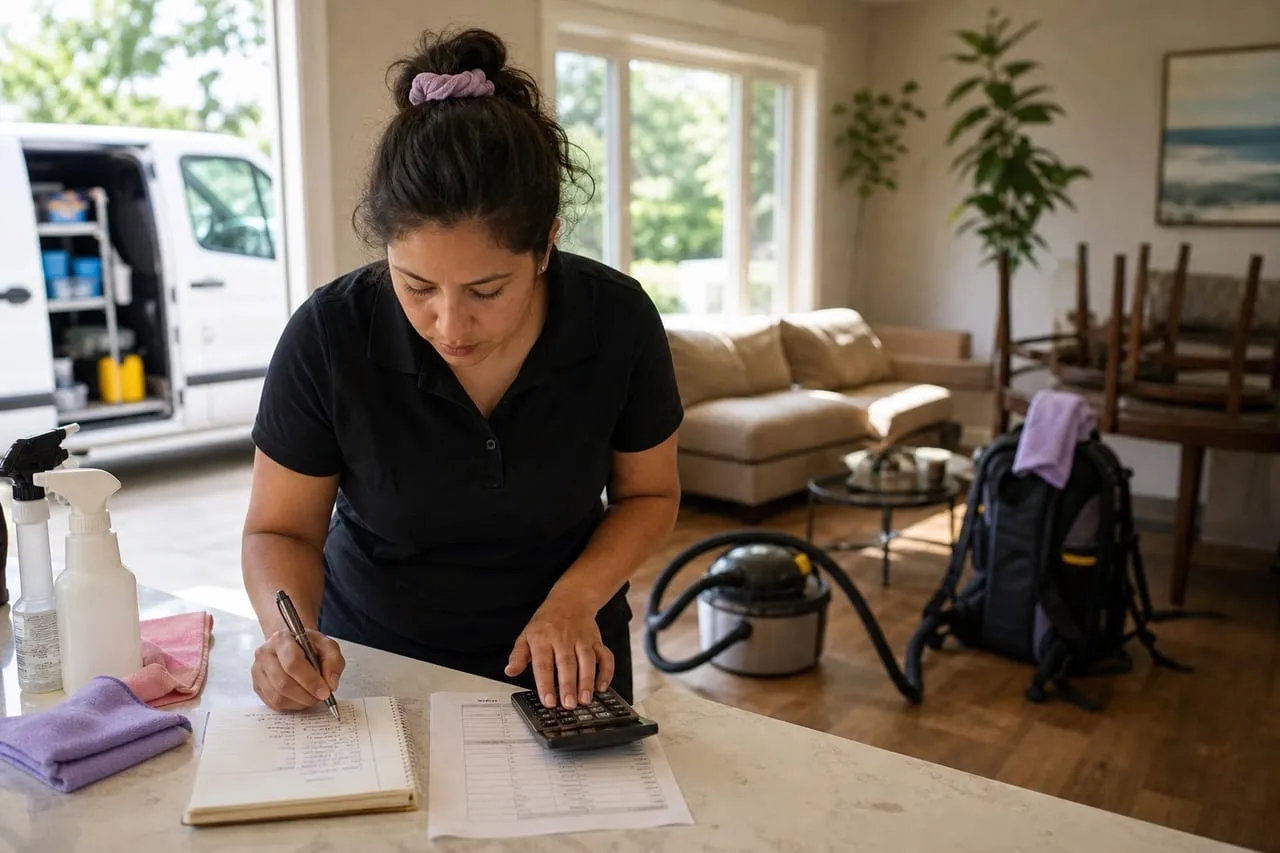
Most cleaning businesses do not fail because the cleaning is bad. They fail because the owner is brilliant on the job site and a mess everywhere else: jobs priced from a gut feeling, no idea which accounts actually make money, a schedule held together by text messages, and a phone that rings only when a customer is angry. Running a cleaning business well is mostly an operations problem, not a mopping problem. Get the boring parts tight and you can charge more, keep crews longer, and stop trading your evenings for paperwork.
Know your numbers before you scale anything
Growth hides problems. Double your jobs and you also double your bad pricing, your turnover, and your unbilled drive time. Before you chase more work, you need to know your true cost to deliver one hour of cleaning. Add up wages plus payroll taxes (typically another 10% to 15% on top of wage), supplies, vehicle and fuel, insurance, and a slice of your overhead. For most residential and small commercial operators that fully loaded cost lands somewhere around $20 to $30 per labor hour, which is why a crew billed at $40 to $60 an hour can still be thin once everything is counted.
The number that actually tells you whether a job is worth keeping is gross margin: revenue minus the direct cost of doing that specific job. Aim for 40% to 50%. Track it per account, not just for the whole business, because one ugly contract can quietly eat the profit from three good ones. For the full pricing logic, see cleaning business how much to charge and best prices for cleaning business.
Make recurring revenue the backbone
One-off move-out cleans and post-construction jobs pay well, but they reset your sales effort to zero every time. The businesses that feel calm and predictable are built on recurring contracts: weekly offices, biweekly homes, monthly commons. You want recurring work to be 60% to 80% of revenue so that each new month starts mostly full. Commercial and janitorial accounts are especially sticky once you are in, which is why so many operators graduate from homes into offices. See how to find cleaning contracts and how to grow cleaning business.
Price recurring work slightly below your one-off rate to win the commitment, but never below your margin floor. The trade is predictability for a small discount, not predictability for a loss.
Staff the work without bleeding margin
Labor is both your product and your biggest cost, usually 25% to 40% of revenue. The two levers that matter are how you classify workers and how long you keep them. Misclassifying employees as 1099 contractors to dodge payroll tax is one of the fastest ways to get hit with back taxes and penalties, because cleaners you schedule, train, and supervise almost always fail the legal test for contractor status.
W-2 employees vs subcontractors
- You control schedule, methods, and quality standards, which protects your brand on every visit
- Lower turnover when you offer $2 to $4 above local minimum plus simple bonuses
- One blended insurance and training program instead of vetting each contractor
W-2 employees vs subcontractors
- Payroll taxes and workers comp add roughly 12% to 20% on top of wages
- You carry the cost of downtime, no-shows, and PTO
- More admin: onboarding, tax filings, and compliance you cannot skip
The decision rule is W-2, not 1099: if you set the schedule and the standard, hire employees and price the overhead in. Build a simple checklist-based training system so quality does not depend on one star cleaner. The full playbook is in hire and train staff for cleaning business.
Run operations on systems, not memory
The difference between a $100k owner-operator and a $1M company is almost never talent. It is systems. Once you pass a few crews, a shared calendar and a notebook stop working and start costing you jobs. Field-service software (Jobber, Housecall Pro, ZenMaid and similar) typically runs $50 to $200 a month and handles scheduling, route optimization, automatic invoicing, and payment collection. The first time it stops a double-booking or auto-chases an overdue invoice, it has paid for itself.
| Operations area | Run it on | Typical monthly cost | What it saves you |
|---|---|---|---|
| Scheduling and dispatch | Field-service app | $50 to $200 | Double-bookings, missed visits |
| Invoicing and payments | Same app or QuickBooks | $30 to $90 | 2 to 4 weeks of late payments |
| Supplies and inventory | Par-level checklist | Near zero | Emergency store runs, overbuying |
| Quality control | Photo + checklist per visit | Included | Callbacks and lost accounts |
Tighten supply spend with par levels: every vehicle carries a set quantity, and you only reorder to that number. It keeps cash off the shelf and stops the panic mid-route restock. See buying equipment and supplies for cleaning business.
Get found without doing our job for us
Here is the honest part. You can run flawless operations and still starve if nobody local can find and trust you fast. Good lead generation for a cleaning business looks like this: you show up in the local map results when someone searches “house cleaning near me,” your reviews are recent and plentiful, your site loads in under three seconds on a phone, and a visitor can request a quote in one tap. When that machine works, the same number of searches turns into far more booked jobs.
The reason this is high-stakes is that the mistakes are invisible and expensive. A slow page, a quote form that asks fifteen questions, ad spend pointed at the wrong keywords, or a Google Business Profile that is unclaimed: each one quietly leaks money every single day, and you will not see it in any report you know to look at. This is a different trade from cleaning, and doing it badly costs more than not doing it at all.
The few things that are genuinely free and worth doing yourself: claim and fully fill out your Google Business Profile, and ask every happy customer for a review the day the job is done. Beyond that, getting the website and the campaigns right is exactly the work we do, so you stay on the job site. For how the channels stack up, see digital marketing for cleaning business and promote cleaning business locally.
If your site is the bottleneck, get a free video walkthrough. For ads, SEO, and paid social handled for you, see our services. And if you have a bigger idea that needs a plan, start at expntl.com.
Frequently asked questions
What is the single most important number to track?
Gross margin per account, not total revenue. Revenue tells you how busy you are; margin tells you whether being busy is worth it. Check it monthly and you will spot the accounts quietly losing you money long before they sink the business.
Should I hire employees or use subcontractors?
If you set the schedule, the methods, and the quality standard, hire W-2 employees. Cleaners you direct that closely almost always fail the legal test for contractor status, and misclassification means back taxes and penalties. Price the extra 12% to 20% in payroll cost into your rates rather than dodging it.
How much of my revenue should be recurring?
Aim for 60% to 80%. Recurring contracts mean each month starts mostly booked instead of resetting your sales effort to zero. One-off jobs are great margin boosters on top, but they should not be the foundation you depend on.
When is the right time to buy scheduling software?
The moment you run more than one crew or find yourself rescheduling by text message. At $50 to $200 a month it pays for itself the first time it prevents a double-booking or auto-collects a late invoice. Waiting until chaos forces your hand usually means you have already lost a customer or two.
Why not just build my own website and run my own ads?
You can claim your Google Business Profile and gather reviews yourself, and you should. But websites and paid campaigns are a separate trade where the costly mistakes are invisible, like a slow page or misaimed ad spend leaking money daily. That is the work we do so you can stay on the job. Get a free video walkthrough or see our services.