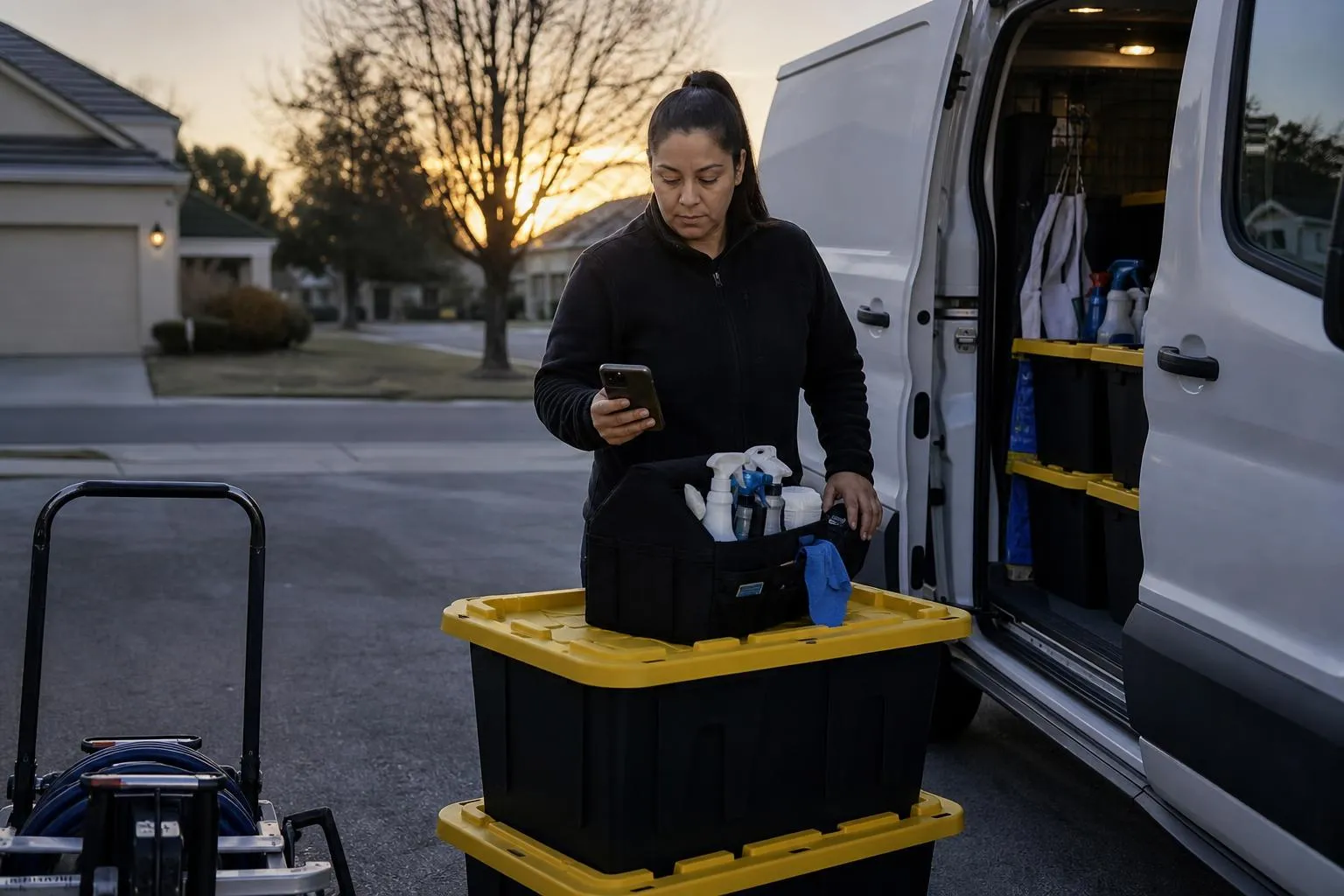
Cleaning business how much to charge

Most new cleaners pick a number that sounds fair, lose money on half their jobs, and never figure out why. Pricing a cleaning business is not about being cheap or premium. It is arithmetic: your hourly cost to be in business, plus the margin that pays you, divided across the time a job actually takes. Get that right and a $35 house clean and a $0.12-per-square-foot office contract become the same decision.
Know your cost floor before you quote a single job
Every price decision starts with one number: what it costs to put a cleaner on a site for one hour. Skip it and you are guessing.
Start with the wage. If you pay $18 an hour, that is not your cost. Add payroll tax, workers’ comp, and paid time, and loaded labor is closer to $22 to $26. Now add the per-hour share of everything else: supplies and consumables (microfiber, pads, chemicals, refills) at $1.50 to $3; equipment wear on vacuums, mops, and a cart at $0.50 to $1.50; vehicle and fuel at $2 to $4; and the overhead almost nobody counts, insurance, software, phone, and your own admin time, another $3 to $6.
Stack those and the typical owner-operator floor lands between $18 and $28 per cleaner-hour. That is break-even, and anything below it loses money on every visit.
What matters is the gap. If your loaded cost is $24 and you bill an effective $45, that $21 is where your salary, taxes, and slow weeks all come from. For how that gap becomes take-home across a year, see how much profit a cleaning business can make.
Pick a pricing model: hourly, flat-rate, or per square foot
Three models cover almost every job, and using the wrong one is how good cleaners end up underpaid.
Hourly is right when scope is unknown: first-time deep cleans, post-construction, and “not sure how bad it is” jobs, because a flat quote on an unknown is a coin flip you usually lose. Residential hourly runs $25 to $50 per cleaner. Flat-rate per job is right for anything repeatable: you quote one number, and getting faster goes into your pocket instead of being clawed back by a shrinking invoice. The catch is you must time real jobs first.
Per square foot is the commercial standard: offices, retail, and medical at $0.10 to $0.30 per square foot per visit, the rate falling as square footage rises and climbing for regulated spaces. A 4,000-square-foot office at $0.13 is $520; the same building at $0.20 because it is a dental suite is $800. For the commercial playbook, see starting a commercial cleaning business.
| Model | Typical range | Best for | Main risk |
|---|---|---|---|
| Hourly | $25 to $50 per cleaner-hour | First-time, unknown-scope jobs | Penalizes you for working faster |
| Flat-rate per job | $120 to $250 per standard house | Repeat residential, recurring | Underquoting before you have timed jobs |
| Per square foot | $0.10 to $0.30 per sq ft | Offices, retail, medical | Forgetting detail level changes the rate |
| Deep clean / move-out | 1.5x to 2x standard | One-time intensive | Callback risk if scope is vague |
The thread running through the table: match the model to how much you know. Known and repeatable goes flat-rate, unknown goes hourly until you time it, and big and recurring goes per square foot. For benchmark numbers by service type, best prices for a cleaning business digs in.
Price deep cleans, move-outs, and add-ons for what they cost
Standard recurring work is your bread and butter, but the money is made or lost on the intensive jobs, where time blows out and callbacks live. Deep cleans, first-time cleans, and move-out turnovers should bill at 1.5x to 2x standard. A move-out with baseboards, inside cabinets, oven, and fridge can take three times a maintenance clean, and the client is often a landlord or tenant chasing a deposit, so the standard is unforgiving. Price it like the project it is. Add-ons belong on a published line-item menu, not a free favor: inside-oven, inside-fridge, interior windows, and wall washing each carry a fixed surcharge ($25 to $75 is typical), so “can you also do the oven?” becomes revenue instead of an unpaid half hour. Skip the menu and you absorb scope creep on nearly every job.
There is also a floor below which a job is not worth taking. A minimum charge, commonly $80 to $150, protects you from the small condo that eats ninety minutes once you count parking and setup, the job that quietly becomes your least profitable.
Decide W-2 employees vs subcontractors before it sets your prices
How you staff the work changes your cost floor, your insurance, and your legal exposure, so it belongs in the pricing conversation.
W-2 employees vs subcontractors
- You control schedule, methods, and quality, which protects the flat-rate margins your pricing depends on.
- One trained, reliable crew cuts callbacks, and a callback can erase the profit on three good jobs.
- Clean classification means clean insurance and tax, the foundation commercial contracts check before they sign.
W-2 employees vs subcontractors
- Loaded labor cost runs 15 to 30% above the raw wage once payroll tax and workers’ comp are in.
- You carry payroll in slow weeks whether the calendar is full or not.
- More admin: onboarding, scheduling, and compliance all land on you or paid software.
The decision rule is employees, not subcontractors, the moment you control how the work is done: if you set the schedule, supply the products, and dictate the method, the law in most states already treats them as employees, and misclassifying to dodge payroll tax is a bet against back taxes and a denied claim. Onboard them properly with hiring and training staff for a cleaning business.
Where pricing meets getting found
Correct pricing only pays off if the phone rings. The free pieces are genuinely free: claim and complete your Google Business Profile, get every happy customer to leave a review (recent reviews are what local clients actually read), and keep your price tiers clear so shoppers self-qualify before they call.
The hard part is the website and the paid channels that feed it, and they are high-stakes because a cleaning lead is worth hundreds in lifetime recurring revenue and a weak page wastes every click. A good cleaning website is a measurable discipline, not a design opinion: it loads in under three seconds, puts a tap-to-call and instant-quote button in thumb’s reach on mobile, names your service area above the fold, shows real reviews, and is built to turn a visitor into a booked clean rather than just look tidy. Getting it wrong is expensive in a way that never shows up on an invoice: you never see the leads you lost, you just see a thin calendar and blame the season. We build cleaning websites engineered around that one job. Get a free video walkthrough.
The same logic applies to the ads, SEO, and paid social that feed that page. Learning those on your own ad budget is the expensive way; for the full lead engine, see our services. And if you have a bigger idea than one cleaning business, start there first.
Frequently asked questions
How much should I charge for a one-time house cleaning?
For an unknown first-time job, bill hourly so a rough house does not sink you, commonly $25 to $50 per cleaner-hour depending on market and condition. Once you have timed similar homes, switch to a flat per-job quote so your speed becomes profit. Always apply a minimum charge, often $80 to $150, so small jobs do not lose money on drive time alone.
What is a typical price for weekly recurring service?
Weekly maintenance cleans usually run $75 to $200 per visit depending on home size, thoroughness, and local cost of living. Recurring clients are worth far more than the per-visit number because they remove your biggest cost, the constant hunt for new jobs. Price recurring slightly below your one-time rate as a loyalty trade, but never below your floor.
How do I price commercial and office cleaning?
Commercial is usually priced per square foot, typically $0.10 to $0.30 per visit, the rate dropping as the building grows and rising for medical or regulated spaces. Always walk the site before quoting, because floor type, restroom count, and frequency change the time more than raw square footage does. Bid annually with a 30 to 60 day cancellation clause so a lowball competitor cannot poach the contract mid-year.
Should I publish my prices or quote each job?
Publish ranges or starting-at tiers so shoppers self-qualify and you stop wasting time on calls that were never going to book, then quote the exact number after you understand the scope. Hiding pricing entirely makes a cleaning shopper assume the worst and call a competitor who showed theirs. Clear tier ranges do the filtering for you before the phone rings.
Your move
Reading this does not book a job.
The owners who pull ahead are the ones who change one thing this week. If you want that one thing to be a website that sells and ads that put it in front of the right people, we build and run both for you.
Straight answer on whether we can help, usually the same day.