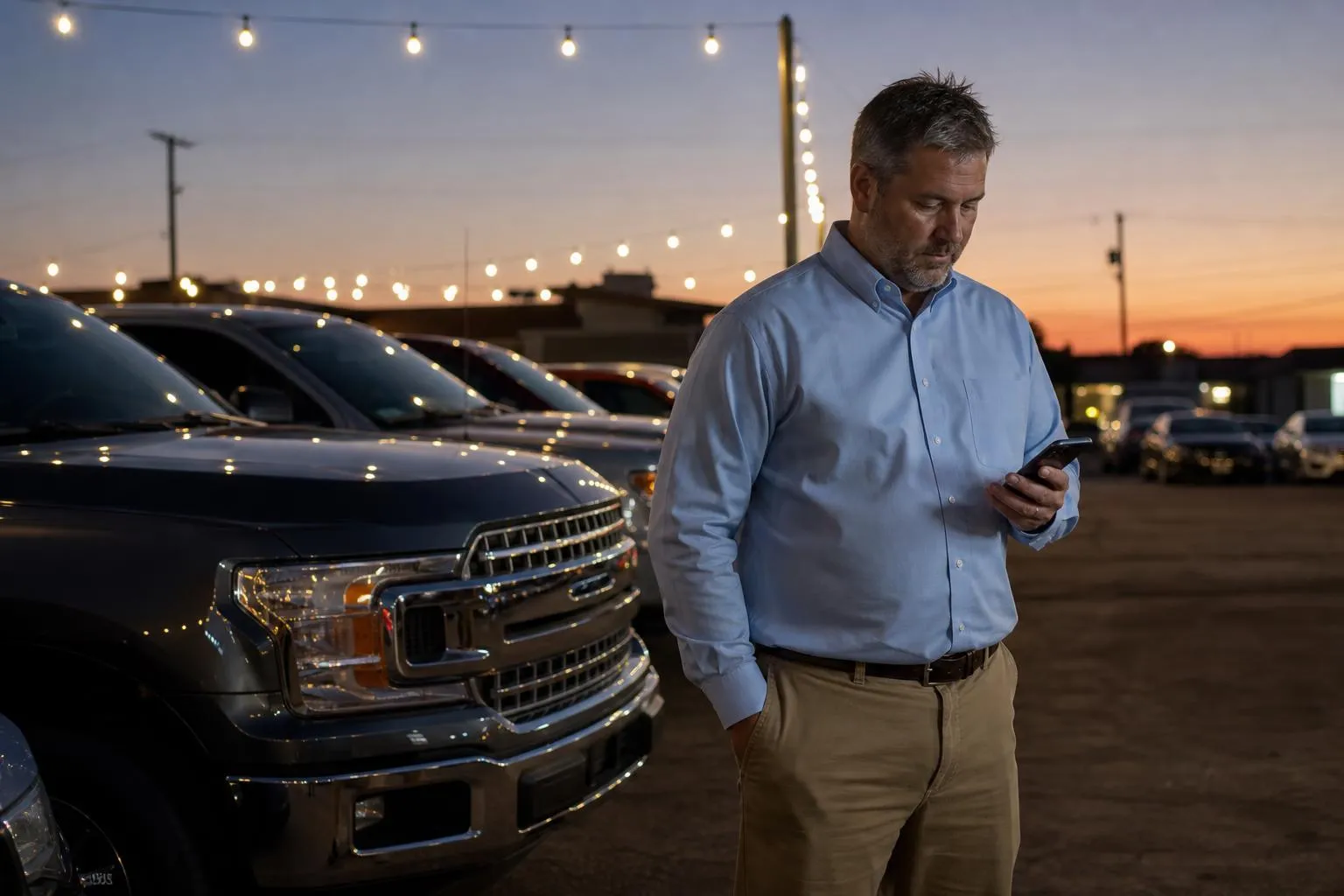
How to promote car dealership on Youtube

The dealer who wins on YouTube is not the one with the slick 60-second brand film scored to stock music. It is the one who walks out to the lot with a phone and films an honest three-minute walkaround of the actual 2018 Silverado sitting on it, dents and all. Car buyers do not want your commercial; they want to see the specific truck before they drive an hour to look at it, and they want to trust the person selling it. YouTube is the one platform that does both jobs at once, and it does them for years after you hit publish. Here is how to use it like an operator, not an ad agency.
Walkaround videos are the whole strategy
Forget the brand film. The video that sells cars is a walkaround of one specific unit you have in stock: start outside, walk the body pointing out condition honestly, open the doors, show the interior and the odometer, start it up, and end with the price and a “call the lot, ask for me.” Three to five minutes, shot on a phone with a $150 to $250 gimbal and a $30 lav mic. Do one for every car worth over $10k on the lot.
Two things make this work. First, honesty. Show the curb rash on the wheel and the buyer trusts everything else you say, which is the entire game in used cars. Second, the video does double duty: it lives on YouTube where searchers find it, and it embeds on your vehicle detail page where it keeps shoppers on the listing longer and pushes them toward a call.
Rank for the research buyers do before they shop
Here is what most dealers miss: YouTube is the second-largest search engine on earth, and car buyers use it to research long before they hit a lot. Someone deciding between a used Highlander and a Pilot types “2019 Toyota Highlander review” into YouTube and watches for twenty minutes. If your video is a genuinely useful walkaround-and-review of that exact model, you are in front of a buyer at the precise moment they are choosing what to buy.
So title and structure for search intent: “2019 Toyota Highlander XLE Review, Walkaround and Common Problems, [Your City].” Fill the description with the specs, the price, a link to the listing, and your phone number. Add chapters. This content ranks and keeps working for years, unlike a paid click that dies the second the budget stops. It pairs naturally with your local promotion efforts.
Set the channel up so it works, not so it is pretty
Brand the channel with your logo, a banner showing your lot and hours, and a clear “about” section with your address and phone. But do not sink weeks into channel polish; the videos do the work, not the wallpaper. Organize into playlists (SUVs, Trucks, Under $15k, Customer Deliveries) so a browser who likes one walkaround falls into three more.
The one production rule that matters: audio over video. Buyers forgive shaky footage but they click away from bad sound instantly, so the $30 mic matters more than the camera. Post consistently, a couple of walkarounds a week beats a burst of ten then silence.
| Video type | Job | Effort | Shelf life |
|---|---|---|---|
| Per-car walkaround | Sell that specific unit, embed on VDP | 30 min/car | Until the car sells |
| Model review/comparison | Rank in search, catch researching buyers | 1 to 2 hrs | Years |
| Customer delivery/testimonial | Build trust, social proof | 15 min | Years |
| Financing/buy-here-pay-here explainer | Answer the question that stalls the sale | 1 hr | Years |
That leads to a real choice: film the walkarounds yourself with your salesperson on camera, or hire a videographer to shoot them.
Salesperson films it vs hired videographer
- The salesperson on camera is the person the buyer will actually meet, which builds real trust.
- You can film a new arrival the day it hits the lot, so inventory videos never lag.
- Near-zero marginal cost, so every car worth over $10k gets its own video.
Salesperson films it vs hired videographer
- A pro delivers cleaner footage, lighting, and editing that looks more polished.
- It frees your salesperson to sell instead of filming and editing.
- But polish rarely sells more cars than authenticity, and a videographer you book weekly is a real recurring cost for a marginal gain.
For almost every small lot, the salesperson-filmed walkaround wins on trust, speed, and cost; save the hired pro for a one-time lot-tour or an about-us video, not the daily inventory grind.
Layer in cheap in-market video ads
Once you have a library, YouTube ads are remarkably cheap attention. Google’s in-market-for-autos audiences let you show a 15 to 30 second version of your best walkaround, or a quick lot-tour spot, to people actively shopping for a vehicle in your area, often for $0.02 to $0.10 per view. That is a fraction of what a search click costs, and it warms up buyers before they ever search your name. Keep the targeting tight to your metro so you are not paying for views three states away. The paid mechanics overlap with running Google Ads, since both run through Google’s platform.
Getting the video-to-sale path built is where it pays off
The camera work is genuinely DIY, and you should start today: film honest walkarounds of your slowest cars, title them for search, and post consistently. That alone puts you ahead of most lots. The Instagram and TikTok playbooks show how to cut the same footage into short-form clips.
Where it gets high-stakes is the path from video to booked appointment: the walkaround has to embed on a fast inventory site with a click-to-call button, or the warm YouTube viewer lands somewhere clunky and leaves. The video and the site have to work as one system. That is the part we do. To have the inventory site built so video actually converts, get a free video walkthrough. For YouTube, Google, and paid social management, see our services. If the lot is still a plan, start at expntl.com.
Frequently asked questions
Do I need expensive gear to make YouTube videos for my dealership?
No, and expensive gear often hurts more than it helps because it delays you. A modern phone, a $150 to $250 gimbal for smooth footage, and a $30 clip-on mic for clean audio is all you need to film honest walkarounds that sell cars. Buyers care about seeing the actual vehicle and trusting the person, not cinematic production, so spend the money on consistency, not a camera.
What kind of videos actually sell cars on YouTube?
Two kinds. Per-car walkarounds of specific in-stock vehicles sell that unit and embed on its listing to lift conversion, and honest model reviews or comparisons rank in search and catch buyers researching what to buy. Both beat brand films because they are useful and specific. Add customer-delivery clips for social proof, and skip the glossy commercial nobody searches for.
How is YouTube different from running Facebook or Google Ads?
YouTube plays two roles at once: it is a search engine where your videos rank for free for years, and a cheap video ad platform. Google Ads catches buyers actively searching to buy now, and Facebook and Marketplace drive local volume and retargeting. YouTube’s edge is trust and research: it reaches buyers earlier, when they are still deciding what car to get, and it builds credibility no text ad can.
How often should I post to my dealership’s YouTube channel?
Aim for two or three videos a week, mostly per-car walkarounds of new arrivals or slow movers, with the occasional model review. Consistency beats intensity, because YouTube rewards channels that publish steadily and buyers reward lots that clearly have fresh inventory. A burst of ten videos followed by months of silence signals an abandoned channel and stops ranking.
Can YouTube videos help my cars rank on Google too?
Yes. YouTube is owned by Google, and video results frequently show up in regular Google searches, so a well-titled walkaround-review can appear when someone Googles that model in your area. Embedding the video on your vehicle detail page also keeps visitors on the listing longer, which helps that page’s own search performance. One honest walkaround can work for you on YouTube, in Google video results, and on your own site at the same time.
Your move
Reading this does not book a job.
The owners who pull ahead are the ones who change one thing this week. If you want that one thing to be a website that sells and ads that put it in front of the right people, we build and run both for you.
Straight answer on whether we can help, usually the same day.