Setting the Best Prices and Billing for a Baking Business
Most bakers price by feel, glancing at what the shop down the street charges and shaving a dollar off to feel competitive. That is how you end up working 60-hour weeks to lose money on every wedding cake. Price is not a popularity contest with your neighbor; it is a math problem where your ingredients, your labor, and your overhead all have to come out on the right side. Get the formula right once and every order after that pays you. Here is the math bakers who actually clear a profit use.
Cost the recipe to the penny before you price anything
You cannot price what you have not costed. Take one recipe, weigh every ingredient it uses, and divide each bulk price down to the amount in the batch. Flour at $18 for a 25-pound bag is $0.72 a pound; if a batch of 24 cookies uses two pounds, that is $1.44 in flour. Add butter, sugar, eggs, vanilla, chocolate, and the paper liner, and you get a true batch cost. Divide by yield and you have the food cost per unit. Do this for every product, once, in a spreadsheet, and never guess again.
The number bakers forget is the stuff that is not in the recipe: the parchment, the box, the ribbon, the propane for the oven, the plastic dome. These “packaging and consumables” add 5% to 15% on top of ingredient cost and quietly turn a “profitable” item into a break-even one. If you are still buying supplies, buying equipment and supplies for a baking business covers where the recurring costs hide.
Use the food-cost formula, then sanity-check against the market
Once you know food cost per unit, the price falls out of one division: divide cost by your target food-cost percentage. A cupcake with $0.90 of ingredients at a 28% target prices at $0.90 / 0.28 = $3.21, round to $3.25. That price already builds in room for labor, rent, and profit, because ingredients are only 28% of it. Then, and only then, glance at competitors: if the market clearly bears $4, take the extra 75 cents; if nobody nearby breaks $3, tighten your costs rather than dropping below your formula.
| Item | Ingredient cost | Target food cost % | Formula price | Typical retail |
|---|---|---|---|---|
| Standard cupcake | $0.90 | 28% | $3.21 | $3.00-$4.00 |
| Croissant | $0.65 | 25% | $2.60 | $3.50-$5.00 |
| Loaf of sourdough | $1.80 | 30% | $6.00 | $7.00-$10.00 |
| Dozen cookies | $2.40 | 30% | $8.00 | $12.00-$18.00 |
| 8” layer cake (base) | $9.00 | 30% | $30.00 | $45.00-$75.00 |
Notice the formula price is usually the floor, and the market often bears more. That gap is your margin cushion, and giving it away by underpricing is the single most common way home bakers stay broke. The bigger-picture view of where the money actually lands is in how much profit a baking business can make.
Price custom orders by the hour, because that is what you are selling
Custom and celebration cakes are not products, they are labor with some flour attached. Use whichever of two methods gives the higher number. Method one: materials cost times 3 to 4. Method two: your hourly rate ($25 to $40 for a skilled decorator) times hours, plus ingredient cost, plus a delivery and setup fee if you transport it. For a wedding cake with $40 materials and 10 hours of work, method two gives $40 + (10 x $30) = $340, and that is the number that actually pays you. Always charge the higher of the two.
Build a simple tiered price list so you are not re-quoting from scratch every time: a base price per serving ($4 to $8 for buttercream, $6 to $12 for fondant or intricate work), plus add-ons for sugar flowers, hand-painting, and multiple tiers. Serving-based pricing is how the professionals quote, and it makes you look like one.
Wholesale is a different price entirely, so run the batch math first
Selling to cafes, grocers, and restaurants is a volume game at a thinner margin. Wholesale price is typically 50% of your retail price, because the cafe needs to mark it up to their own retail. A scone you sell for $4 at your counter goes to the cafe at around $2. That only works if your cost per unit at batch scale supports it: at a 30% food cost, that $2 wholesale scone can cost no more than about $0.60 in ingredients and packaging. If it costs $1, wholesale loses money on every unit and no amount of volume fixes it.
Wholesale earns its lower margin through predictability: standing weekly orders, no walk-in staffing, and production you can batch efficiently. Retail earns higher margin but demands foot traffic, a case that looks full, and waste from unsold goods at close.
Wholesale to cafes and grocers
- Predictable standing orders let you batch-produce and plan flour buys weeks ahead.
- No retail staffing, no storefront rent, no display case to keep looking full.
- One good grocery account can be $2,000 to $8,000 a month in steady, boring revenue.
Wholesale to cafes and grocers
- Margin is roughly half of retail, so a bad batch cost turns the whole account into a loss.
- The buyer can drop you or squeeze your price, and losing one account can gut a month.
- Delivery, invoicing, and net-30 terms mean you are financing their inventory for a month.
Bill it right: deposits, cards, and invoices that get paid
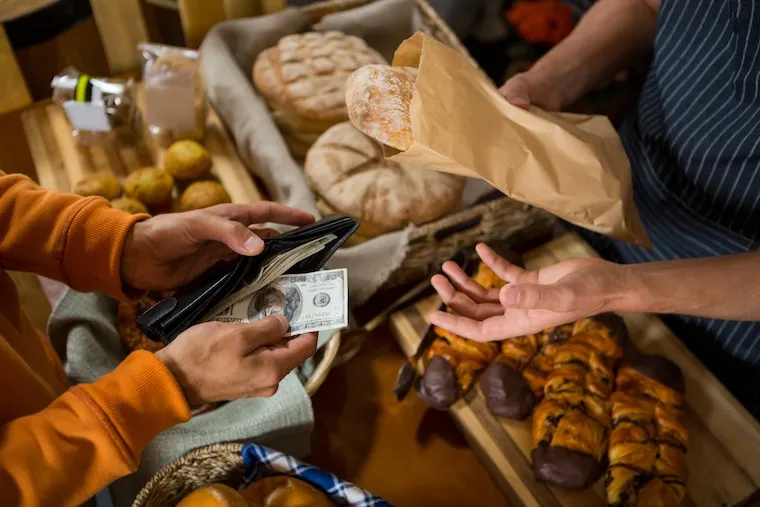
The billing system is where custom-order bakers lose money they already earned. Two rules protect you. First, take a non-refundable deposit of 50% on any custom order, due at booking, with the balance due at pickup or before delivery. A no-show on a $340 wedding cake with no deposit is a $340 hole plus wasted ingredients; a 50% deposit turns that into a covered loss. Second, take card payments and stop chasing cash. The 2.6% to 3% processor fee (Square, Stripe, Toast) is trivial next to the orders you lose by being cash-only and the bad checks you eat.
Use real tools: Square or Toast for the point of sale, Square Invoices or QuickBooks for custom-order invoices with the deposit built in, and a written contract for weddings that states the deposit is non-refundable and the design is locked two weeks out. For accounting, QuickBooks or Wave keeps your food-cost tracking honest and your taxes sane. The margin discipline this creates is the same discipline that makes the whole operation work, covered more broadly in how to successfully run a baking business.
Getting found is the part that decides everything
Perfect pricing does nothing if nobody sees your order form. Two free steps today: complete your Google Business Profile with photos of your actual products and current prices in the description, and put a plain, current price list where customers can find it, because “DM for price” kills more orders than any number ever will. People who have to ask usually just scroll on.
Then the part that quietly decides whether good pricing turns into revenue: the website and its order flow. A bakery site should load in under three seconds on a phone, show your price list and a working order-and-deposit button above the fold, and take the 50% deposit online so a booking is a real commitment, not a maybe. The gap between an order page that converts and a pretty one that leaks customers is invisible until you compare the numbers. That is the work we do; to have it handled, get a free video walkthrough. For local SEO and ads that fill your order calendar, see our services. If you have the recipes but not the business plan, start at expntl.com.
Frequently asked questions
How do I set the right price for my baked goods?
Cost the recipe to the penny, then divide that cost by a target food-cost percentage of 25% to 33%. A cookie costing $0.20 in ingredients at a 30% target prices at about $0.67, so a dozen lands near $8. That formula bakes in room for labor and overhead, unlike a flat “double the ingredients” markup, which usually loses money.
How much should I charge for a custom cake?
Use the higher of two numbers: materials cost times 3 to 4, or your hourly decorating rate ($25 to $40) times hours plus ingredients. A cake with $40 of materials and 10 hours of work should be around $340, not $120. Serving-based pricing ($4 to $8 for buttercream, $6 to $12 for fondant) makes quoting fast and consistent.
Should I take wholesale orders from cafes and grocers?
Only if your cost per unit at batch scale supports selling at roughly half your retail price. Wholesale trades margin for predictable standing orders and no retail staffing, which is great if your batch food cost is low, and a slow bleed if it is not. Run the batch math before you agree to a standing order.
Do I really need to take deposits on orders?
Yes, a 50% non-refundable deposit at booking, or you are financing every customer’s risk yourself. A no-show on a $340 custom cake with no deposit is a total loss plus wasted ingredients, while a deposit turns it into a covered one. Put the non-refundable term in writing for weddings and large events.
What billing tools should a small bakery use?
Square or Toast for point of sale, Square Invoices or QuickBooks for custom-order invoices with deposits built in, and Wave or QuickBooks for accounting and food-cost tracking. Accept cards despite the roughly 3% fee, because being cash-only costs you more in lost orders and bad checks than the processor ever will.
Your move
Reading this does not book a job.
The owners who pull ahead are the ones who change one thing this week. If you want that one thing to be a website that sells and ads that put it in front of the right people, we build and run both for you.
Straight answer on whether we can help, usually the same day.