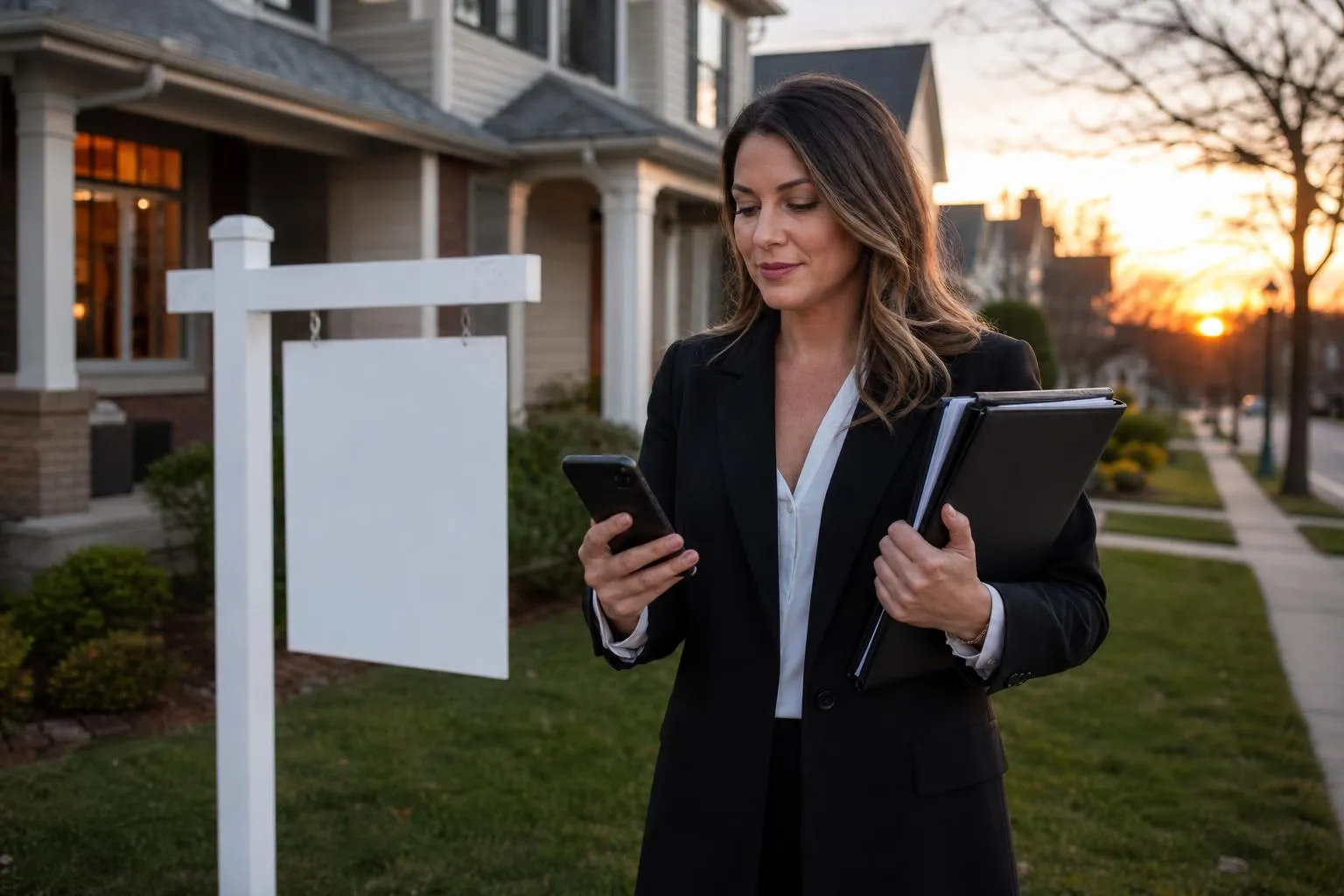
Start real estate agency with no money and for free

“No money” is mostly a myth in this trade, and that is the good news. A real estate agency is one of the cheapest service businesses on earth to start, because your inventory is other people’s houses and your main asset is a license you carry in your pocket. The real cost is the few hundred dollars in licensing and the dry months before commissions land. Get those two things right and you can open the doors for under a thousand dollars.
Where the money actually goes (and where it does not)
Forget the idea that real estate takes a big bankroll. It does not. What it takes is enough runway to survive the lag between starting work and getting paid, because in this business you can do six weeks of full-time work before a single dollar arrives at closing. That lag, not equipment, is what kills undercapitalized agents.
Here is the honest startup math for a solo agent hanging a license under a broker.
| Line item | Typical range | Notes |
|---|---|---|
| Pre-license course | $200 to $700 | Online self-paced is cheapest |
| State exam + license fee | $150 to $500 | One-time, varies by state |
| Local board / Realtor dues | $200 to $700 / year | Required for most MLS access |
| MLS access | $200 to $1,000 / year | Often billed quarterly |
| E&O insurance | $250 to $600 / year | Sometimes covered by broker |
| Lockbox / key fob | $100 to $250 | Supra eKey or similar |
| Total to open | $800 to $2,500 | Plus living-expense runway |
Notice what is not on that list. No office, no staff, no fleet of vehicles, no signage warehouse. You work from a laptop and a phone, you show houses in your own car, and your broker supplies the brokerage name, the legal forms, and usually the office address. For a deeper breakdown see how much you need to start a real estate agency and the full setup and registration walkthrough.
The license is the one thing you cannot skip
You cannot bootstrap your way around the license. Every U.S. state requires a real estate salesperson license to represent a buyer or seller for compensation, and practicing without one is not a gray area, it is a fineable offense that can bar you from ever getting licensed. The path is the same almost everywhere: complete the state-mandated pre-license hours (often 60 to 180 hours), pass the state exam, pass a background check, and then place your license with a sponsoring broker before you do any deals.
That last step matters for the “no money” goal. A new salesperson legally cannot operate independently. You must work under a broker, and the broker is also where your runway comes from, because most new-agent brokerages charge nothing until you close.
Pick a broker that charges you nothing up front
The biggest free lever you have is your brokerage split. New agents generally choose between a traditional desk-fee model and a pure commission-split model, and for a no-money start the split model wins almost every time because you pay only when you get paid.
Hang under a commission-split broker
- $0 monthly desk fee, so a slow month costs you nothing out of pocket
- Splits typically run 50/50 to 70/30 in your favor as a new agent
- Free access to the broker’s forms, E&O coverage, and training
Hang under a commission-split broker
- You keep less per deal, sometimes only 50% on your first few closings
- Caps and fees vary, so a $300,000 sale at a 50/50 split nets you roughly $4,500, not $9,000
- Less hand-holding than a high-fee boutique that “earns” its desk fee
The decision rule is split, not desk fee: until you are closing two or more deals a month consistently, never pay a fixed monthly fee for a desk you might not use. For how to weigh brokerages and entry paths, see the best way to start and get into a real estate agency and how to start step by step.
Your network is the free lead engine
Here is the part that genuinely costs nothing and out-produces any ad budget in year one: your sphere of influence. Every agent who survives the first 12 months does it on people who already know them, because in real estate trust is the entire product and a warm introduction converts at a rate cold leads never touch. The mechanic is simple. You tell everyone you know that you are now licensed, you ask directly for introductions, and you partner with the adjacent professionals every transaction already needs.
Build a free referral ring with the people who touch the same client you do: mortgage brokers, real estate attorneys, home inspectors, appraisers, title officers, and contractors. You send them business, they send you business, and nobody pays for the lead. One closed deal also seeds the next, because a sold sign and a happy seller on a given street typically produce 1 to 3 inquiries from neighbors thinking about moving.
To turn one deal into many, study how to get clients for a real estate agency and how to promote a real estate agency locally.
The free claims to make, and the paid work to hand off
Some of your highest-leverage moves are genuinely free, and you should do them yourself this week. Claim and fully complete your Google Business Profile so you appear when someone searches your name plus “realtor.” Ask every closed client for a Google review while the keys are still warm, because review velocity is what makes you look like a living business. Set up a free profile on Zillow and Realtor.com through your brokerage. List on free local directories. None of this costs a dollar and all of it compounds.
Then there is the work that decides whether strangers ever become clients, and this is exactly where “free” turns expensive. A real estate website that actually ranks and converts, Google and Facebook ad campaigns that do not burn cash, and a lead-capture system that does not leak inquiries are not weekend DIY projects. Good looks like a site that loads in under 2.5 seconds, has a clean under-six-field inquiry form, ranks for “[your town] real estate agent,” and turns the same traffic into multiples more calls. Getting it wrong is invisible and brutal: the phone simply does not ring and you blame the market. That is why we do this for agents rather than hand them a build manual.
When you are ready for a site that ranks and converts from day one, our done-for-you builds are Professional at $2399£1,899 and Elite at $7500£5,900. Get a free video walkthrough and see exactly what a converting agency site looks like for your town. For ad campaigns, SEO, and paid social run by people who do it daily, start at our services rather than gambling your first commission on the learning curve. And if what you really have is an idea for a business and no plan yet, do not start with marketing at all, start with the offer and the numbers at expntl.com.
For the bigger picture once the doors are open, see how to grow a real estate agency and how much profit a real estate agency can make.
Frequently asked questions
Can I really start a real estate agency with no money?
You can start for very little, but not literally zero, because the license itself costs $800 to $2,500 all-in and cannot be skipped. The bigger requirement is runway: budget several months of living expenses, since you can work for weeks before a commission closes. Hang under a no-desk-fee broker and lean on your existing network and the cash outlay stays tiny.
Do I need to form an LLC to start?
Not on day one. Most new agents begin as a sole proprietor with their license placed under a broker, and that is perfectly legal. An LLC or S-corp becomes worth the filing and accounting cost later, usually once you are netting enough that the tax and liability benefits outweigh the setup, so see how to set up and register for the timing.
What is the cheapest way to get my first clients?
Your own sphere of influence, by a wide margin. Personally tell everyone you know that you are licensed and ask for introductions, then build a free referral ring with mortgage brokers, attorneys, and inspectors. One closed deal typically seeds 1 to 3 more from the same street, which is the engine that replaces an ad budget in year one.
Should I pay for a website and ads right away?
Claim the free assets first: Google Business Profile, Zillow, Realtor.com, and reviews from every closed client. Hold paid ads until you have closed a few deals and have cash to invest, because a poorly built site or campaign quietly wastes money you cannot spare. When you are ready, hand the build to people who do it daily rather than learning on your own commission.
How long until I make money?
Plan for a 3 to 6 month gap between starting and your first closing, because the pipeline from new client to signed contract to funded closing is long. This is exactly why the “no money” question is really a “how much runway” question. Keep your fixed costs near zero with a split brokerage and the wait is survivable.
Your move
Reading this does not book a job.
The owners who pull ahead are the ones who change one thing this week. If you want that one thing to be a website that sells and ads that put it in front of the right people, we build and run both for you.
Straight answer on whether we can help, usually the same day.