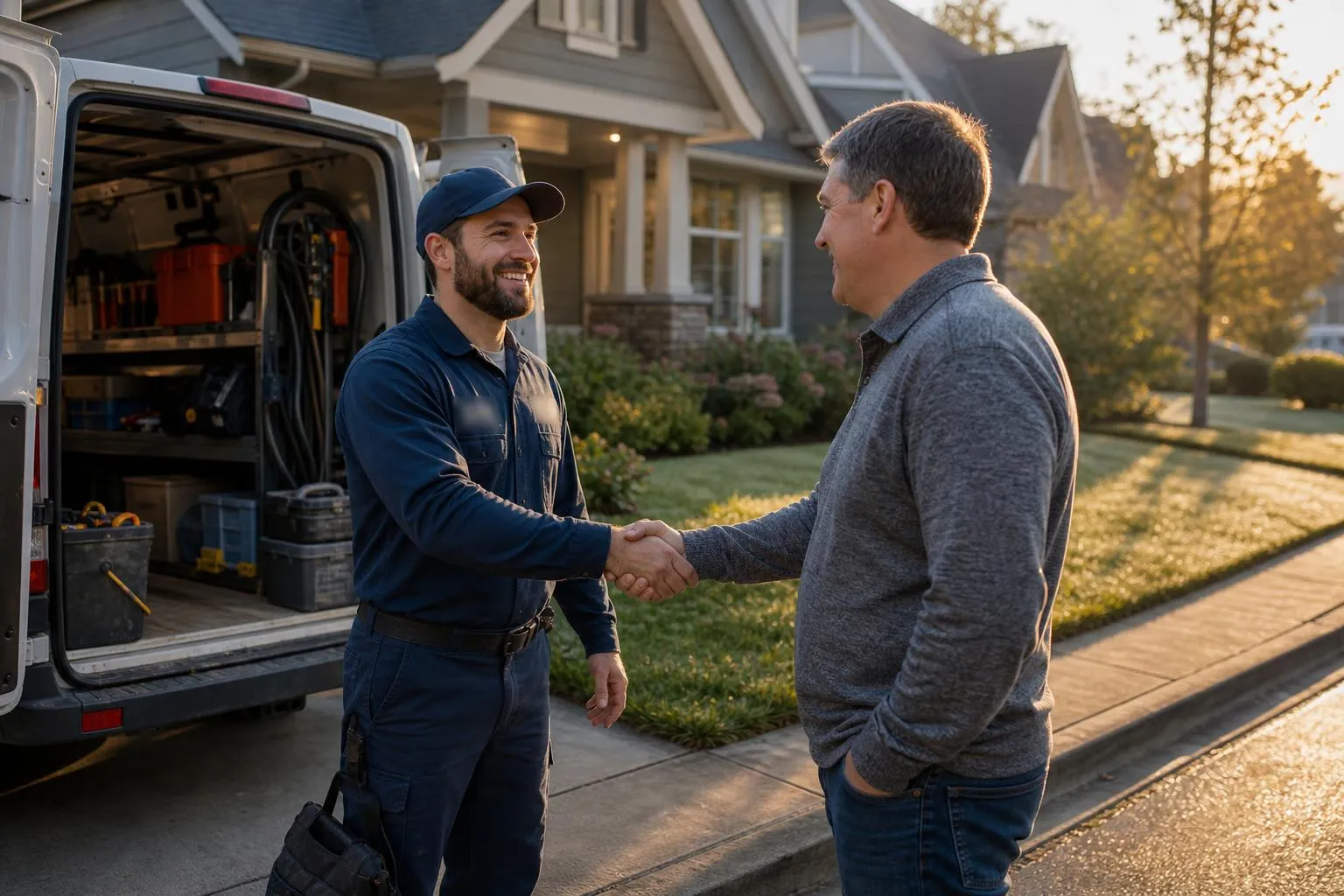
How to run Facebook for plumbing business

Nobody scrolling Facebook on a Tuesday night wakes up wanting a new water heater. They want one the second it floods the garage, and that panic does not happen in the feed. So Facebook works for plumbers in exactly two lanes: staying familiar enough that yours is the name people remember, and paid targeting that finds homeowners before the emergency. Both are simple to do badly and expensive to get wrong, which is the whole reason to run them on purpose instead of off the side of your desk between service calls.
Why Facebook is a top-of-mind channel, not an emergency channel
Plumbing demand is almost entirely reactive. A burst supply line at 11pm sends someone to Google or their recent-calls list, not to your Facebook page. That single fact should reshape what you expect from the platform. Facebook is where you win the planned jobs, the repipe someone has dodged for a year, the softener install, the remodel rough-in, and where you stay familiar enough that when the emergency hits, yours is the name that surfaces first.
So your content job is recognition, not entertainment. A before-and-after of a clean sweat joint, a 20-second clip of you running a sectional machine down a main line, a quick note on why pressure drops after a water main repair. None of it needs to go viral. It needs the few hundred people in your town who follow you to keep seeing a competent local plumber, so the brand is warm when they finally need you. Treat Facebook as the slow-burn complement to the channels that catch live demand, like your Google presence and local promotion, and it stops feeling like a waste of time.
The free moves that actually pay off
Most of what helps a plumber on Facebook costs nothing and has nothing to do with clever marketing. It is housekeeping and habit, and it quietly raises the return on everything else you do.
First, claim and complete every free profile, not just Facebook. Your Google Business Profile is the single highest-value free listing a local plumber owns, because it feeds the map pack where emergency searchers actually look. Facebook, Nextdoor, and Google should carry the same name, address, and phone number character for character, since inconsistency erodes how the platforms trust you. Second, build a review habit into the job itself. The moment work is done and the customer is happy, send one text with a direct link to leave a review. Plumbers who ask every single customer routinely sit at 4.8 stars with hundreds of reviews, while those who mean to ask stay stuck in the teens. Aim for 1 to 3 new reviews a week and the math compounds over a year.
Third, answer fast. The plumber who replies in five minutes beats the one who replies in five hours almost every time, because the homeowner is dialing three plumbers and hiring whoever picks up first. If you cannot watch the inbox from under a sink, that is a real operations problem, and it ties straight into getting and keeping customers.
What “good” paid Facebook looks like, and why it is high-stakes
Here is the honest part most guides skip. Organic posting on a local page reaches only a sliver of your own followers, typically 2 to 5 percent, because Facebook throttles unpaid business reach to sell you ads. So if you want the platform to produce real, countable leads, you are talking about paid campaigns. And paid is where plumbers bleed money fast.
Good paid social for a plumber is not “boost this post.” It is a deliberately built machine: the right objective (leads or calls, never engagement), tight geographic and homeowner targeting, an offer worth responding to, separate creative for emergency versus planned work, a lead form that loads instantly on a phone, and conversion tracking so you know which dollar produced which booked job. Miss any one piece and you get clicks that never become customers, or a steady spend with no way to tell whether it works. The stakes are high because the meter is always running. A misconfigured campaign does not just fail quietly, it bills you daily while it fails. That is why the gap between amateur and professional paid social is so wide, and so expensive.
The numbers: Facebook against a built system
You cannot manage what you will not measure, so here is the realistic shape of the costs. These are typical ranges for how plumbing and home-services advertising behaves, not a guarantee, and your market and season will move them.
| Approach | Typical cost per lead | What you control | Realistic outcome |
|---|---|---|---|
| Boosting posts | Often untrackable | Almost nothing | Reach numbers, no traceable jobs |
| DIY lead campaign | $25 to $60 | Targeting, budget, creative | Some leads, heavy wasted spend while you learn |
| Pro-built paid social | $15 to $40 | Full funnel and tracking | Leads you can trace to revenue |
| Our built systems | Managed for you | Done for you, optimized | More inquiries from the same spend |
The pattern is simple: the cheaper the cost per lead, the more of the funnel is actually built and measured. That is not a secret targeting trick, it is the whole path from ad to booked job being engineered and watched.
Keep cost per lead in perspective, though. A single repair nets a few hundred dollars and a repipe runs into the thousands, so even a $50 lead can be wildly profitable when your booking rate and pricing are right. The leak is rarely the lead cost. It is leads that never get called back, or jobs priced too low to matter, which is why tightening your prices and billing makes every lead worth more.
This is also the core decision most owners get wrong: who runs the campaigns.
Run paid social in-house
- No agency fee, so a $1,000 monthly budget all goes to ad spend
- Full control to pause or shift budget the same hour a job board fills
- You learn the levers, which sharpens every future marketing dollar
Run paid social in-house
- The learning curve commonly burns $1,000 to $3,000 in wasted spend before results stabilize
- Setup and weekly tuning eat 5 to 10 hours that could be billable work at $100-plus an hour
- One broken tracking pixel and you are flying blind for weeks, paying daily the whole time
The decision rule is buy the expertise, not the tool: run it in-house only if you have 5-plus spare hours a week and stomach for a months-long learning bill, otherwise hand it to someone who has already paid that tuition.
Do not let Facebook paper over weak operations
Marketing that works just sends more people toward your business, which exposes every weak spot at full volume. If your booking process is a phone that rolls to voicemail, paid Facebook simply buys you more missed opportunities at $30 a head. The most profitable thing you can do before scaling any channel is make the business behind it convert: someone answers fast, quotes go out same-day, the truck shows up when promised, and the price leaves real margin after the marketing is paid.
Those basics matter far more than which platform the lead came from. If you are still building that foundation, the grow and run it successfully guides are the place to start, and the profit math shows why margin, not lead volume, is the real constraint.
When the operations are solid and you want the lead engine built properly, that is the work we do. We build the website and lead funnel that turns Facebook and search traffic into booked jobs. Get a free video walkthrough at our plumbing website service. If you want the paid campaigns built and run for you across Facebook and Instagram, that is our Meta ads service. And if you have a bigger idea and need a plan to get there, start at expntl.com.
Should you run Meta ads yourself, or hand them off?
Boosting posts is easy. Running real Facebook and Instagram campaigns that book jobs is a different skill, and the meter runs daily whether or not the setup is right. We wrote an honest breakdown of when to keep it in-house and when handing off pays for itself: 6 signs it’s time to hand off your Facebook and Instagram ads. If a few of them ring true, you are past the boost button. When you want it run for you, request a free proposal.
Frequently asked questions
Is Facebook or Google better for a plumbing business?
For live, urgent jobs, Google usually wins, because someone with a burst pipe searches with intent to hire right now. Facebook is stronger for staying top of mind and for planned work like remodels, repipes, and water-heater upgrades. Most plumbers should not pick one. Let search catch the emergencies and use Facebook to capture the planned jobs, with both wired to track real bookings.
How much should a plumber spend on Facebook ads?
A common starting point is $500 to $1,500 a month, but the number matters less than whether the campaign is built to be measured. Spending $300 on boosted posts you cannot trace is worse than spending $800 on a real lead campaign you can. Start only when you can track which dollar produced a booked job, otherwise you are paying for reach numbers, not revenue.
Can I just boost my posts instead of running real ads?
You can, and it is mostly a waste of money for a plumber. Boosting optimizes for likes and reach, not for booked jobs, and it skips the targeting, offer, lead capture, and tracking that make paid social actually pay. It feels productive because the reach number is big, but big reach with no traceable leads is not a result. It is a receipt.
Do I really need a website, or is my Facebook page enough?
A Facebook page is fine for recognition, but it is rented land you do not control and a weak place to convert a ready-to-buy homeowner. A fast, purpose-built website is where ad clicks and search visitors turn into calls and form fills, and it is what lets you measure cost per lead at all. The page supports the brand. The website does the converting.
Why is my cost per lead on Facebook so high?
Usually because one or more pieces of the funnel are missing: loose targeting, a weak or absent offer, no proper lead form, a slow mobile page, or no conversion tracking telling Facebook who is worth showing the ad to. Each gap quietly raises what you pay per real lead. Closing those gaps is exactly why professionally built systems reach a much lower cost per lead than DIY campaigns.
Your move
Reading this does not book a job.
The owners who pull ahead are the ones who change one thing this week. If you want that one thing to be a website that sells and ads that put it in front of the right people, we build and run both for you.
Straight answer on whether we can help, usually the same day.