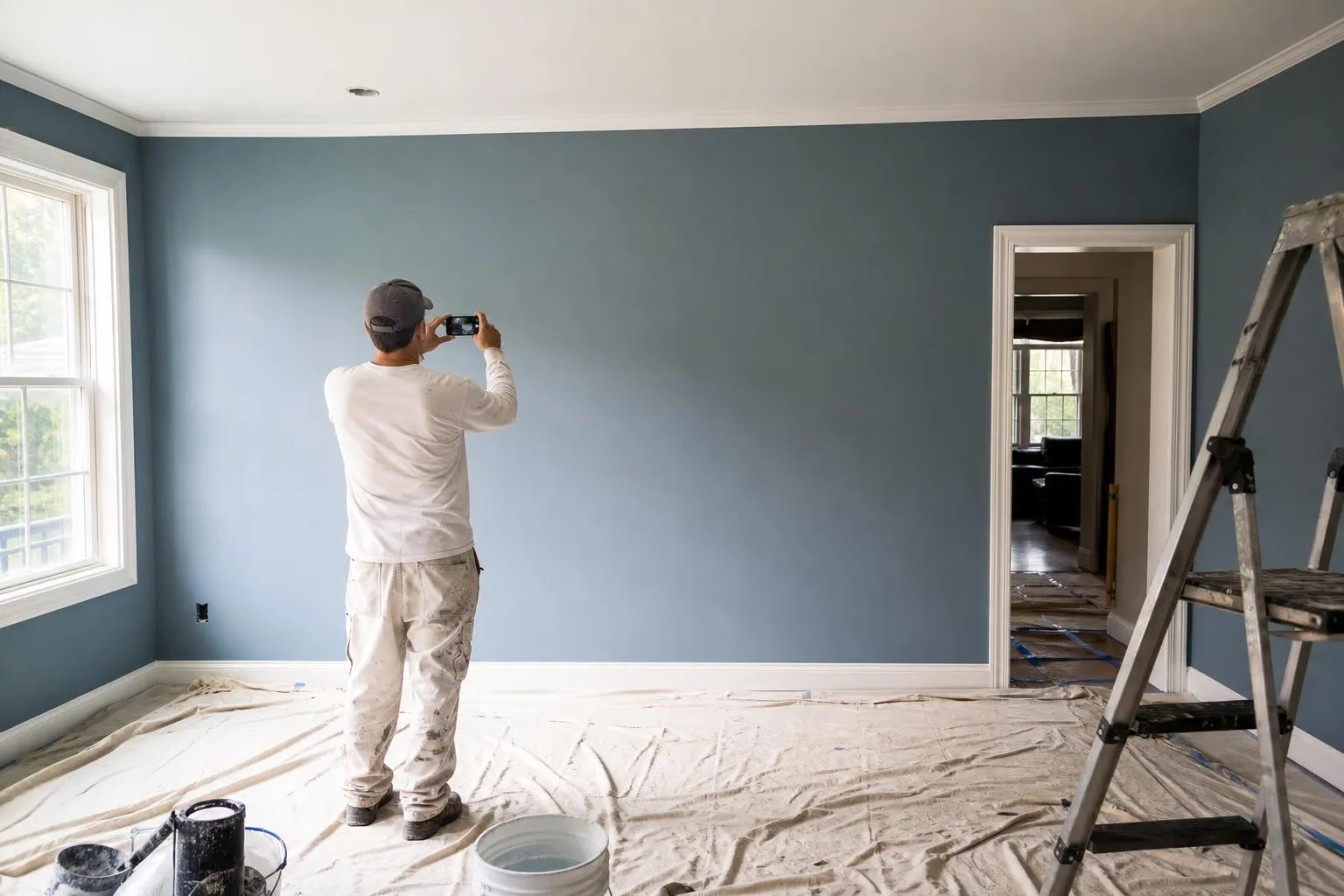
How to run Facebook for painting business

Facebook is not a place where homeowners go looking for a painter. Nobody wakes up and searches Meta for “kitchen cabinet refinishing.” So the winning play is the opposite of Google: you are not catching demand, you are creating it by putting a stunning before/after in front of the exact 3-mile pocket of homeowners who could afford you, then making it one tap to ask for a quote. Run that way and Facebook is the cheapest lead source a residential painter has. Run it like a reach contest chasing 2.8 billion users, and you will pay to entertain people who will never own a wall you touch.
Build the page as a proof wall, not a billboard
Before you spend a dollar on ads, the page has to do one job: convince a skeptical homeowner in ten seconds that you do clean, finished work and real people vouch for you. That means the cover photo is your sharpest exterior repaint, the intro line says what you paint and where (“Interior & cabinet painting in [City] + 20 miles”), and the button is set to “Send WhatsApp” or a call, not “Learn More.” Post before/after pairs, drip work, and a two-line caption naming the neighborhood. Skip the daily motivational quotes; homeowners are checking whether your cut lines are straight, not whether you can find a paint pun.
The other half of the proof wall is recommendations. Facebook Recommendations sit right on your page and show up when someone’s neighbor asks “anyone know a good painter?” in a local group. Ask every happy customer to leave one, and reply to each publicly.
Target the 5-mile homeowner and nobody else
The single biggest lever on Facebook for a painter is the audience, and it is almost always too big. Start with location: drop a pin on the zip codes where your best-paying jobs came from and set a 3 to 5 mile radius, not your whole metro. Set “People living in this location,” not “recently in” (that catches tourists and commuters). Age 35 to 65+. Then layer the one detail that changes everything: behaviors, “Homeowners” or “Likely to move,” so you stop paying for renters who cannot say yes to a $6,000 exterior.
For a warm audience, upload your past-customer list as a Custom Audience, then build a 1% Lookalike from it. A lookalike of people who already paid you outperforms any interest targeting you can guess at.
Run lead ads, not boosted posts
The blue “Boost Post” button is the most expensive mistake on the platform. It optimizes for engagement and sends traffic nowhere. Instead, build a proper campaign in Ads Manager with the Leads objective and an Instant Form so the homeowner taps once, their name and number auto-fill, and it lands in your inbox. Here is how the common ad types actually perform for painting.
| Ad approach | Typical cost per lead | Lead quality | Verdict |
|---|---|---|---|
| Boost post, no form | $50 to $150 | Low, tire-kickers | Avoid |
| Traffic ad to website | $30 to $80 | Medium, many bounce | Only if site converts |
| Lead form ad, before/after reel | $15 to $40 | Good, needs fast callback | Run this |
| Messenger/WhatsApp ad | $12 to $35 | High, self-selected | Run this if you reply fast |
| Retargeting past site visitors | $8 to $20 | Highest, already warm | Always on |
Add two qualifying questions to the Instant Form (“What are you looking to paint?” and “When do you want it done?”) to thin out the idle browsers. Fewer, better leads beat a flood you cannot reach.
Facebook lead ads vs boosted posts
- Lead ads capture a name and phone on one tap, so you own the contact instead of hoping they message you.
- You can optimize for cost-per-lead and see exactly what a booked estimate costs.
- Qualifying questions filter renters and “just curious” before they hit your inbox.
Facebook lead ads vs boosted posts
- Lead ads demand a fast callback; a form that sits 24 hours converts like a cold list.
- Setup lives in Ads Manager, which is fiddlier than the one-click Boost button.
- Auto-filled numbers include the occasional typo or throwaway, so expect to dial a few dead ends.
Feed the funnel with content between campaigns
Ads get the lead; organic content keeps you free and warm. Post two or three times a week: a before/after, a short “how we prep so paint does not peel” clip, and the occasional five-star screenshot. Join the local “[Town] Community” and “[County] Recommendations” Facebook groups and answer painting questions plainly without pitching. When a homeowner in that group asks for a painter, your name is already the one people tag. This is the same audience your paid ads warm up, so the two compound.
If you also want to reach people at the exact moment they are searching with intent, that is a different channel with different math; see how to run Google Ads for a painting business. To build the local reputation that makes both cheaper, work through how to promote a painting business locally, and for the Instagram side of the same photos, promoting on Instagram.
Getting found is the part that decides everything
Two things are free and worth doing before your next ad goes live: fully complete the page with a real service-area line and a call button, and text your last ten happy customers a link to leave a Recommendation. That alone makes every paid lead cheaper, because a page with 30 recommendations converts the same click far better than a bare one.
The paid side is where doing it badly costs more than not doing it at all: a lead form that dumps into an inbox nobody checks, or a campaign optimized for likes, quietly trains Meta to send you worse traffic every week. That handoff, from the ad to a page and site that actually books the job, is the work we do. To have your site built to convert those clicks, get a free video walkthrough. For the ad and retargeting builds themselves, see our Meta ads service. If you have the painting business in your head but not the plan yet, start at expntl.com.
Should you run Facebook and Instagram ads yourself, or hand them off?
A painter with a good before/after reel, a tight radius, and the discipline to text every lead back in five minutes can run this himself and do well. The creative is the hard part, and that part is you. Where it goes sideways is the machinery: the Special Ad Category trap, the learning phase, a lead form quietly dumping into an inbox nobody checks. We wrote an honest breakdown of when to keep it in-house and when handing off pays for itself: signs it’s time to hand off your Facebook and Instagram ads. If a few ring true, you are past the boost button. When you want it run for you, request a free proposal.
Frequently asked questions
How much should a painting business spend on Facebook ads to start?
Start at $15 to $25 a day, about $450 to $750 a month, on one well-built lead-form campaign, and hold it there for three weeks before judging it. Meta needs roughly 50 conversion events to exit its learning phase and stabilize your cost per lead, so switching ads or budgets every few days keeps it dumb and expensive. Once you see leads landing at $15 to $40, scale the winning ad, not the whole account.
What kind of Facebook posts work best for painters?
Before/after pairs and short vertical videos of an actual transformation, every time. A steady pan from a taped, primed wall to the finished coat stops the scroll better than any graphic. Add a one-line caption that names the neighborhood and the service, and you give the algorithm both the visual and the local signal it needs.
Should I use the Boost Post button?
Almost never. Boosting optimizes for engagement and sends the traffic nowhere useful, so you pay $50 to $150 for leads that a proper lead-form campaign delivers at $15 to $40. Build the campaign in Ads Manager with the Leads objective instead; it is a few more clicks for a fraction of the cost.
Why do my Facebook leads never answer the phone?
Usually because you called too late. A Facebook lead is a homeowner who tapped a button on impulse, so their intent decays by the hour; reply by text within five minutes and you book five to eight times more of them than the painter who calls back tomorrow. Set up an instant notification and a saved text reply so you catch them while the idea is still warm.
Is Facebook or Google better for a painting business?
They do different jobs, so most painters eventually run both. Google catches homeowners actively searching “painter near me” today and closes fast, while Facebook creates demand with proof and is cheaper per lead but needs quicker follow-up. If you only have budget for one at launch, start with the channel that matches your patience for callbacks; the details are in how to run Google Ads for a painting business.
Your move
Reading this does not book a job.
The owners who pull ahead are the ones who change one thing this week. If you want that one thing to be a website that sells and ads that put it in front of the right people, we build and run both for you.
Straight answer on whether we can help, usually the same day.