When and How to Hire and Train Staff for Junk Removal
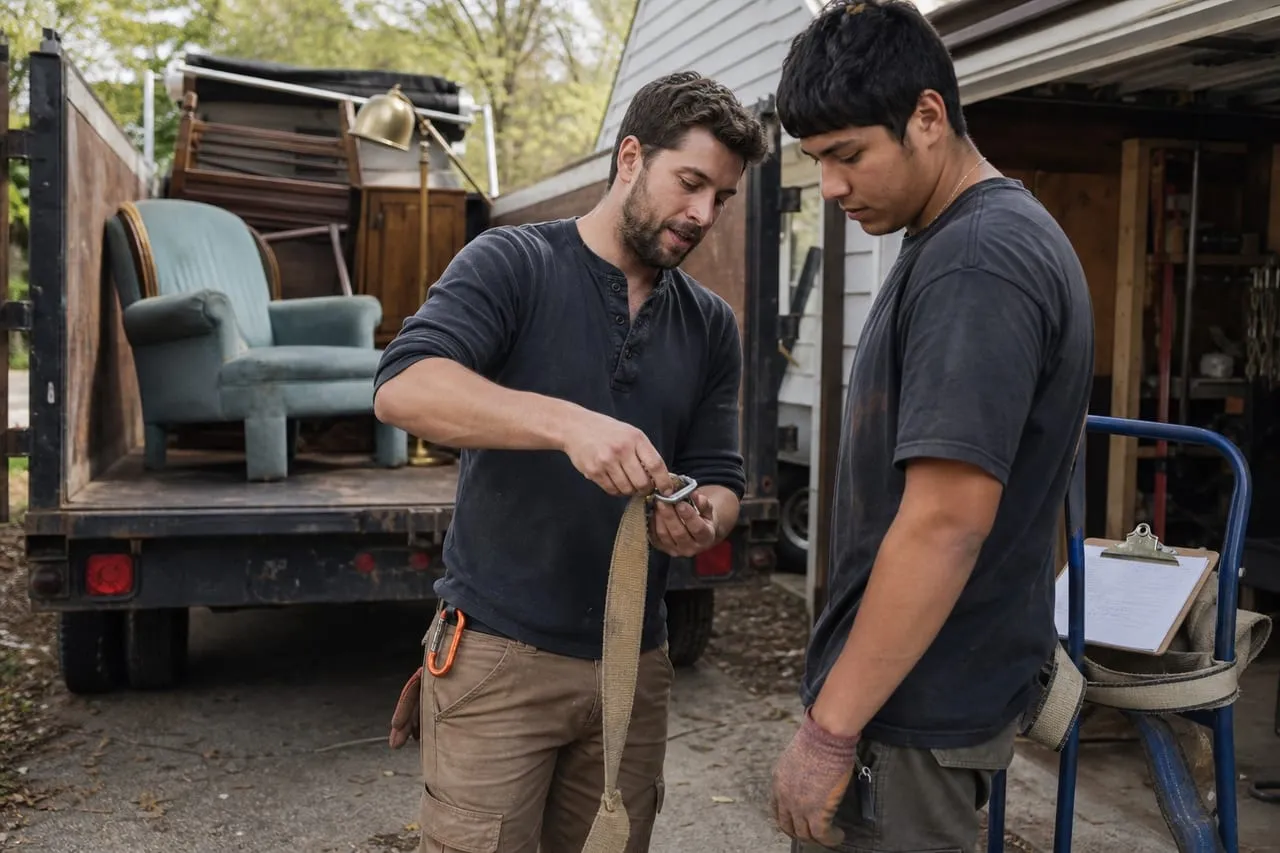
Hiring is the single most leveraged decision in junk removal growth. Most haulers wait too long, then hire the wrong person, then burn out doing both jobs. The right framework is simple: hire a driver when you’re consistently turning down jobs, source from real channels, pay competitively with tip share, and run a 2-week ride-along training. Here’s the full process.
The reason hiring is the inflection point is an hour-value flip that sneaks up on every solo operator. In month three, your hour in the cab is the most valuable hour you have, because the truck is the business. By the time you are turning down work, the math has inverted: an hour spent hauling earns one job, while the same hour spent answering calls inside three rings, quoting from photos, and visiting one property manager books several. A driver at $22/hour is not an expense against the truck’s revenue. They are how you buy your own hours back at the exact moment those hours became the most expensive thing in the company.
When to Make the First Hire
The signal for hire one isn’t a revenue number. It’s the number of jobs you’re turning down.
- Green light: 2+ jobs per week turned away for capacity reasons over 3 consecutive weeks. You have more demand than one truck can serve.
- Yellow light: hitting $12k+/month consistently but still doing every job yourself. You’re capped at solo capacity.
- Red flag (don’t hire yet): revenue inconsistent under $10k/month, partner accounts not yet established, owner still figuring out pricing.
Hiring before product-market fit (steady demand at correct pricing) burns cash and breaks the operator. Hire after, and the first driver typically pays for themselves within 30 to 45 days.
The first hire is a driver, not an admin, not a partner, not a marketing person. Drivers free the owner to answer calls, sell partner accounts, and quote jobs. The highest-leverage owner work. For the growth framework, see how to grow a junk removal business.
One either-or decision is worth settling before you post the job: full-time driver or part-time helper first.
Full-time driver first
- Frees the owner from the cab entirely, which is where the leverage is
- One person to train, schedule, and build trust with
- Can run the truck solo within 3 weeks, enabling same-day add-on jobs
Full-time driver first
- $4,500/month commitment lands all at once, slow months included
- Wrong hire costs 2 to 3 months of training time, not just wages
- A helper at $15–18/hour covers the two-person heavy jobs for a third of the cost
The tiebreaker is what is actually capping you. If you decline jobs because you physically cannot be in two places, hire the driver. If you decline only the heavy two-person jobs (pianos, hot tubs, full estate cleanouts), a part-time helper removes that cap for a fraction of the commitment, and the full-time hire can wait one more quarter.
How to Find Quality Drivers
The five sources that consistently produce reliable drivers in junk removal.
- Indeed: post a clear job description with pay range. $50 sponsored post. Filter by junk removal, moving, delivery driver, landscaping experience.
- Craigslist gig and jobs section: still works in 2026 for blue-collar trades. Free or $25 post.
- Facebook job groups in your metro: free, lots of active candidates.
- Referrals from current crew, past customers, and partner accounts: highest-quality source. Offer $250 to $500 referral bonus paid at 30 days.
- Word of mouth at industry stops: the kid behind the counter at the auto parts store, the helpers at U-Haul, friends from past trades. Ask around.
What to avoid: low-quality day-labor platforms for permanent hires, recruiting from competitors (legal risk and bad culture fit), hiring family without clear roles.
Interview process: 15-minute phone screen + 30-minute in-person interview + driver’s license and background check + drug test if required by your insurance. Total cost: $100 to $200 per hire. Don’t skip the background check.
What you are actually screening for is not hauling skill, which takes two weeks to teach, but the two things that cannot be taught on a ride-along: a clean driving record your insurer will accept, and customer temperament. Your driver walks into customers’ garages, bedrooms, and dead relatives’ homes. One review that says “the crew was kind” wins more jobs than any ad, and one that says the opposite undoes a month of marketing. Hire the polite, punctual applicant over the strong, experienced one every time the choice comes up.
Pay Structure That Retains
Junk removal driver turnover is brutal when pay is wrong. Competitive comp keeps drivers and reduces re-hire costs.
| Component | Range | Notes |
|---|---|---|
| Hourly base | $18–25/hr by metro | Below $18 you lose drivers to landscaping and moving |
| Tip share | $3–7/hr equivalent | Pool tips per job, split among the crew on it |
| Per-job bonus | $25–50 | On jobs over $400 or full-truck loads; rewards selling up |
| Mileage allowance | $0.65/mile | Only if personal vehicles run errands |
| Paid PTO | 1 wk yr one, 2 wks yr two | Starts after 90 days; cheap retention |
| Workers comp | $1,500–4,000/yr per driver | Required in most states; varies by state and payroll |
Total annual comp for a quality driver: $45,000 to $60,000. Pay slightly above market and you’ll keep drivers for 2 to 4 years instead of replacing every 6 months.
The retention math is worth spelling out, because “pay above market” sounds like charity until you price the alternative. Replacing a driver costs the $100 to $200 hiring pipeline again, two weeks of the owner back in the cab for the ride-along (call it $3,000 to $5,000 of displaced owner time), and a 30-day productivity ramp. That is $5,000+ per departure. Paying $2/hour above market costs about $4,000 a year and removes the most common reason drivers leave. One prevented departure pays for more than a year of the premium.
The 2-Week Ride-Along Training
A driver who’s never run a route alone shouldn’t go solo on day one. Run a structured 2-week ride-along that produces a confident, independent operator.
Week 1: Owner driving, new hire shadowing.
- Day 1: orientation, paperwork, safety protocol, truck familiarization, dollies/straps/tarps, dump-station tour. End of day: small jobs together.
- Day 2 to 3: shadow owner on full days of jobs. New hire watches customer interaction, quoting from photos, loading, sorting donation, dump-station drop-off.
- Day 4 to 5: new hire handles loading and customer signoffs, owner handles quoting and payment. Debrief after every job.
Week 2: New hire driving, owner shadowing.
- Day 1 to 2: new hire drives the route, handles all customer interaction. Owner observes and corrects after the job, not in front of customers.
- Day 3 to 4: new hire handles quoting at the door for repeat customers and small jobs. Owner handles new customer quotes.
- Day 5: new hire runs the day solo with owner on phone backup.
Week 3 onwards: solo with daily check-ins for the first 30 days.
What to drill into every new hire:
- Customer interaction script: greet by name, walk-through, repeat the quote, “is there anything else you’d like us to take?”
- Loading discipline: heaviest items first, distribute weight, tarp the load before leaving.
- Donation and recycling sorting on the truck.
- Photo-taking for marketing library.
- Asking for the review at job completion.
- Payment processing on the truck.
Two weeks feels long for what looks like simple work, and that is exactly the misread to avoid. The hauling is simple. What the ride-along installs is the revenue layer that rides on top of every job: the upsell question adds 10 to 20 percent to average tickets, the review ask feeds the engine that books next month, and the donation sorting cuts your dump fees on every load. A driver who hauls perfectly but skips those three habits runs the truck at a quiet 25 percent discount, and you will not see it on any single invoice. The script is not customer-service polish. It is the product.
For broader operational training, see how to successfully run a junk removal business.
When to Add the Next Hire
After driver one is solo and stable, the next hires follow a predictable order based on revenue.
- Part-time helper ($15 to $18/hour) once driver one is consistently at $15k+/month per truck and 2-person jobs (heavy items, large cleanouts) are common.
- Driver two for truck two once partner accounts are sending 8 to 15 jobs/month independent of paid ads.
- Dispatcher / office admin at $40k+/month total revenue or 3+ trucks. Owner can no longer dispatch from the phone effectively.
- Operations manager at $80k+/month or 5+ trucks. Owner shifts to pure CEO role: sales, finance, expansion.
Each hire should pay for themselves within 60 to 90 days at the correct revenue trigger. Hiring too early or too late both kill margin.
Notice the pattern in that ladder: every hire buys back a specific category of owner hours, and the order follows which hours are most valuable at each stage. The helper buys back muscle, the second driver buys back capacity, the dispatcher buys back the phone, the manager buys back the calendar. When you feel the urge to hire out of sequence (an admin before truck two is the common one), check which hours are actually constraining you this month. The answer usually points back to the ladder.
Frequently asked questions
Should I hire family for the first role?
Generally no. Mixing family and business creates conflicts that compound. If you do hire family, write a clear job description and pay structure up front.
How long until I can step out of the cab entirely?
Most owner-operators step out of regular driving by month 8 to 14 after first hire. Some choose to stay in the cab part-time longer for hands-on quality control.
What’s the biggest hiring mistake?
Hiring the first warm body who applied because you’re burned out. Take the extra 2 weeks to find the right person. Bad hires cost 2 to 3 months of wasted training.
Do I need an HR system at one or two employees?
Gusto or Justworks ($40 to $150/month) handles payroll, tax filings, and workers comp from day one. Don’t run payroll manually.
Should drivers get to keep all their tips?
Mixed approach: jobs done solo, driver keeps the tip. Jobs done with a helper, pool the tip and split. Document the policy in writing.