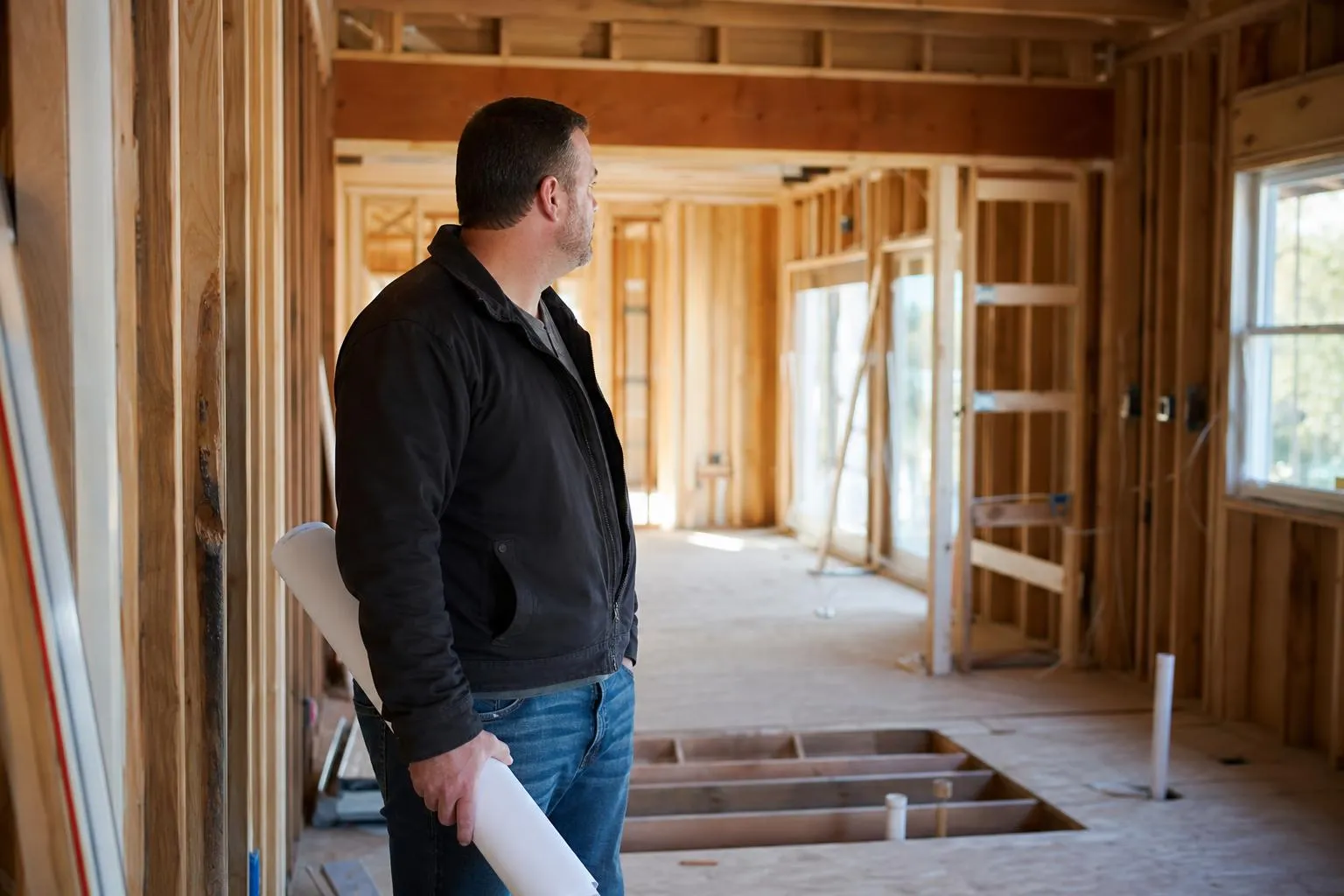
How to Start a Construction Company Step by Step

Starting a construction company is not a to-do list you can attack in any order, it is a dependency chain where each step unlocks the next. You cannot bind insurance without a registered entity, cannot pull most licenses without proof of insurance, and cannot open supplier credit without all three. Contractors who launch clean do it in a fixed sequence and run the slow parts in parallel with the fast ones. Here is that sequence, in the order that actually works, with the timing and the gates that decide it.
Step 1: Form the entity and get the EIN (week 1)
Nothing else can start until this exists. File articles of organization for an LLC with your secretary of state ($50 to $500 depending on the state), then apply for an EIN on irs.gov, it is free, takes about ten minutes, and every downstream step demands it. The LLC matters more in construction than in most trades because a structural defect or an injury on your site is exactly the claim that reaches for your house; the entity is the wall between the business and your personal assets, but only if you run it as a separate company.
The moment the EIN lands, open a dedicated business bank account (Chase Business Complete, Bluevine, or a local bank that knows contractors) and a business credit card. Do this before any money moves. Commingling funds is the single easiest way for a plaintiff’s attorney to pierce the LLC and reach you personally.
Step 2: File the contractor license and bond immediately (week 1, in parallel)
The license is the slowest step, so you start it the same week as the entity, not after. Requirements swing hard by state, some need years of documented experience and two exams, others just a city registration.
| State type | Example states | Timeline | What it takes |
|---|---|---|---|
| Strict state license | California (CSLB), Nevada, Arizona | 6 to 16 weeks | Experience proof, trade + law exams, bond |
| Moderate state license | Florida, North Carolina, Virginia | 3 to 8 weeks | Exam, financial statement, bond |
| City/county registration | Most of Texas, much of the Midwest | 1 to 4 weeks | Registration, sometimes a local exam |
| Specialty-only threshold | Varies by scope and dollar limit | Varies | License often required only above a job-cost limit |
Order your license bond at the same time, a contractor bond typically runs $10,000 to $25,000 in coverage and costs roughly $100 to $400 a year, because the license application usually requires it. Book your exam date through PSI or Pearson VUE early; seats fill weeks out in busy states, and the licensing clock does not start until your file is complete.
Step 3: Bind insurance the week your entity clears (weeks 2 to 3)
With the entity and bank account live, bind coverage, and you need it before the license approves anyway, since most applications require the certificate. The core stack for a general contractor:
- General liability: $1M per occurrence / $2M aggregate is the market standard GCs, GCs’ clients, and permit offices expect. Roughly $1,200 to $6,000 a year depending on scope and revenue.
- Workers compensation: required in nearly every state the day you have one employee. Construction class codes are mid-to-high risk, commonly $5 to $15 per $100 of payroll depending on trade.
- Commercial auto: on the work truck, about $1,500 to $3,500 a year.
- Builder’s risk / tools: per-project coverage for the structure under construction and your equipment.
Pick your agent like a subcontractor, not a vendor. Construction runs on certificates of insurance, every GC you sub for, every supplier credit line, every commercial bid wants a COI naming them, often same-day. An agent who issues certificates within hours is worth a slightly higher premium.
Step 4: Open supplier accounts and set up the back office (week 3 to 4)
Once you are licensed and insured, take the certificate package to your suppliers and open net-30 trade credit at more than one. For a general contractor that means the lumberyards, a supplier like ABC Supply or Beacon for envelope materials, and Home Depot Pro or a local building-supply house. Open at least two accounts even though you will favor one, the delivered price on an identical material list varies by hundreds of dollars per job between suppliers, and after a busy season the accounts you hold get materials allocated first.
At the same time, stand up the minimum back office: estimating and project-management software (Buildertrend or Procore for larger operations, a spreadsheet plus a contract template to start), a written contract vetted for your state’s lien and payment rules, and a bookkeeping system. This is the point where the full launch sequence and cost detail is worth reading in depth, and where you decide how you will price, markup versus margin is where new contractors lose money.
Start as a solo owner-operator vs hire a crew day one
- Owner-only means workers comp is often a cheap “ghost” policy ($750 to $1,500) instead of full payroll coverage.
- Your break-even is a few thousand a month, so you can take smaller jobs profitably while you build a name.
- You learn your true costs on real jobs before you carry the fixed weight of a payroll.
Start as a solo owner-operator vs hire a crew day one
- You are the estimator, PM, and laborer at once, so you can only run one job at a time and growth stalls.
- Turning down work you cannot staff hands those clients to a competitor with a crew.
- Bigger, more profitable projects often require a crew and a track record you cannot show yet.
The rule: start owner-operator (or with vetted subs) until your pipeline consistently exceeds what one person can build, then hire your first employee the month you are turning work away.
Getting found is the part that decides everything
You can complete every step above and still sit idle if the phone never rings. Two moves are free and worth doing the week you are legal.
Claim and fully complete your Google Business Profile, service area, real photos of finished work, and your first reviews, and ask every early client for a review before they leave the site. Then list yourself in the local channels where homeowners search for contractors. Those two steps pull more first calls than any ad while you are new. The broader playbook is in getting your first clients.
The higher-stakes part is your website and paid lead flow, where doing it badly costs more than not doing it. A contractor site is not a brochure, it has to load fast on a phone, rank for “contractor near me, ” and turn a searching homeowner into a booked estimate. That is the work we do: to have the site handled instead of guessed at, get a free video walkthrough. For ads, SEO, and paid social, see our services. If you have the company idea but not the business plan yet, start at expntl.com.
Frequently asked questions
How long does it take to legally start a construction company?
You can be fully legal in 30 to 60 days in most states, the entity and EIN take a week, insurance a few days, and suppliers a day once you have the paperwork. The variable is the license: 1 to 4 weeks for a city registration, up to four months in a strict state like California. File the license first and the rest overlaps.
What is the very first step?
Form the LLC and get the EIN, then open the business bank account, in that order, all in week one. Everything downstream (insurance, license, supplier credit) requires the entity and bank account to exist first. At the same time, submit the license application, since it is the slowest piece and needs to run in parallel.
How much money do I need to start?
Plan on $8,000 to $20,000 for year-one setup, entity, license, bond, insurance, basic tools, and software, but only about $4,000 to $8,000 is actually due before your first job, since insurers bill in installments. The detailed line-by-line is in how much you need to start.
Do I need a license to start, or can I take small jobs first?
Check your state and job-cost threshold before you take anything. Many strict-license states require the license for any contracting work or for jobs over a low dollar limit, and working unlicensed can make your contract unenforceable, the client can legally refuse to pay for finished work. Confirm your state’s rule with the licensing board before you sign a single contract.
Should I form an LLC or stay a sole proprietor?
Form the LLC. Construction is the trade where liability gets tested, a structural defect or a jobsite injury is exactly the claim that reaches for your personal assets, and most insurers and GCs also prefer to work with a registered entity. The $200 to $500 to file is trivial next to the protection, provided you keep business and personal money strictly separate.
Your move
Reading this does not book a job.
The owners who pull ahead are the ones who change one thing this week. If you want that one thing to be a website that sells and ads that put it in front of the right people, we build and run both for you.
Straight answer on whether we can help, usually the same day.