How to start an office cleaning business
Office cleaning is the rare trade where you can land a $1,500-a-month contract before you own a tool that costs more than a vacuum. The work happens after hours in empty buildings, and one signed account can pay your rent for a year. The catch: commercial buyers do not hire the cheapest mop. They hire the operator who looks legitimate, carries the right insurance, and answers the phone. Here is how to set that up without burning money.
What office cleaning is as a business
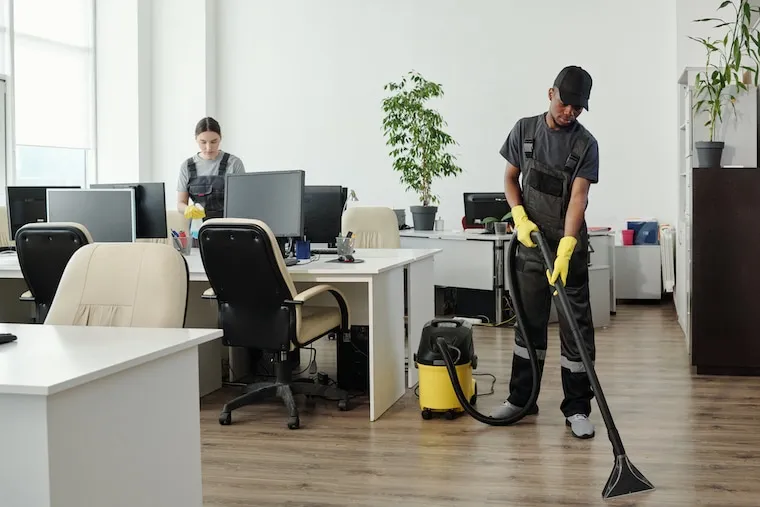
Office cleaning, also called commercial janitorial, is a recurring-contract business, and that is the whole point. You are not selling one-off deep cleans; you are selling a nightly or three-nights-a-week routine, billed monthly on a one-year contract that renews on autopilot: empty trash, vacuum, disinfect desks, sanitize restrooms, spot-clean glass, lock up. That is why it beats one-time residential for predictable cash: an operator with eight accounts walks into the month already knowing roughly what lands in the bank. The flip side is that you work nights and sales cycles are slow. The wider category is covered in how to start a commercial cleaning business.
Legal setup: entity, license, insurance, and the bond nobody warns you about
Get the paperwork right first, because commercial clients check it and homeowners never will. Most office cleaners register an LLC ($50 to $500 by state) for the liability shield a sole proprietorship lacks, which matters when your crew has keys to other people’s buildings. There is rarely a special “cleaning license,” but most cities require a general business license, typically $50 to $400 a year.
Insurance is the real gatekeeper. A general liability policy, usually $1M per occurrence, runs $500 to $1,500 a year for a small operator, and managers ask for a certificate, often naming them as additional insured, before you start. The moment you hire, workers’ compensation becomes legally required in almost every state. Then there is the janitorial bond, the one that catches new owners off guard: this surety bond protects the client if an employee steals, a live worry when your people are alone in a building at midnight. It is cheap, often $100 to $300 a year, and “licensed, bonded, and insured” is what commercial buyers scan for.
The state-by-state walkthrough is in setting up and registering a cleaning business.
The gear, and what it really costs
You can outfit one crew for a few thousand dollars, most of it on the two or three machines that set your pace.
| Item | Typical cost | Why it matters |
|---|---|---|
| Commercial backpack vacuum | $250 to $500 | 2 to 3x faster than an upright in open offices |
| Microfiber kit (cloths, flat mops, buckets) | $150 to $400 | Color-coded to avoid cross-contamination |
| Cordless auto scrubber (entry) | $1,200 to $3,500 | Hard-floor lobbies; optional until you win them |
| Chemicals + restroom supplies | $200 to $500 | Disinfectant, glass, floor cleaner, liners, paper |
| Cart, caddies, wet-floor signs, gloves | $150 to $300 | Wet-floor signs are a liability requirement |
| Liability insurance + bond (year 1) | $600 to $1,800 | The cost of being allowed to bid at all |
Buy the vacuum and microfiber kit new and skip the auto scrubber until a contract pays for it. A backpack vacuum from a commercial brand like ProTeam or Sanitaire is the highest-leverage purchase: it roughly doubles vacuuming speed in open-plan offices, and since labor is your biggest cost, speed is margin.
Pricing and the profit math
Office cleaning is priced per square foot, per hour, or a flat monthly rate, and buyers want the monthly number. Light nightly cleaning runs about $0.05 to $0.20 per square foot per visit (or $25 to $45 an hour), so a 10,000-square-foot office cleaned three nights a week often lands between $1,200 and $2,500 a month. Bill that account $2,000 and the math works: labor might run $700 to $1,000 and supplies and overhead another $250, leaving a gross margin north of 40 percent. Stack two to four such accounts on one nightly route and a single cleaner carries $4,000 to $8,000 of monthly billing.
Staffing: W-2 employees vs subcontractors
You can run your first account or two solo, but the moment you add a third you face the defining decision of this trade: W-2 employees or independent subcontractors.
Hire W-2 employees
- You control schedule, quality, and the checklist; clients meet a consistent, trained crew.
- Workers’ comp and supervision make you the accountable party clients want for a multi-year contract.
- Easier to scale a branded operation: uniforms, training, and standards stick.
Hire W-2 employees
- Payroll taxes and workers’ comp add roughly 10 to 15 percent on top of wages.
- You carry onboarding, scheduling, and turnover, which runs high in cleaning (often 75 to 200 percent a year).
- Slow nights still cost you, because employees are paid whether the route is full or not.
The decision rule is employees for accounts you own, subcontractors only to overflow: build core contracts on a W-2 crew you control, and use vetted subs to cover a route while you hire. Misclassifying a full-time, schedule-controlled worker as a 1099 contractor is the trap, and back taxes plus penalties can dwarf what you “saved.” The vetting and training system is in how to hire and train staff.
Finding accounts, and the website that decides whether they call
Office accounts come from direct outreach to property and office managers, referrals, commercial real estate contacts, and inbound “office cleaning near me” searches. The work of landing contracts (who to call, how to bid an RFP, how to walk a building) is its own discipline, covered in how to find cleaning contracts. Two free moves are worth doing today: claim your Google Business Profile so you show in local map results, and ask every satisfied account for a review, because a manager picks the bidder with twelve reviews over the one with none.
Where new owners quietly lose money is the website. A manager who hears your name looks you up before calling, and a thrown-together site tells a buyer weighing a year-long contract that your cleaning will look the same. What good looks like: it loads fast on a phone, states your service area and “licensed, bonded, and insured” above the fold, shows real photos of finished work, and makes requesting a quote a single tap. That is brutally hard to get right: the gap between a site that converts at 2 percent and one at 5 percent is more than double your booked accounts from the same traffic, and you cannot see the leak yourself because the manager who bounces never tells you why.
This is fiddly, high-stakes work, which is why we build the site for you. If your site is doing anything less than turning visitors into booked walkthroughs, get a free video walkthrough and we will show you where it is leaking, or see what a converting site needs in how to make a website for a cleaning business. Running paid ads or SEO to feed that site is a different animal and where DIY budgets die, so route it through our services. And if you are still deciding between offices, a janitorial model, or a different business and need a real plan, start at expntl.com.
Frequently asked questions
How much does it cost to start an office cleaning business?
Plan for $2,000 to $10,000. The low end covers an LLC, a license, a backpack vacuum, a microfiber kit, chemicals, and your first year of insurance and a bond. The high end adds an auto scrubber, a second crew’s gear, and a website.
Do I need a license and insurance to clean offices?
Almost always a cheap general business license, but insurance is the real gate: clients require a general liability policy (commonly $1M) plus a janitorial bond, and ask for a certificate before you start. Once you hire, workers’ compensation becomes legally required in nearly every state.
How many accounts can one cleaner handle?
Two to four mid-size accounts a night, depending on building size and drive time. That is why concentrating accounts in one office park matters so much: tight routes turn windshield time back into billable production, while a scattered service area burns the night in the car.
Should I focus on offices or take any cleaning work I can get?
Pick a lane. Office work is recurring and scales on routes; one-off residential deep cleans fragment your schedule and equipment. Win three to five office accounts in one area first, then expand to adjacent buildings. The first one is the slowest, often 30 to 90 days, but a referral speeds up the rest.
Your move
Reading this does not book a job.
The owners who pull ahead are the ones who change one thing this week. If you want that one thing to be a website that sells and ads that put it in front of the right people, we build and run both for you.
Straight answer on whether we can help, usually the same day.