How to get clients/customers for a cleaning business
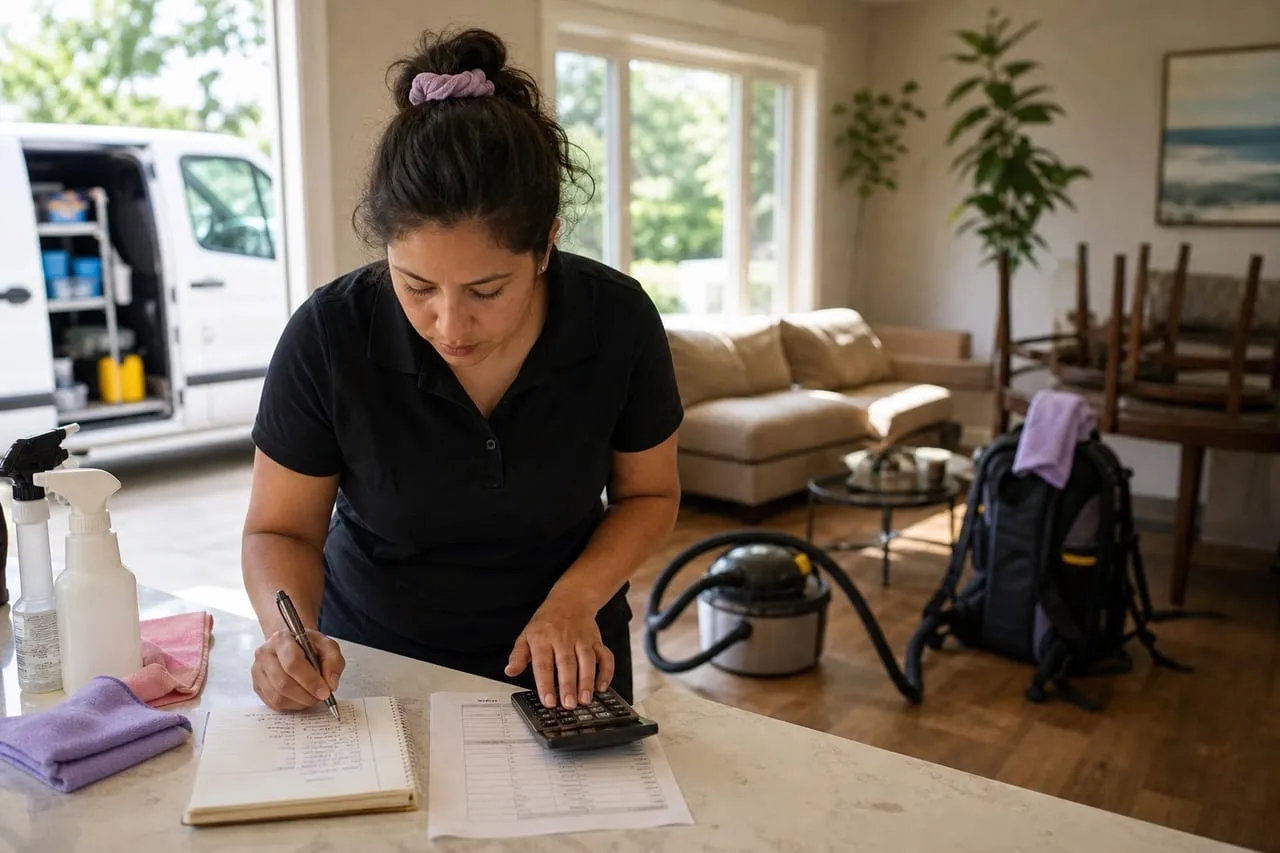
Most cleaning businesses do not have a service problem. They have a math problem. A new house-clean client is worth $150 to $300 a visit and, if you keep them, $2,000 to $6,000 a year in recurring revenue. That means a single signed recurring client can be worth more than a month of your old day job, and yet most owners chase one job at a time with no system for where the next ten come from. Fix the system, not the hustle.
Know what a client is actually worth before you spend a dime
You cannot decide what to spend to get a client until you know what a client returns. The number that runs your whole acquisition game is lifetime value (LTV): average ticket times visits per year times years retained. A bi-weekly residential client at $180 a clean, 26 cleans a year, kept for two years, is worth roughly $9,360 in revenue. Even at a 30 percent net margin that is about $2,800 in profit from one signature.
Against that, a customer acquisition cost (CAC) of $50 to $150 is not an expense, it is the cheapest inventory you will ever buy. The owners who stay broke are the ones who flinch at a $40 lead while sitting on $2,800 of downstream profit. Run your own numbers first. Commercial and janitorial contracts swing the math even harder, which is why a single account can carry a route. If contracts are your lane, read how to find cleaning contracts and how much profit a cleaning business can make.
Make referrals a system, not a hope
Word of mouth is the highest-converting channel in this trade, full stop. Referred prospects show up pre-trusted, they haggle less, and they close at 2x to 5x the rate of a cold lead. The mistake is treating referrals as something that just happens. They happen when you ask, with a specific offer, at the moment of peak happiness, which is the 60 seconds after a client tells you the place looks amazing.
Build a two-sided incentive: the referrer gets a credit, the new client gets one too, so the introduction is a gift rather than a favor. Give every recurring client a couple of physical cards or a one-tap share link. Track it so you know which clients are your engine. A program that pays out $40 to $60 per side and converts even one neighbor a month is the cheapest growth you will ever run.
Answer faster than everyone else, because speed is the real edge
Here is the unglamorous truth that beats clever marketing: most cleaning leads go to whoever replies first. A homeowner who fills out three quote forms hires the company that calls back while they are still thinking about it. Industry-wide, replying within 5 minutes instead of an hour can roughly double your booking rate, and most of your competitors take hours or never call at all.
So before you spend on getting more leads, plug the bucket. Have a way to respond to every inquiry within minutes during the day, a simple text template ready, and an after-hours auto-reply that buys you the booking until morning. Pair that with a clear, easy quote so the client never has to chase you for a number. The look at your pricing matters here too, because a quote that lands fast and reads simple wins. See how much to charge and setting the best prices.
Reactivate the clients you already had
The cheapest client to win is one who already paid you once. People stop cleaning services because of a move, a budget squeeze, or simple drift, not because they hated you. A “we miss you” offer to your lapsed list converts far better than cold outreach because the trust is already built. Before you pay for new attention, mine the attention you already earned.
Reactivating past clients vs buying new leads
- Conversion on a warm past-client list often runs 10 to 20 percent versus 1 to 3 percent cold.
- Cost is basically free: a text or email blast to a list you already own.
- They already know your quality, so the sales conversation is one message, not five.
Reactivating past clients vs buying new leads
- The list is finite, so it caps how much it can grow you in a given month.
- Some lapsed clients left for a real reason, like price, and a discount may not move them.
- It does nothing to reach the new movers and new homeowners entering your market every week.
The decision rule is sequence, not either-or: reactivate your existing list first because it is free and fast, then turn on paid acquisition to reach the new demand your list cannot.
Get found by people searching right now
Once your referral and reactivation engines are running, you have to capture the people actively looking, and most of that demand starts in two places: a search and a map. The single highest-leverage free move is to claim and fully fill out your Google Business Profile, then ask every happy client for a review. Reviews and a complete profile are what put you in the local map pack where ready-to-book homeowners are searching “house cleaning near me” today.
That is where the free part ends and the stakes begin. The next table is the honest landscape of where cleaning clients come from.
| Channel | Typical cost to acquire | Time to first client | Best for |
|---|---|---|---|
| Referral program | $40 to $80 per client | Days | Every owner, day one |
| Reactivating past clients | Near zero | Days | Anyone with a client list |
| Google Business Profile and reviews | Free (your time) | 2 to 8 weeks | Local visibility |
| Your website plus Google Ads | Managed for you | 1 to 4 weeks | Predictable, scalable growth |
| Facebook and Instagram ads | $15 to $50 per lead | 1 to 3 weeks | Residential demand generation |
Here is where honesty matters more than a sales pitch. A good website and a tuned ad account are not “post some stuff and wait.” Good means a site that loads fast, states your service area and price band, and turns a click into a booked quote, plus ad campaigns with the right keywords, negative keywords, geo-targeting, and tracking so you know which dollar produced which client. Get those wrong, and you will pour real money into clicks that never become clients, which is exactly how owners conclude “ads do not work.” They work, but the execution is high-stakes and unforgiving, which is the part we do every day.
Getting clients is not one big trick. It is a stack: know your numbers, ask for referrals every time, reply faster than anyone, win back the clients you had, and then put real money into the channels that scale. The first four are free and you can start them today. The fifth is where we come in.
Your website is the machine that turns all of that traffic into booked jobs, and it is the one piece most owners get wrong. If you want a site built to convert cleaning visitors into quotes, not just look nice, get a free video walkthrough. If your problem is the ads, SEO, and paid social that feed it, see what we run for service businesses at our services. And if you are still shaping the whole plan, start at expntl.com.
Should you win customers yourself, or hand it off?
Replying fast, running referrals, and reactivating old clients are yours to own, and honestly no one will do them with more urgency than you. The engine that keeps new leads arriving, the ads, SEO, and paid social, is a weekly discipline that competes with the actual cleaning. We wrote an honest answer to whether paying for that help is worth it for a small operator: is a marketing agency worth it for a small local business?. Read it before you decide to carry it all yourself. When you want it handled, request a free proposal.
Frequently asked questions
How do I get my first cleaning clients with no money?
Start with the free channels that move fastest: tell everyone you know with a specific offer, claim your Google Business Profile, and ask your first one or two clients for a review and a referral the moment they are happy. Door-to-door flyers in a single target neighborhood still work for residential. See start a cleaning business with no money for the full bootstrap path.
How much should I spend to get one cleaning client?
Tie it to lifetime value. If a recurring client is worth $2,000 to $6,000 over their stay, spending $50 to $150 to acquire one is usually a strong trade. The trap is judging cost-per-lead in isolation instead of against what that client returns over a year or two.
Why are my ads not bringing in cleaning clients?
Almost always it is one of three things: the campaign targets the wrong searches and wastes budget, the website you send clicks to does not convert, or no one replies to the leads fast enough. Each is fixable, and each is easy to get expensively wrong, which is why we handle the website and the campaigns as a system rather than in pieces.
Do online reviews really get me more cleaning clients?
Yes, more than almost anything else local. Reviews and a complete Google Business Profile are what land you in the map pack where ready-to-book homeowners search, and they reassure people about letting a stranger into their home. Ask every satisfied client the day of the clean, when the result is right in front of them.
Should I focus on residential or commercial clients to grow faster?
Commercial and janitorial contracts give you bigger, more stable revenue per account, while residential is faster to start and scales through referrals and local search. Many owners begin residential for cash flow, then add commercial for stability. Read how to find cleaning contracts to weigh the trade-offs.