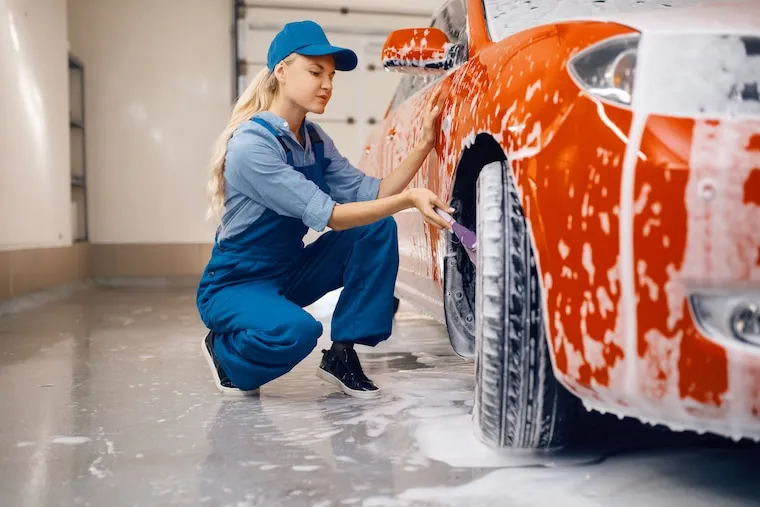
How to advertise car wash business on Facebook

The “2 billion users” pitch is the exact wrong way to think about Facebook for a car wash. You do not want 2 billion people, you want the drivers who pass your tunnel every week, and you want them to join your unlimited plan. Meta is unusually good at that one job because it can drop a video of a gleaming car in front of everyone inside a tight local ring and then chase the ones who lingered. Here is what good looks like, so it signs members, not likes. If you are weighing the channel, this guide covers whether and why; how to run Facebook for a car wash covers the reputation and retention side.
Your audience is a five-mile ring, not the whole platform
Start with a complete Page (Local Business category, address, hours, cover photo of the tunnel, click-to-call), then forget the follower count. The thing that matters in the ad account is the location ring. A good account draws it around your address, or by drive time if your town has a river or highway that people will not cross. Everything outside that ring is a wasted impression, because nobody drives 20 minutes for a car wash.
Inside that ring, good accounts keep the targeting broad. Stacking many interests on top of a small radius shrinks the audience to nothing and raises the price. In a small area, the tighter your creative and offer, the less you need to micro-target.
Sell the membership, not the $8 wash
The offer is where most car wash ads fail. Running “$8 basic wash” on Facebook attracts a one-time discount hunter worth a few dollars once. Running “Unlimited washes, $99 for 3 months, then $25/month” attracts a member who keeps paying month after month. Same ad spend, wildly different return. Your Facebook offer should almost always be the membership, framed around the intro deal that lowers the commitment to join.
Write the ad to a commuter, not a shopper. The hook is the shine and the convenience: a car exiting the tunnel spotless, a driver breezing through the members-only lane while the pay lane backs up. The copy is short: what they get, the intro price, and one clear button. “Join now” or “Get offer” pointing straight at your signup page, not your homepage.
The retargeting loop does the real work
Cold ads introduce you; retargeting closes. A good account has tracking on the website and membership signup page from the day it launches, because that starts building retargeting audiences immediately. Then it runs two layers: a cold video to the local ring, and a follow-up to everyone who watched most of that video or visited the join page but did not sign up.
That second layer is where cost per member usually collapses, because someone who already watched your wash video and clicked to the join page is half-sold. The warmth flows down a ladder:
| Audience layer | Who they are | What the ad does |
|---|---|---|
| Cold | Everyone in the local ring | Introduces the wash with video |
| Warm | Watched most of your video | Sends them to the join page |
| Hot | Visited the join page, did not sign up | Closes, with a deadline |
The follow-up ads add something the cold ad did not: a deadline (“intro ends Sunday”) or a testimonial. The person who abandoned your signup form is your cheapest member on the platform, so a good account never leaves that audience unaddressed. The deeper campaign picture lives in how to run Facebook for a car wash.
What a well-run account looks like, and why guessing costs more than the ads
Meta will show you a dozen metrics and most are noise. Three tell you whether the machine is working. Cost per member, not cost per click or per like, is the only number that ties spend to revenue. Video view rate tells you whether the creative stops the scroll, before you judge the offer. Click-to-signup completion tells you whether the landing page is the leak: cheap clicks and rare signups means the ad is fine and the page is broken.
Reading those three well is where the money is made or lost, and it is harder than it looks. Judge a campaign too early and you kill the winner before the platform has learned who pulls into your lot. Scale the winner too fast and you reset that learning and pay launch prices twice. Optimize for the wrong event and Meta will happily buy you a pile of cheap clicks that never reach the join button, because it delivers exactly what you asked it for. Every one of those mistakes is paid in real dollars and in members who joined the wash down the road instead. If you would rather the campaign was built, read, and scaled by someone who does it every day, see how we get leads for local businesses.
One evergreen membership campaign vs seasonal promo bursts
- An always-on membership ad compounds retargeting data, so cost per member keeps falling.
- Steady spend keeps the signup pipeline full instead of feast-or-famine around promos.
- The tracking and audiences mature, making every future campaign cheaper to launch.
One evergreen membership campaign vs seasonal promo bursts
- A single evergreen ad suffers creative fatigue, so cost per result creeps up without new video.
- You miss the urgency spikes that a “spring detail special” or holiday burst can drive.
- Always-on spend can quietly bleed if you stop watching cost per result week to week.
Most washes run both: an evergreen membership campaign as the base, plus short promo bursts (grand opening, spring cleaning, back-to-school) layered on when a deadline creates urgency.
Getting the signups is the part that decides everything
You can run a flawless Facebook campaign and still stall if the page the ad points to cannot close. A couple of pieces are free and worth doing today; the rest is high-stakes work where doing it badly costs more than skipping it.
The free pieces, now: complete the Facebook Page fully, pin your best wash video to the top, respond to every comment and message within the hour, and post before-and-after clips weekly so the organic Page reinforces the paid ads. Meta favors accounts that stay active, and a live Page makes your ads cheaper.
Now the high-stakes part. The ad is only half the machine; the landing page is the other half. Good means a page that loads fast on a phone, shows the membership price and a join button above the fold, and lets a commuter sign up at a red light without pinching and scrolling. That gap between a page that converts Facebook clicks and one that just looks fine is invisible until you compare the numbers: a page that converts far fewer of your ad clicks wastes a large share of your ad spend. Paid social is the same, where a badly built campaign trains Meta to send you cheaper, worse traffic. This is the work we do. To have the ads and the signup page handled instead of guessed at, get a free video walkthrough. For paid social, ads, and SEO, see our paid social service. If you have the wash idea but not the plan yet, start at expntl.com.
Should you run Facebook and Instagram ads yourself, or hand them off?
Filming a phone video of a clean car is squarely DIY, and plenty of washes sign their first members off a simple membership ad they built themselves. It gets harder once the money lives in the retargeting loop: the tracking, the warm-audience ladder, and reading cost per member before you scale, which is easy to get wrong and expensive when you do. We laid out an honest read on when that hand-off pays for itself: 6 signs it’s time to hand off your Facebook and Instagram ads. If a few describe your setup, you are past the boost button. When you would rather it was handled, see how we run Google and Meta ads for car washes.
Frequently asked questions
How much should I spend on Facebook ads for my car wash?
There is no universal number. It depends on your market and how many members the wash can absorb, and a launch window usually deserves more than steady state. Judge it by cost per membership signup, not by reach or likes. If a member stays paying for months, you can afford a meaningful cost to sign one, so work out that ceiling before you spend.
What kind of Facebook ad works best for a car wash?
A short vertical video of a car going through the wash and coming out clean, paired with a membership offer and a single “join now” button pointing at your signup page. Video of water and a shine stops the scroll far better than a static photo, and a membership offer is worth far more than a single-wash promo per signup.
Should I target by interests or just by location?
In a small trade area, location does almost all the work. A good account sets a tight radius (or drive-time) and lets Meta’s delivery find the car owners. Stacking many interests on top of a small radius shrinks your audience and drives up cost per result for no real gain.
Why are my Facebook ads getting clicks but no members?
Almost always the landing page, not the ad. If clicks are cheap but signups are rare, the leak is between the click and the join button: a slow page, a hidden price, or a signup form that is painful on a phone. Fix the page before you touch the ad, because the ad is doing its job.
How long before Facebook ads start working for a car wash?
Give any campaign a few weeks and enough spend to gather real data before judging it, because Meta needs time to learn who converts and settle on a stable cost per result. Cost per member usually improves as the algorithm learns who pulls into your lot, so judging in the first few days kills winners early.
Your move
Reading this does not book a job.
The owners who pull ahead are the ones who change one thing this week. If you want that one thing to be a website that sells and ads that put it in front of the right people, we build and run both for you.
Straight answer on whether we can help, usually the same day.