Best way to start and get into car wash business
The best way to get into the car wash business is not to decide you want “a car wash.” It is to decide which of four completely different businesses you are actually starting, because a self-serve bay, an in-bay automatic, an express tunnel, and a mobile detailing rig share a name and almost nothing else. They have different price tags, different labor, different real estate, and different ways of making money. Pick the format first and the rest of the plan falls out of it.
Pick the format before you fall in love with a building
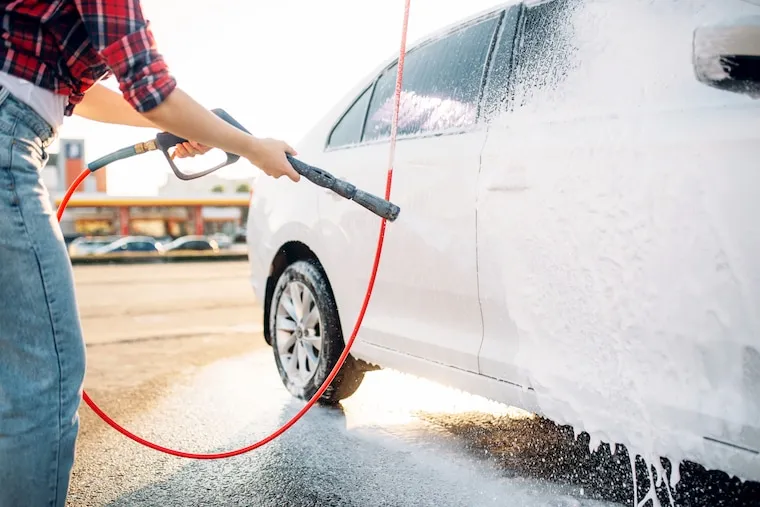
There are four ways in, and they are not interchangeable. Self-serve is coin-and-card wand bays plus vacuums: low labor, low revenue, high uptime, the cheapest entry. In-bay automatic (IBA) is a single machine in a bay where the driver stays in the car while a gantry or rollover does the work: one machine, one car at a time, roughly 15 to 20 cars an hour. An express tunnel is a conveyor that pulls the car through 100-plus feet of equipment with attendants loading and free vacuums after: 80 to 150 cars an hour, and the format every private-equity dollar in this industry is chasing. Mobile and detailing is a truck, water tank, and your labor: near-zero real estate, and you sell time, not throughput.
Most first-timers should start with a self-serve or an IBA on land they can afford, or buy an existing site with a lease-hold already zoned and permitted. The tunnel is the highest-return format and also the one most likely to bankrupt a first-timer who underestimates the buildout. The full launch order is in the step-by-step guide, and the deeper walkthrough is the ultimate guide.
Site selection is the decision that is already made before you spend a dollar
Ask any operator what matters and the answer is traffic count, access, and the median. You want a road carrying 25,000-plus vehicles per day, a hard corner or a mid-block with a signal so cars can turn in and out, and your entrance on the going-home side of the street. A wash trapped behind a raised median, where drivers have to make a U-turn to reach you, quietly loses a third to half of its potential traffic and never recovers it. Do not sign anything until you have pulled the state DOT traffic counts for the exact intersection.
The other half is the dirt. A tunnel needs 0.75 to 1.5 acres; an IBA can fit on a corner of an existing lot. Zoning has to allow a car wash by right or by conditional-use permit, and you need a stormwater and wastewater discharge path, which is its own permit fight covered in how to set up and register the business. The detailed criteria live in identifying the ideal locations.
The membership model is what makes a wash a real business
For anything beyond self-serve, the unlimited monthly plan is the game. You sell a customer a $20 to $30 per month pass that lets them wash as often as they like, they wash two or three times a month, and you collect recurring revenue that shows up whether it rains or not. A tunnel doing 500 cars a day with 50 percent of them on membership has a base of thousands of dollars a month that arrives before a single retail car pulls in. That is the number lenders and buyers care about, because it is predictable.
The mechanics matter. You need a point-of-sale and RFID system (DRB Systems, ICS/Innovative Control Systems, or Sonny’s CarWash Controls are the common ones) that reads a windshield tag and opens the gate automatically. You price the top wash package so that a single visit costs almost as much as a month of membership, which makes the pass an obvious yes. The math on all of this is in how much profit a car wash makes.
Know your unit economics before you sign the loan
A wash is a fixed-cost machine. The building, the equipment, the land payment, and one or two attendants cost roughly the same whether you wash 100 cars or 500 cars in a day, so almost every additional car is close to pure margin. That is why throughput and membership dominate everything: your job is to fill the tunnel, not to shave pennies off soap.
The variable cost per car is small and worth knowing precisely. Chemicals run $0.30 to $1.50 depending on the package, water after reclaim is a few cents, and card processing is a few percent. Compare that to a $12 to $35 ticket and you see why the format that pushes the most cars through wins. Pricing packages and add-ons is covered in setting prices and billing, and the equipment that drives cost per car is in buying equipment and supplies.
Self-serve or IBA versus an express tunnel
- Self-serve and IBA open for $150k to $800k, a range a first-timer can actually finance.
- Low labor: a self-serve can run nearly unattended, and an IBA needs one person part of the day.
- Uptime is forgiving; one bay down does not close the business.
Self-serve or IBA versus an express tunnel
- Revenue ceilings are low: a self-serve nets $15k to $40k a year per bay, not the six figures a tunnel can.
- Membership works far better on a tunnel; self-serve is mostly one-and-done retail cash.
- You are more exposed to a tunnel opening nearby that pulls your automatic customers.
Getting found is the part that decides everything
You can pick the perfect format on the perfect corner and still watch an empty lot if drivers do not know you exist and cannot sign up for a membership in ten seconds. A couple of pieces are free and worth doing this week; the rest is high-stakes work where doing it badly costs more than not doing it.
The free pieces, now: claim and fully complete your Google Business Profile with real photos of the tunnel and the free vacuums, post your wash packages and hours, and put a QR code at the pay station that opens your membership signup. Details on the local basics are in how to promote the business locally and getting your first customers. Now the high-stakes part: a wash website is not a brochure, it is a membership signup machine that has to load in under three seconds, show the plans and a join button above the fold, and rank for “car wash near me.” The gap between a site that converts and a pretty one that does nothing is invisible until you compare the numbers. To have that handled instead of guessed at, get a free video walkthrough. For ads, SEO, and paid social, see our services. If you have the idea but not the plan yet, start at expntl.com.
Frequently asked questions
Which car wash format makes the most money?
An express tunnel, by a wide margin, because it pushes 80 to 150 cars an hour and runs on recurring memberships, so a busy tunnel can clear $400k to $1M-plus in annual cash flow. Self-serve and in-bay automatics make far less, roughly $15k to $100k a year, but they cost a fraction to open and are the realistic entry point for most first-timers. The tunnel is also the riskiest because the buildout can top $5M.
How many cars a day do I need to break even?
It depends entirely on format and debt. A self-serve or IBA with modest overhead can break even at 30 to 60 cars a day; a new express tunnel carrying a multimillion-dollar loan often needs 250 to 350 cars a day just to cover debt and fixed costs. This is why membership matters so much, because it guarantees a slice of that volume regardless of weather.
Can I start a car wash with no experience?
Yes, and many owners do, but treat the first year as paid tuition and buy help. Join the ICA (International Carwash Association), tour operating washes in other markets, and hire an equipment distributor who supports your build rather than the cheapest one. The starting with no money piece covers the leanest possible entry.
Should I buy an existing car wash or build new?
Buying an existing site is usually the safer first move because the zoning, the discharge permit, and the traffic pattern are already proven, and you can see the real revenue before you commit. Building new gives you a modern tunnel and full control but exposes you to permit delays, construction overruns, and a cold-start ramp with zero members. For a first-timer, an underperforming existing wash you can improve often beats a ground-up build.
How long until a car wash is profitable?
A self-serve or IBA can cash-flow from month one if it is bought right. A new express tunnel typically takes 12 to 24 months to ramp its membership base to a healthy level, and lenders expect you to carry the debt through that ramp. Plan for a slow first year and keep a reserve, because the washes that fail usually run out of cash during the ramp, not because the format was wrong.
Your move
Reading this does not book a job.
The owners who pull ahead are the ones who change one thing this week. If you want that one thing to be a website that sells and ads that put it in front of the right people, we build and run both for you.
Straight answer on whether we can help, usually the same day.