Buying equipment and supplies for plumbing business
A plumbing business is a rolling parts store with a person attached. A roofer gets shingles dropped at the curb; you carry the warehouse with you, because the second trip to the supply house is the trip that kills the day. A real starter kit runs $25,000 to $60,000 all in, and almost every dollar of that range is decided by one question: did you buy the cheap version of the three machines that actually earn money?
The service van is the business, not just transport
A plumber works out of a van, not a pickup. A cargo van (Ford Transit, Ram ProMaster, Mercedes Sprinter) is a mobile workshop, a parts warehouse, and a billboard rolled into one, and it is the single biggest line in your budget. A high-mileage Transit in honest shape runs $12,000 to $22,000, while a cleaner unit at 60k to 110k miles runs $25,000 to $38,000. That spread is the biggest decision you will make. Buy for the drivetrain and the cargo box, not the paint, and pay a mechanic $150 for a pre-purchase inspection before you wire a cent.
The empty box is only half the cost, and the half people forget. A shelving and bin system (Adrian Steel, Weather Guard, Ranger Design) runs $2,500 to $6,000 installed, and it is not a luxury. The difference between a built van and a pile of loose parts is fifteen minutes of digging on every single job, which at a loaded labor cost of $75 to $125 an hour is real money walking out the side door. Add a vinyl wrap with your phone number and license ($2,500 to $4,500) and the van advertises on every drive once you are booked. For what reads at fifty feet, see how to make a logo for a plumbing business.
Hand and power tools: where good is good enough
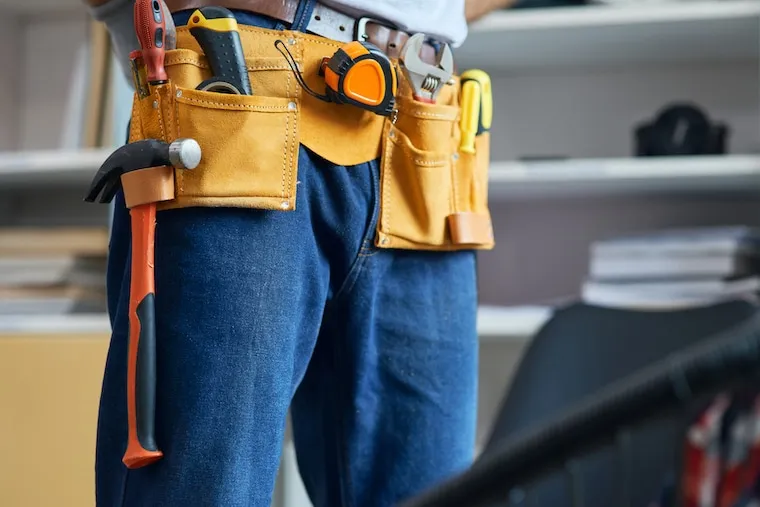
Residential or commercial decides the back half of your list, but the core hand-tool kit is the same everywhere. Budget $2,000 to $4,000 and skew toward brands a plumber actually recognizes: Ridgid for anything that grips or cuts pipe, Milwaukee or DeWalt for cordless, Knipex for pliers.
- Pipe wrenches in 10”, 14”, 18”, 24”, plus channel-locks and a basin wrench.
- Tubing and pipe cutters for copper, PEX, and PVC, plus a hacksaw.
- A PEX expansion or crimp tool ($200 to $500) and a MAPP torch kit for copper.
- A cordless drill/driver combo, a compact reciprocating saw, and a right-angle drill.
- Inspection mirror, headlamp, a 4-foot and a torpedo level, stud finder.
One rule keeps the budget honest. Buy the best version of anything that cuts, threads, presses, or grips pipe, because failure there is a botched joint and a callback. Buy mid-tier on everything that just turns or measures. A cheap PEX tool that crimps inconsistently is not a saving, it is a kitchen flooded at 2 a.m. and a customer who never calls again.
The three machines that actually earn money
These three separate the plumber who clears a drain for $150 from the one who bills $600 to camera, locate, and jet the same line. A sewer inspection camera (Ridgid SeeSnake or comparable) runs $3,000 to $12,000 and does two jobs at once: it diagnoses the problem and it sells the repair, because a homeowner watching roots invade their pipe on a screen does not argue price. A drain machine (a compact handheld plus a larger drum unit for main lines, Ridgid K-400 up to K-7500) runs $400 to $3,500. A hydro-jetter clears grease and roots a cable cannot touch and runs $4,000 to $12,000, turning a $200 cable job into an $800 one.
Do not finance all three at launch. Start with the camera and a mid-size drain machine, rent the jetter, and buy it the week you start turning away jetting work. For how this gear maps to what your market pays, see setting prices and billing and how much profit a plumbing business can make.
Buy or rent the jetter: the real decision
The jetter is the one big-ticket machine where renting is genuinely smart at the start, so run the actual numbers instead of buying on pride.
Buy the jetter
- Owned and on the van 24/7, so you capture emergency grease and root jobs the same hour they call.
- A $200 cable job becomes an $800 jetting job, and 10 to 15 jobs a month covers a $7,000 machine inside a year.
- No $250 to $400 daily rental eating the margin on every single job once volume is steady.
Buy the jetter
- $4,000 to $12,000 of capital frozen in a machine you may use twice a month at first.
- Maintenance, winterizing, and pump repair are now your problem and your downtime.
- A trailer or larger van may be needed to haul it, which is another cost stacked on top.
The decision rule is rent until it hurts, not buy on day one: rent the jetter while you use it occasionally, and buy the week you are renting more than five or six times a month.
Rolling inventory: the parts a roofer never carries
This is where plumbing budgeting differs from every other trade. Nobody delivers fittings to your jobsite; you carry them. A van stocked to finish the common 80% of jobs with no return trip holds $3,000 to $8,000 in fittings and consumables, and that stock is working capital, not a one-time buy. Carry copper, PEX, brass and PVC fittings, supply lines and angle stops, wax rings and flanges, P-traps, common faucet cartridges, solder and flux, and a deep bin of the boring stuff that quietly prevents a second trip.
The reason to overstock is pure economics. A return trip is 45 to 90 minutes of unbillable time plus a delay that annoys the customer, and at $75 to $125 an hour, three of those a week costs you $300 to $600 in lost time. Restock from a master list every morning. Once you run more than one van, field-service software (ServiceTitan, Housecall Pro, Jobber) earns its keep tracking inventory, dispatching, and invoicing. Budget $50 to $300 a month and treat it as equipment.
What the whole kit costs
Used is fine for the van, big drum drain machines, ladders, and a compressor. Buy new for anything electronic or pressurized, where condition stays invisible until it fails on a job: the camera, the jetter pump, and your PEX and press tools. Never cut the safety line, which covers cut and chemical gloves, Z87 eye protection, a sewer respirator, and a first-aid kit in every van.
| Item | Typical range | New or used |
|---|---|---|
| Cargo van (Transit / ProMaster / Sprinter) | $12,000 to $38,000 | Used, inspect first |
| Van shelving and build-out | $2,500 to $6,000 | New |
| Hand tool kit (Ridgid, Knipex, Milwaukee) | $2,000 to $4,000 | New |
| Cordless power tools | $1,000 to $2,500 | New |
| Sewer inspection camera (Ridgid SeeSnake) | $3,000 to $12,000 | New |
| Drain machines, small plus main (K-400 to K-7500) | $400 to $3,500 | Used OK on big drum |
| Hydro-jetter | $4,000 to $12,000 | New, rent first |
| Rolling parts inventory | $3,000 to $8,000 | New, working capital |
| Safety gear and consumables | $500 to $1,200 | New |
| Van wrap | $2,500 to $4,500 | New |
For launch costs and the order to buy in, see how much you need to start and the best way to get into plumbing.
Equipped, but invisible: the gap a tool budget cannot fill
You can own the best-stocked van in the county and still sit idle, because the homeowner with a burst pipe is not browsing your shelves. They are typing “plumber near me” and calling whoever shows up first and looks trustworthy. What good looks like here is concrete: a page that loads under two seconds on a phone, a tap-to-call number above the fold, real recent reviews, and a quote form that actually works on mobile. That is harder than it sounds and high-stakes, because the site is the front door to every lead you generate, and getting it wrong leaks the exact jobs your tools and trucks were bought to serve. The free parts you should do yourself: claim your Google Business Profile and ask every happy customer for a review.
We build sites engineered for exactly this. To see what that looks like for your business, get a free video walkthrough. Turning that traffic into booked work through ad targeting and search visibility is its own discipline that burns cash fast when done wrong, so see how mujgos drives leads. And if what you have is an idea you want turned into a plan, start at expntl.com.
Frequently asked questions
How much does it cost to equip a plumbing business?
A working kit runs $25,000 to $60,000, with the van and shelving at 60 to 70% of that total. Launch near the bottom of the range with a high-mileage van and a rented jetter, then upgrade as the schedule fills. The fastest way to overspend is financing all three big machines before the work justifies them.
What is the single most important piece of equipment?
After the van, the sewer camera. It diagnoses problems a cable job would miss and sells the repair on the spot, because the homeowner sees the damage with their own eyes. It also pays for itself fastest, often inside five months.
How much inventory should I keep on the van?
Enough to finish the common 80% of jobs with no return trip, usually $3,000 to $8,000 in fittings and consumables. A single supply-house run costs 45 to 90 minutes of unbillable time plus a customer left waiting. Restock from a master list every morning so the van is full before the first call.
Should I buy new or used?
Used is fine for the van, big drum drain machines, ladders, and a compressor, where wear is visible and repairs are cheap. Buy new for anything electronic or pressurized (the camera, jetter pump, PEX and press tools) because hidden condition only reveals itself when it fails on a job. Never buy used safety gear.
Where do I open supplier accounts?
Ferguson, Winsupply, and strong regional plumbing distributors are the main wholesalers. Walk in with your license, insurance certificate, and EIN letter and apply for net-30 terms. Open two accounts so one supplier’s stock outage never strands a job.
Your move
Reading this does not book a job.
The owners who pull ahead are the ones who change one thing this week. If you want that one thing to be a website that sells and ads that put it in front of the right people, we build and run both for you.
Straight answer on whether we can help, usually the same day.