Buying equipment and supplies for dental practice
A dental practice is a manufacturing floor disguised as a waiting room. The chair, the handpieces, the imaging, and the sterilizer are the production line, and a single operatory equipped from scratch runs $50k to $120k before you see one patient. Get the lease-versus-buy and new-versus-refurbished calls right and you protect years of cash flow; get them wrong and you are servicing equipment debt with a chair that sits empty half the week. Here is where to spend, where to save, and what the supply houses actually deliver.
Build the operatory before you build the wish list
An operatory is a fixed kit, and the temptation is to start with the toys (a laser, a CAD/CAM mill) instead of the bones. The bones are the dental chair and delivery system, an operatory light, an X-ray source, a digital sensor, and the central air and vacuum that feed every room. A new chair-and-delivery package from A-dec, Midmark, or DentalEZ runs $8k to $25k per operatory; the light adds $1.5k to $4k. None of that is where rookies overspend.
Where they overspend is buying three operatories of premium gear when two are booked and the third is a closet with a chair in it. Equip the rooms you can fill, plumb the rest for air, vac, and data so they are a weekend from going live, and let the schedule pull the next build. Two running rooms and one roughed-in beats three pretty rooms and a loan payment built for five.
The shared mechanical core sits behind all of it. A dental air compressor (oil-free, $3k to $9k) and a vacuum system (wet-ring or dry-vac, $4k to $12k) are the lungs of the building, and undersizing them makes every handpiece stutter when three rooms run at once. Buy ahead of your operatory count here, because retrofitting after the walls close costs more than buying right.
Imaging separates a real practice from a referral funnel
You cannot diagnose what you cannot see, and imaging is the highest-value buy and the one most tangled in compliance. The baseline is intraoral digital sensors (Dexis, Carestream, $6k to $12k per pair) and a panoramic unit ($25k to $60k), with cone-beam CT increasingly common for implant and endo work ($60k to $120k). Sensors pay back fast: no film, no chemicals, and an instant image of the cracked molar on screen closes treatment plans. Cone-beam is the genuine judgment call: place implants or do surgical endo and a CBCT keeps that revenue in-house, but a general practice can refer out and buy later.
Buy CBCT in year one
- Keeps implant and surgical-endo revenue in-house instead of paying $150 to $400 per referral scan
- A 3D scan on the screen closes high-value cases (implants, full-arch) at a noticeably higher rate than a 2D pan
- Positions the practice for guided surgery work that general-only offices cannot quote
Buy CBCT in year one
- $60k to $120k of capital, or a $1,200 to $2,400 monthly lease, before you have the case volume to feed it
- Adds a state radiation-machine registration, shielding, and often a lead-lined room
- Idle most of the week for a low-surgical practice, so the per-scan cost balloons
The decision rule is volume, not prestige: buy the CBCT when your monthly surgical and implant cases would otherwise send 8 to 12 scans a month to an outside imaging center, and refer out until then.
Sterilization and instruments: cheap to buy, fatal to skimp
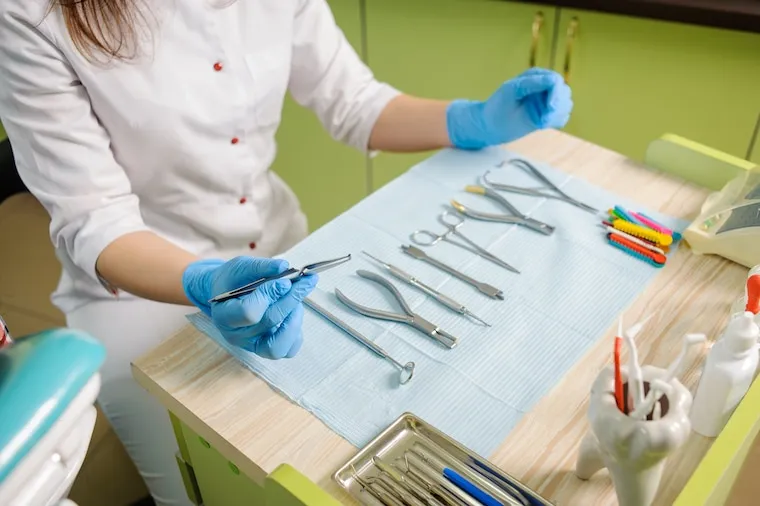
Infection control is where the regulators, the lawsuits, and the patient reviews all point the same way, and the gear is comparatively cheap. You need a Class B autoclave (Midmark M11, Tuttnauer, or SciCan Statim, $4k to $9k), an ultrasonic cleaner, a pouch sealer, and a weekly biological spore-test log. Then the rotating stock: high- and low-speed handpieces (two to four per operatory at $300 to $900 each because they fail and you cannot stop mid-procedure), hand instruments in cassettes, and curing lights.
The hidden cost is duplication. Sterilization takes time, so you need enough cassettes and handpieces in rotation that a room never waits on the autoclave, and most new owners underbuy instruments by half and bottleneck their own schedule.
Lease the big iron, own the small stuff
The biggest financial decision in the buildout is not the brand of chair, it is how you pay for the heavy equipment. Dental gear finances cleanly, so you will be offered leases and loans on nearly everything over a few thousand dollars.
Lease the major equipment
- Preserves $200k-plus of cash for buildout, payroll, and marketing during the slow first year
- Predictable payment (often $3k to $8k for a three-operatory package) covered by a fraction of monthly production
- Lease or Section 179 financing can be structured for tax advantages; your CPA confirms the right shape
Lease the major equipment
- You pay 1.3 to 1.6 times the cash price over a 5-to-7-year term, so a $400k package can cost $520k to $640k
- The payment is fixed whether the chairs are booked solid or sitting empty in month three
- Early-payoff penalties and end-of-term buyout clauses bury real money in the fine print
The decision rule is cash runway, not interest rate: lease the chairs, imaging, compressor, and vacuum, and pay cash for the autoclave, instruments, and consumables that are cheap and wear out. For the full capital picture see how much you need to start a dental practice, and for what production must cover those payments, how much profit a dental practice can make.
The whole startup kit on one page
| Item | Typical spec | Price (per item) |
|---|---|---|
| Chair + delivery unit | A-dec / Midmark / DentalEZ, per operatory | $8,000-$25,000 |
| Operatory light | LED, ceiling or chair-mount | $1,500-$4,000 |
| Air compressor | Oil-free, sized to chair count | $3,000-$9,000 |
| Vacuum system | Wet-ring or dry-vac, whole-office | $4,000-$12,000 |
| Intraoral sensors | Dexis / Carestream, per pair | $6,000-$12,000 |
| Panoramic X-ray | Wall-mounted digital pan | $25,000-$60,000 |
| Cone-beam CT (optional) | For implant / surgical endo | $60,000-$120,000 |
| Class B autoclave | Midmark M11 / Tuttnauer / Statim | $4,000-$9,000 |
| Handpieces | High and low speed, 2-4 per room | $300-$900 each |
| Practice-management + imaging software | Per provider, subscription | $3,000-$10,000/yr |
That software quietly bleeds into how patients find you. Platforms push patients toward online booking, and that only works if your practice website converts the visitor into a booked appointment. A good practice site is not a brochure: it loads in under two to three seconds on a phone, puts click-to-call and book-now above the fold, and turns clinic traffic into booked chairs. That is high-stakes and easy to get wrong, which is why we build them for dentists rather than hand you a template to fight with. For a site engineered to convert, get a free video walkthrough. For the channels that drive that traffic (Google, paid social, and the spend behind it), our marketing services handle the execution; the wider playbook is in how to advertise a dental practice.
Frequently asked questions
How much does it cost to equip one dental operatory?
A single fully equipped operatory runs $50k to $80k for the chair, delivery unit, light, intraoral sensors, and a share of the air and vacuum systems. Adding cone-beam CT and premium imaging pushes a multi-operatory startup to $350k to $550k all-in. The chair and imaging are roughly two-thirds of the spend.
Should I buy new or refurbished dental equipment?
Refurbished is fine for chairs, delivery units, compressors, and vacuum pumps from a reputable rebuilder with a warranty, and it can cut 30 to 50 percent off the price. Buy new for the autoclave, handpieces, and anything touching a patient’s airway, where a used unit has no inspection history and the failure cost is a canceled day.
Do I need cone-beam CT to open?
No. A general practice can open with intraoral sensors and a panoramic unit and refer surgical scans out for the first year or two. Buy the CBCT when your own implant and surgical-endo volume would otherwise send 8 to 12 scans a month to an outside imaging center, which is the point where keeping the revenue in-house pays the lease.
What supplies do I actually need to stock?
Far less than you expect. Open net-30 accounts with Henry Schein, Patterson, or Benco and they deliver composite, anesthetic, gloves, burs, and impression material per order. Keep a working stock of daily consumables and pouches, but your startup capital should buy equipment, not a warehouse of inventory.
Can I lease dental equipment instead of buying outright?
Yes, and most new owners do for the major equipment. Leasing preserves cash for buildout, payroll, and the slow first year, at the cost of paying roughly 1.3 to 1.6 times the cash price over the term. Lease the chairs, imaging, compressor, and vacuum; pay cash for the cheap, fast-wearing items.
Your move
Reading this does not book a job.
The owners who pull ahead are the ones who change one thing this week. If you want that one thing to be a website that sells and ads that put it in front of the right people, we build and run both for you.
Straight answer on whether we can help, usually the same day.