Identifying the ideal locations for auto repair shop
Most auto repair shops stall not because the owner cannot turn a wrench, but because they signed a lease on the wrong building. The right bay in the right zip code pulls 40 cars a week from drive-by alone. The wrong one is an empty lot behind a strip mall, paying for square footage no customer ever sees. Location is the one setup decision you cannot fix later without moving, so it deserves more than a gut feeling and a “for lease” sign.
Start with zoning, because it can kill the deal in one phone call
Before you fall in love with a building, find out whether you are even allowed to fix cars in it. Auto repair is classified as an automotive or light-industrial use almost everywhere, and most retail and commercial-general zones either prohibit it or require a conditional use permit. The categories that usually allow a repair shop are light industrial (often coded M-1 or I-1) and certain commercial-automotive overlays. A storefront zoned for general retail will not let you run a lift and store cars overnight, no matter how good the visibility is.
Call the planning department, give them the exact parcel address, and ask three things: is auto repair permitted by right or does it need a conditional use permit and a hearing, and are there limits on outdoor vehicle storage. A conditional use permit can take 60 to 120 days and cost $500 to $5,000 in fees, and it can be denied. Make any lease or purchase contingent on zoning approval in writing. For the full setup sequence, see how to set up and register an auto repair shop.
Size the building to your bay count, not your budget
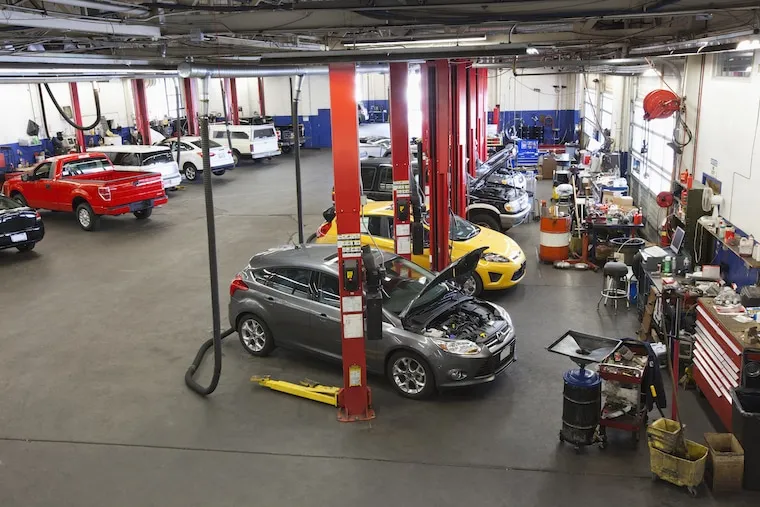
The most useful sizing rule in this trade is square footage per service bay. A general repair bay needs roughly 1,000 to 1,500 sq ft once you account for the lift, the vehicle, the tech’s tool box, and room to roll a jack around. A four-bay shop therefore wants 4,000 to 6,000 sq ft of floor, plus a waiting area, a counter, an office, a restroom, and parts storage.
Three physical specs separate a usable building from an expensive renovation. Ceiling clearance must clear a two-post lift with a truck on it, so you want 12 to 14 feet of clear height minimum. Electrical service needs to be three-phase or upgradeable, because compressors, lifts, and a wheel balancer pull more than a standard single-phase panel delivers. And the slab needs proper drainage and thickness; a four-inch slab cracks under repeated lift loads, so you want six inches where the posts anchor.
| Building spec | What to look for | Why it matters |
|---|---|---|
| Sq ft per bay | 1,000 to 1,500 | Lift, vehicle, tools, walk-around room |
| Clear ceiling height | 12 to 14 ft minimum | Two-post lift plus a raised truck |
| Bay door width | 10 to 12 ft each | Dually trucks and wide vans |
| Electrical | Three-phase or upgradeable | Compressor, lifts, balancer |
| Slab | 6 in where lifts anchor | Prevents cracking under load |
| Parking | 3 to 5 spaces per bay | Cars waiting, finished, and drop-off |
Parking is the spec owners underestimate most. You need room for cars waiting, cars finished and awaiting pickup, customer drop-off, and your own crew. A four-bay shop with six parking spots is a gridlocked lot by 10 a.m. on a Tuesday. For the gear that has to fit inside those bays, see buying equipment and supplies.
Read the catchment, not the whole city
An auto repair shop is a local-radius business. Most customers come from a 3 to 7 mile ring around the shop, and few will drive past two closer competitors for routine work like brakes, oil, and diagnostics. So the question is not “is this a big city” but “who lives and drives inside my ring.”
The numbers that predict demand are vehicle density and vehicle age. Areas with many registered vehicles per household and a median vehicle age of 8 to 14 years are repair gold, because those cars are out of warranty and into the repair-heavy phase of life. Newer, wealthy zips send cars to the dealer under warranty; the sweet spot is working and middle-class households with aging vehicles and daily commutes. A site near apartments, commuter routes, and older single-family neighborhoods will out-bill a flashier location near luxury condos.
Run the rent math before you sign
Rent is your second-largest fixed cost after labor, and it is fixed whether you bill 20 cars a week or 60. Space suitable for auto repair typically runs $12 to $30 per square foot per year, with most shops on triple-net (NNN) leases, meaning you also cover property taxes, building insurance, and maintenance on top of base rent. A 5,000 sq ft building at $18 per sq ft is $90,000 a year, or $7,500 a month in base rent, plus another $2 to $6 per sq ft in NNN charges.
The discipline that keeps shops solvent is treating rent as a percentage of revenue. Total occupancy cost should land around 6 to 10% of gross sales. If your shop realistically bills $80,000 a month, you can carry roughly $5,000 to $8,000 in occupancy. Sign a lease that needs $12,000 a month against $80,000 in sales and you have given away your profit before a tech clocks in.
For the full capital picture this decision sits inside, see how much you need to start an auto repair shop.
Lease or buy the building
Once you have a viable site, the next real decision is whether to rent it or buy it. The right answer depends on your capital and how rooted you are in the area.
Lease vs buy the building
- Lease: move in for first month plus a 1 to 3 month deposit, often under $30,000, instead of a 20 to 30% commercial down payment.
- Lease: keep $100,000-plus of capital free for lifts, a scanner, and working cash while you build the book.
- Lease: walk away at renewal if the catchment shifts or rent climbs past 10% of sales.
Lease vs buy the building
- Lease: rent rises 3 to 5% a year and you build zero equity over a 10-year term.
- Lease: the landlord can decline renewal and you lose the location your reputation is tied to.
- Buy: a mortgage on a $600,000 building needs $120,000 to $180,000 down, money then not in the business.
The decision rule is lease first, buy later: rent until the shop is consistently profitable and the catchment is proven, then buy (often the building you already lease) so rent turns into equity. Plenty of owners buy too early, sink their working capital into real estate, and then cannot afford the equipment or marketing to fill the bays they just bought.
Competition inside the ring is not a reason to avoid an area; a cluster of shops often means the demand supports them. Drive the ring, list every shop, and look for the gap: if everyone is booked two weeks out, or nobody does European diagnostics, that backlog is your opening. But location sets your ceiling, not your floor. A great corner with a weak reputation loses to a shop one street back with 300 five-star reviews and a phone that gets answered. For the groundwork, see how to promote an auto repair shop locally and how to get clients and customers.
That visibility now happens before anyone drives past your sign. The modern catchment is “auto repair near me” on a phone, and what shows up is your Google Business Profile and your website. Getting that right is high-stakes and genuinely hard: a good shop site loads in under two seconds on mobile, ranks for your town plus your services, makes the phone number tappable, shows real reviews, and turns a searching driver into a booked appointment. A bad one quietly sends that customer next door. The free pointers are real and worth doing today: claim and verify your Google Business Profile, fill in hours and services, add photos of your bays, and ask every happy customer for a review.
Building and optimizing the site itself is where it pays to bring in people who do only this. If you want a site built to turn local searchers into booked cars, get a website for your auto repair shop. Get a free video walkthrough. For ongoing search, ads, and lead generation, see our services. And if you have an idea but need the whole plan mapped first, start at expntl.com.
Frequently asked questions
How much space do I need for an auto repair shop?
Plan 1,000 to 1,500 sq ft per service bay, so a four-bay shop wants 4,000 to 6,000 sq ft of floor plus a waiting area, office, and parts storage. Add parking for 3 to 5 cars per bay. Ceiling height of 12 to 14 feet and three-phase electrical are the specs people forget until the lifts will not fit or the compressor trips the panel.
Can I open an auto repair shop anywhere zoned commercial?
No. Auto repair is usually classified as an automotive or light-industrial use, and many general-commercial and retail zones prohibit it or require a conditional use permit. Always confirm the exact parcel’s zoning with the planning department in writing and make any lease or purchase contingent on approval.
How far will customers drive to my shop?
For routine work like oil changes, brakes, and tires, most customers come from within 3 to 7 miles and will not pass two closer shops to reach you. Specialty or reputation-driven work like European diagnostics or restoration pulls from a wider radius because people seek it out by name rather than convenience.
Should I prioritize a high-visibility corner or cheaper rent?
It depends on your service mix. Impulse-driven services like quick-lube and tires justify paying a premium for a busy corner; appointment-and-repeat repair shops can sit one street back at lower rent because customers find them by name. Keep total occupancy cost in the 6 to 10% of sales range either way.
Is it better to lease or buy my shop building?
Lease first. Renting keeps your capital free for equipment and working cash and lets you exit if the location underperforms, while buying too early ties up $120,000-plus in a down payment. Once the shop is consistently profitable and the catchment is proven, buying converts rent into equity instead of a rising expense.
Your move
Reading this does not book a job.
The owners who pull ahead are the ones who change one thing this week. If you want that one thing to be a website that sells and ads that put it in front of the right people, we build and run both for you.
Straight answer on whether we can help, usually the same day.